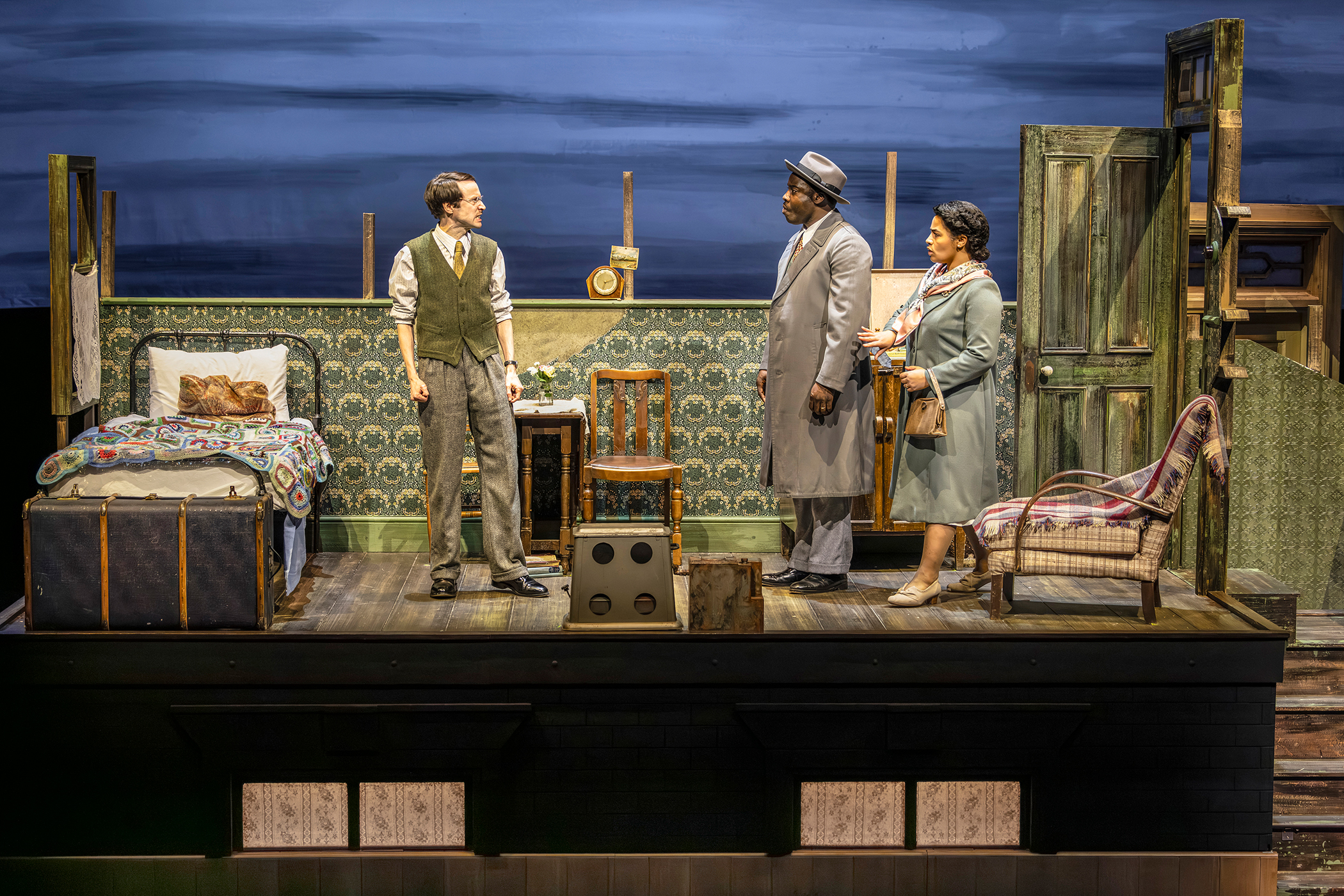


In an interview in 2004, the year Small Island was published, Andrea Levy described her novel as “a shared history” told from both the “black and white experience”. Her narrative darts around in time, interweaving the stories of four main characters born into the British empire in the early 20th century, showing how they are shaped by events, circumstances and choices.
Helen Edmunson’s patchily successful adaptation, first presented at the National Theatre in 2019, upsets the balance of the original by reducing the four key roles to three and diminishes its dramatic effects by rearranging sequences of events. Its episodic first half, switching between Jamaica and England, comes across as an over-extended, plot-covering build-up to the more emotionally resonant, post-interval action, set in grim, narrow-minded 1948 London.
Daniel Ward’s Gilbert, frustrated by the lack of opportunity in Jamaica under colonial rule, volunteers for the wartime RAF; disregarded once demobbed, he sails on HMT Empire Windrush to seek his fortune in the “mother country”. His new wife, “honey-skinned” Hortense (Anna Crichlow), follows him with high hopes for the opportunities her teaching qualifications will bring. They meet discrimination and racism (“Get back to the jungle!” not the worst of the taunts). Resilient farmer’s daughter Queenie (Bronté Barbé) is their landlady. In the adaptation, as in the book, each of these three grows in stature as they confront adversities. By contrast, Levy’s fourth character, Queenie’s husband Bernard (Mark Arends), is here presented as a racist individual; without the novel’s backstory, we lose the sense that he is, more damningly, a product of a wider supremacist mindset.
The strengths of director Matthew Xia’s regional premiere are in the presentation (Simon Kenny’s design, backed by Gino Green’s videos transporting us through time and space, with atmospheres heightened by Luke Bacchus’s music); also in the powerful characterisations from the 15-strong cast, especially the excellent principles.
It is in the second half that the strengths become more apparent as the writing dramatizes, rather than simply demonstrating, the characters’ situations. In a climactic scene, towards the end, powerfully acted and sensitively directed, play and novel mesh. In the presence of Hortense, Queenie and a newborn child, Gilbert challenges Bernard’s exceptionalism: “… You know what your white skin make you, man? It make you white … Stop this man. … We can work together … ”, before concluding: “… you gonna just fight me til the end?” A moment of suspension follows. The timing is perfect: Gilbert’s question percolates through the auditorium, beyond the drama into our wider society. What answer do we give?
Small Island is at Leeds Playhouse until 28 March; touring until 16 May
Photograph by Pamela Raith
Newsletters
Choose the newsletters you want to receive
View more
For information about how The Observer protects your data, read our Privacy Policy