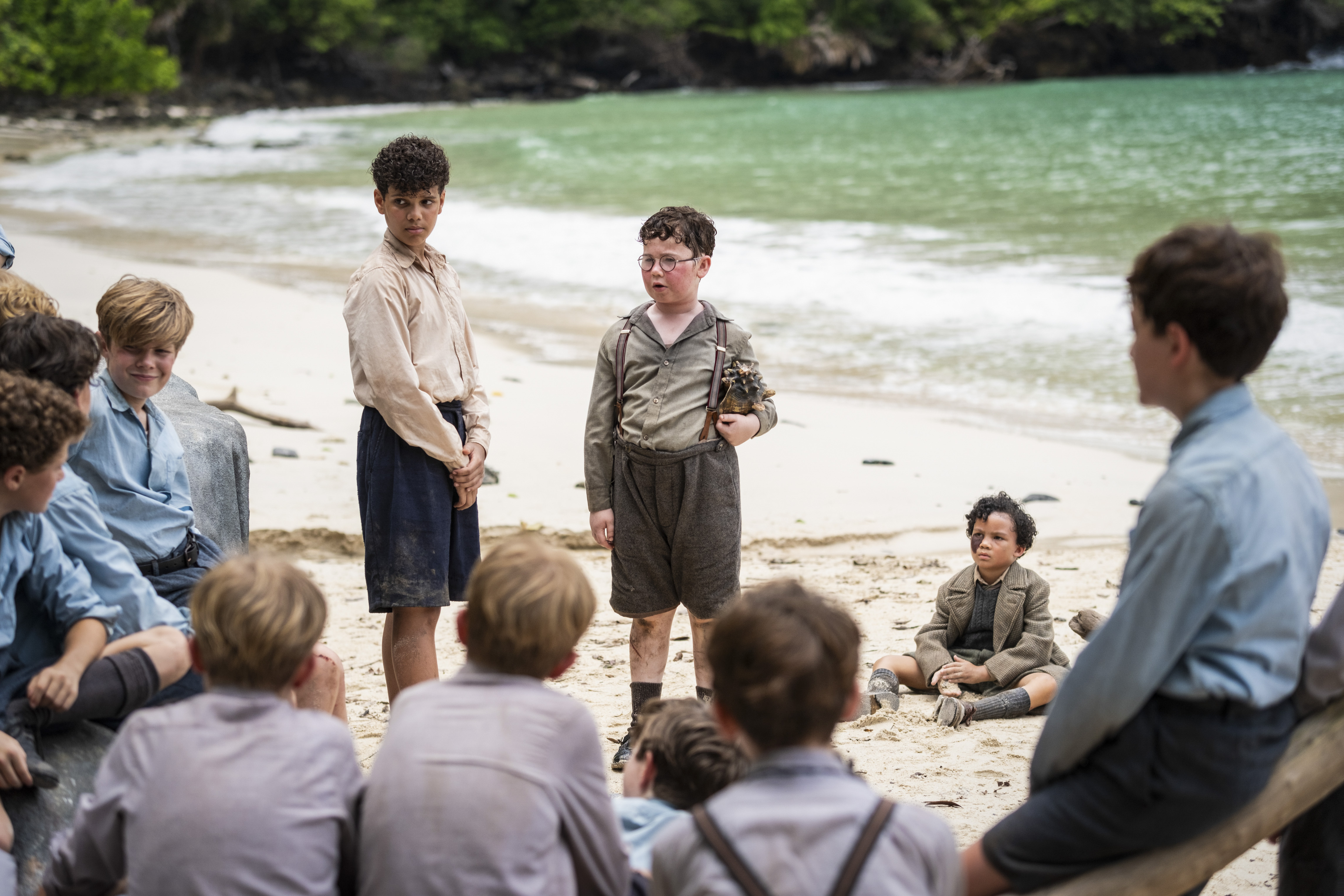

The first episode of the BBC’s new Lord of the Flies adaptation is titled Piggy. That nasty nickname will take anyone who read the book as a teenager back to the days of school savagery – and the horrifying treatment of that character. Better to take sides and survive than be the poor, wheezing, set-upon Piggy.
It is tempting to cast off William Golding’s monstrous 1954 novel as a set text in which the themes are laid out in flashing lights, but in this reworked version by the writer Jack Thorne – a perfect follow-up to Adolescence, his modern study of the cruelty of teenage boys – its uncannily bleak outlook arrives afresh.
As in the novel, a pack of boys who survive a plane crash on a lush tropical island are left to create their own society. A few leaders jostle to the fore: the sporty, cheerful Ralph (Winston Sawyers) and his hopeful sidekick Piggy (David McKenna), an orphan who makes even peeling his socks off a tragic gesture.
Their alliance is tested by alpha boy Jack (Lox Pratt, who will make a brilliantly malevolent Draco Malfoy in the forthcoming HBO Harry Potter series) and his beady-eyed accomplice Simon (Ike Talbut). Set to an unsettling score by the White Lotus composer Cristobal Tapia de Veer – the man behind all those manic monkey ooooh ooh aah aahs – their hastily assembled civilisation burns as a tide of paranoia rises.
Thorne’s script doesn’t shine in the same way as Adolescence, but then the original text already captured the feeble brags, callous put-downs and attempts at adult authority the children try on for size. When Ralph betrays Piggy by telling the group his secret nickname, he says matter-of-factly: “Better Piggy than Fatty.”
Thorne is determined to find sympathy for even the most vicious members of the gang; to understand what might have happened in the lives of these children to cause their behaviour. This inclination is a little hammy at times, but captures the mood of a moment in which we are all trying to explain the cruelty of men in power.
And these are just boys, after all: their sinewy limbs, scrambling on rocks, and huge eyes often make them look like babies. But as the series progresses, a meanness hardens in some sweet faces.
As in our world without shame or consequence, the boys betray their friends to save their own skin and fall recklessly for the excitement of a leader who promises easy alternatives. Watching so many years after GCSEs, you may find yourself longing for the conviction of the one boy who resists herd mentality – even at great personal cost. Oh, to be Piggy.

Caoilfhionn Dunne, Roisin Gallagher and Sinéad Keenan in How to Get to Heaven from Belfast
There is a camper take on the dark arts of adolescence in Netflix’s How to Get to Heaven from Belfast, which comes from the creator of Derry Girls, Lisa McGee. Here the insults land so much better when delivered in a thick Belfast accent, and the casual nastiness of teenage girls is nothing compared with that of thirtysomething friends.
Saoirse (Roisin Gallagher), Robyn (Sinéad Keenan) and Dara (Caoilfhionn Dunne) grew up in Belfast as part of a foursome but lost touch with their friend Greta. Twenty years later, Greta’s sudden death forces them to revisit a shadowy incident involving a burning cabin in the woods.
Newsletters
Choose the newsletters you want to receive
View more
For information about how The Observer protects your data, read our Privacy Policy
We find each of the women unsatisfied with her life. Dara has lost her great love and is duty-bound to care for her mother; Robyn fantasises about beating her head against the steering wheel while her three sons argue in the back; Saoirse is engaged to an idiot and, despite being a successful TV writer, is treated like an intern by the female lead of her show.
If Derry Girls captured the excitement and absurdities of being a teenage girl, How to Get to Heaven from Belfast picks up at the time when those young avatars are like ghosts dancing by your side, beguiling and out of reach.
McGee has a knack for capturing the ways friends know your pressure points. In one scene, Dara and Robyn mistakenly think Saoirse’s TV series, Murder Code, has won an Oscar and yet aren’t particularly effusive in their congratulations. When they pick her up from the airport, she is wearing striped wide-leg trousers; they ask why she’s in her pyjamas.
If these complex disappointments and resentments make the characters feel like flesh-and-blood women, the men by contrast feel two-dimensional. That cartoonish quality works better in the mystery element of the show, when it starts to feel like a Scooby-Doo thrill-ride with swearing and more jokes. When asked where she learned to drive like a stuntman in a car chase sequence, Robyn replies, deadpan: “School run.”
The tonal rollercoaster is hard to pull off, but the series succeeds because it presents these capers as a return to the adventure of being young. Chasing clues surrounding the mystery of their friend’s death, they are allowed to escape the trap of adulthood. That nostalgia for the period of their youth is everywhere: from 1990s needledrops including Nelly and B*Witched to a club night where the women see girls dressed in bandanas and crop tops.
On that night out, the three friends drink terrible wine and consider their life choices. “I just keep thinking about the paths we take in life and the shifts in our direction of travel, because those shifts, they happen so subtly, so gradually,” mourns Saoirse. In a very different way to Lord of the Flies, it is a show that takes youth seriously.
Photographs by BBC/ Eleven/J Redza/Netflix