For a castrato, artistic sacrifice carried a risk. Surgery, often botched, was performed on boys before puberty. Gruesome medical procedures caused physical issues aside from inactive or nonexistent testes: long bodies, barrel lungs, thin legs, fat hips, unnaturally soft skin. The idea was to preserve the pure treble boy’s voice into adulthood. The best of these singers – thousands endured the snip in Italy but failed to make it – were famous. Castrati triumphed on stage or in church, where women were not permitted to sing. A last survivor of the tradition, which was eventually banned, sang in the Sistine Chapel choir until 1903.
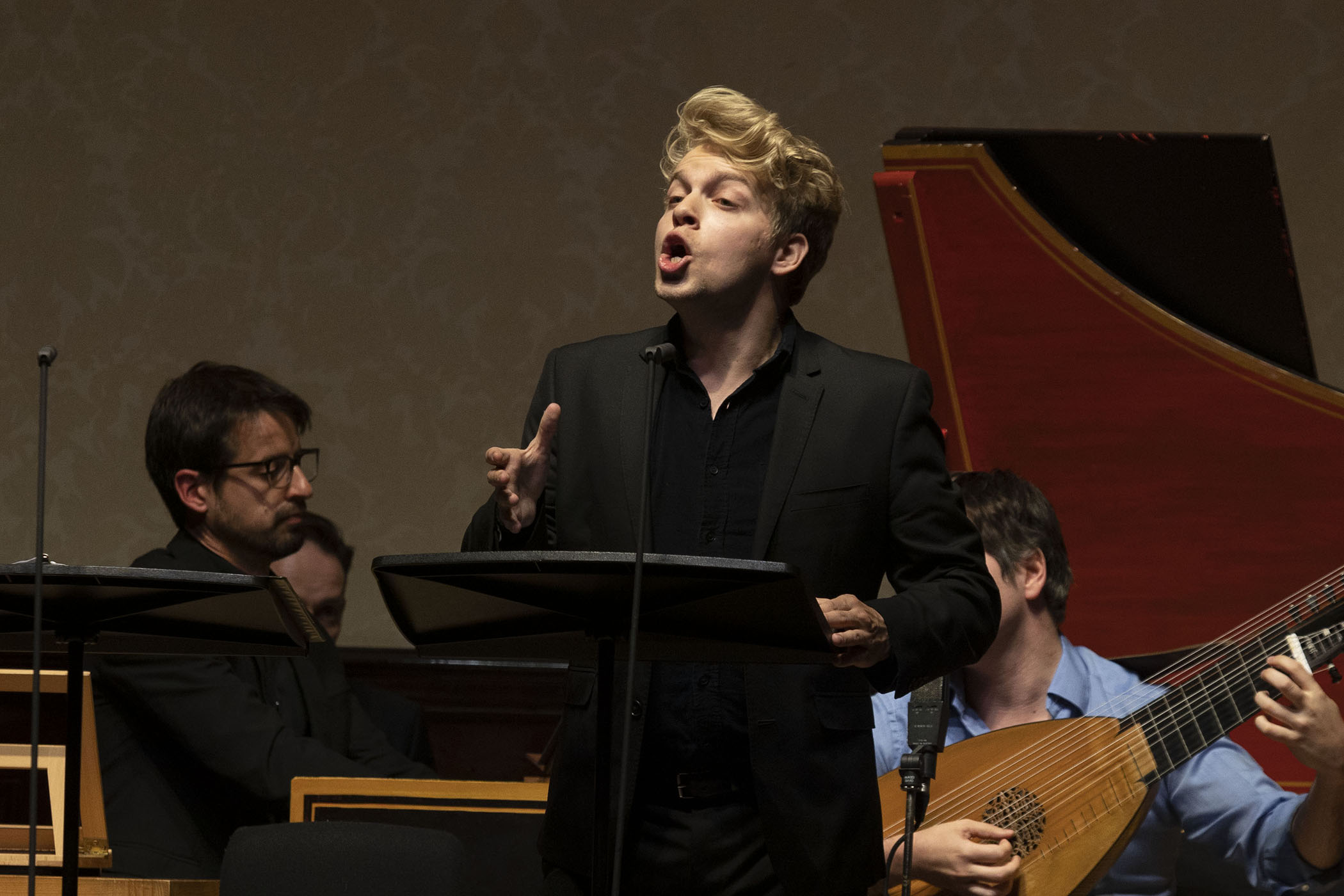
Among the big names was the Italian Giusto Fernando Tenducci (c1735-90), also called il Senesino. He was painted by Gainsborough and taught singing to Mozart. Marriage, divorce and alleged offspring enliven his CV. London was Tenducci’s golden era, thanks to the fashion for Italian opera. Then he moved to Dublin. His story is intriguing and melancholy. The British singer Hugh Cutting, one of a flurry of young countertenor stars now emerging, built a Wigmore Hall programme last week around Tenducci’s repertoire.
Why did no one realise men could sing falsetto – ranging from a female’s low contralto via mezzo-soprano to high soprano – yet keep their manhood intact?
Why did no one realise men could sing falsetto – ranging from a female’s low contralto via mezzo-soprano to high soprano – yet keep their manhood intact?
This music is at the margins of the familiar – by young Mozart, Thomas Arne, JC Bach, Gluck and more – but the hall was sold out (need we even bother to mention Timothée Chalamet’s remark that “no one cares” about opera?). Cutting’s collaborators were the director-harpsichordist Peter Whelan and his sparkling Irish Baroque Orchestra, who also provided variations on Irish folk fiddling and songs by Johann Christian Fischer and Tommaso Giordani. The recital’s emphasis was on the music, but Cutting made one important spoken intervention, thanking the castrati of the past for suffering so much while bringing about a specific and ornate strand of vocal music that he and others can now perform.
That high male countertenor voice, achieved naturally rather than medically, came into its own fairly recently. Why did no one realise that men could sing falsetto – ranging from a female’s low contralto via mezzo-soprano to high soprano – yet keep their manhood intact? One reason is that there was no call. Much baroque music fell out of taste, or could, still can, be sung by women. All changed around the middle of the last century. Benjamin Britten, starting with Oberon in A Midsummer Night’s Dream (1960), wrote operatic roles for the pioneering countertenor Alfred Deller. Subsequent composers have followed suit: Thomas Adès, George Benjamin and Philip Glass among them. You might well hear countertenors singing Beyoncé or Whitney Houston.
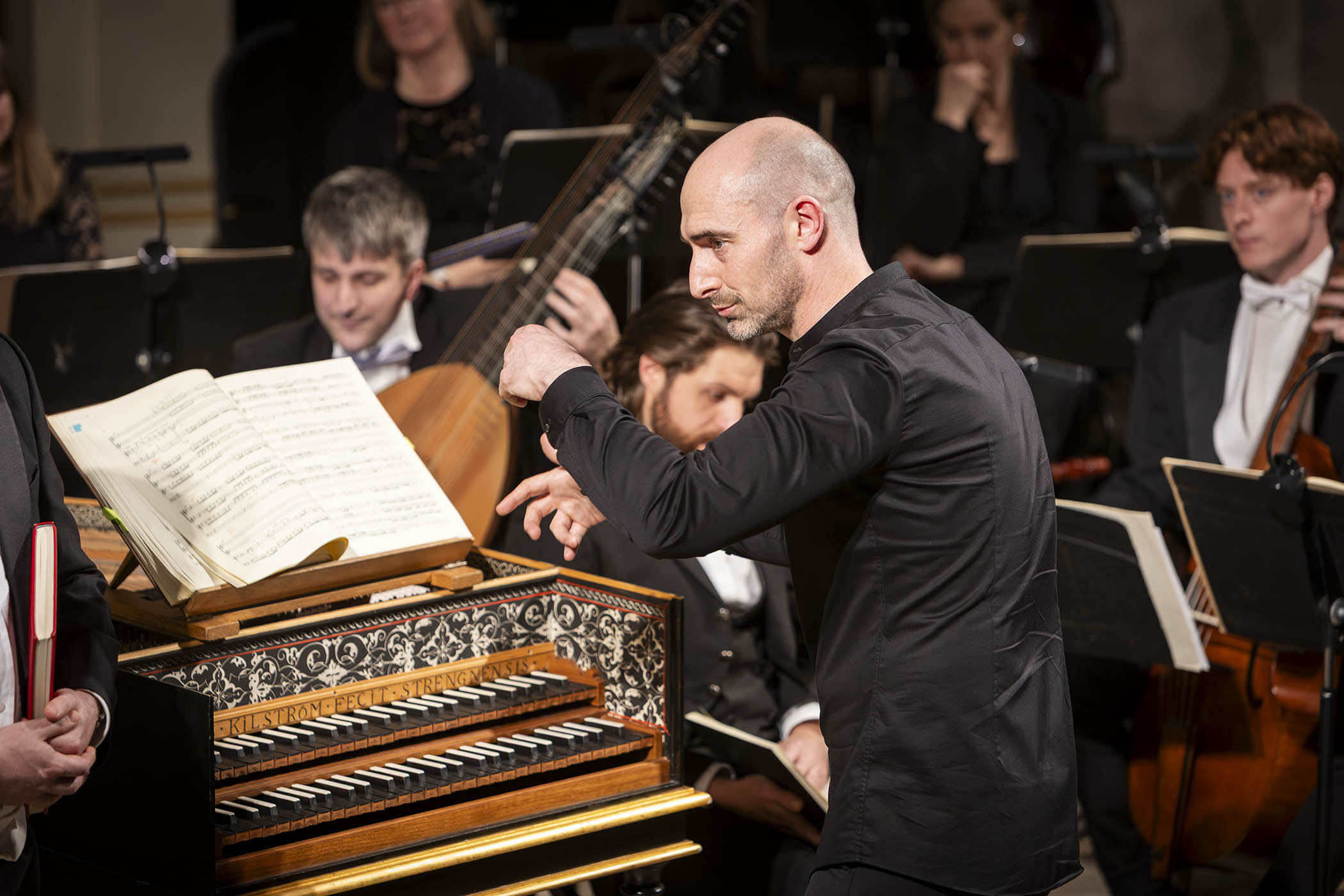
Peter Whelan at his harpsichord directing the Monteverdi Choir and English Baroque Soloists in the St John Passion. Main image: Hugh Cutting
One last point on bringing the hazy past up to a hi-tech present: visualisation software, electroglottography and other kinds of laryngeal and vocal tract imaging are now enabling closer analysis of the voice box and vocal cords. Conservatoires are using them to better understand vocal technique. Cutting’s own musical interests are wide, as his recent album Refound shows, but this 18th-century repertoire perhaps suits him best at this stage. He is a new kind of singer who avoids putting limits on what he performs and is still discovering what works for him. The 16 Irish Baroque players, engaged and energetic, especially in the explosive Dance of the Furies from Orfeo ed Euridice, were fine artistic companions.
This is the season, pre-Easter, of JS Bach’s Passions. The night after Wigmore Hall, Peter Whelan was back at his harpsichord, now directing the Monteverdi Choir and English Baroque Soloists in the St John Passion at the church of St Martin-in-the-Fields. One player overlapped in the instrumental ensemble – the oboist Emma Black, a virtuosic and elegant soloist in both concerts. This dramatic telling of the biblical Passion story (the St Matthew Passion came later) was first performed in Leipzig on Good Friday 1724. Bach, never quite satisfied, revised it throughout his life. Together with the later St Matthew Passion, it remains one of the pinnacles of western art. We should also acknowledge that controversy still rumbles over the Lutheran text, specifically its naming of “the Jews” as a mob baying for the blood of Christ. (For a discussion of this issue, see the Jewish American music writer Robert Harris, who defends the work but considers how we should think about it.)
Whelan’s approach throughout seemed to emphasise the Passion’s humanity. He took a bold approach to tempi, never afraid of erring on the slow side, making repeated passages ever softer and more tender: the recurring theme of the opening chorus; the second verse of a chorale. With Nick Pritchard, Konstantin Krimmel, Julia Doyle and Rebecca Leggett as principal soloists, the chorus warm, rich, precise and the English Baroque Soloists on top form, this was a potent performance. The final chorus, which repeats the words “Ruht wohl” – rest in peace – was fervent and beseeching.
Photographs by Richard Cannon/CountryLife/ Paul Marc Mitchell
Newsletters
Choose the newsletters you want to receive
View more
For information about how The Observer protects your data, read our Privacy Policy