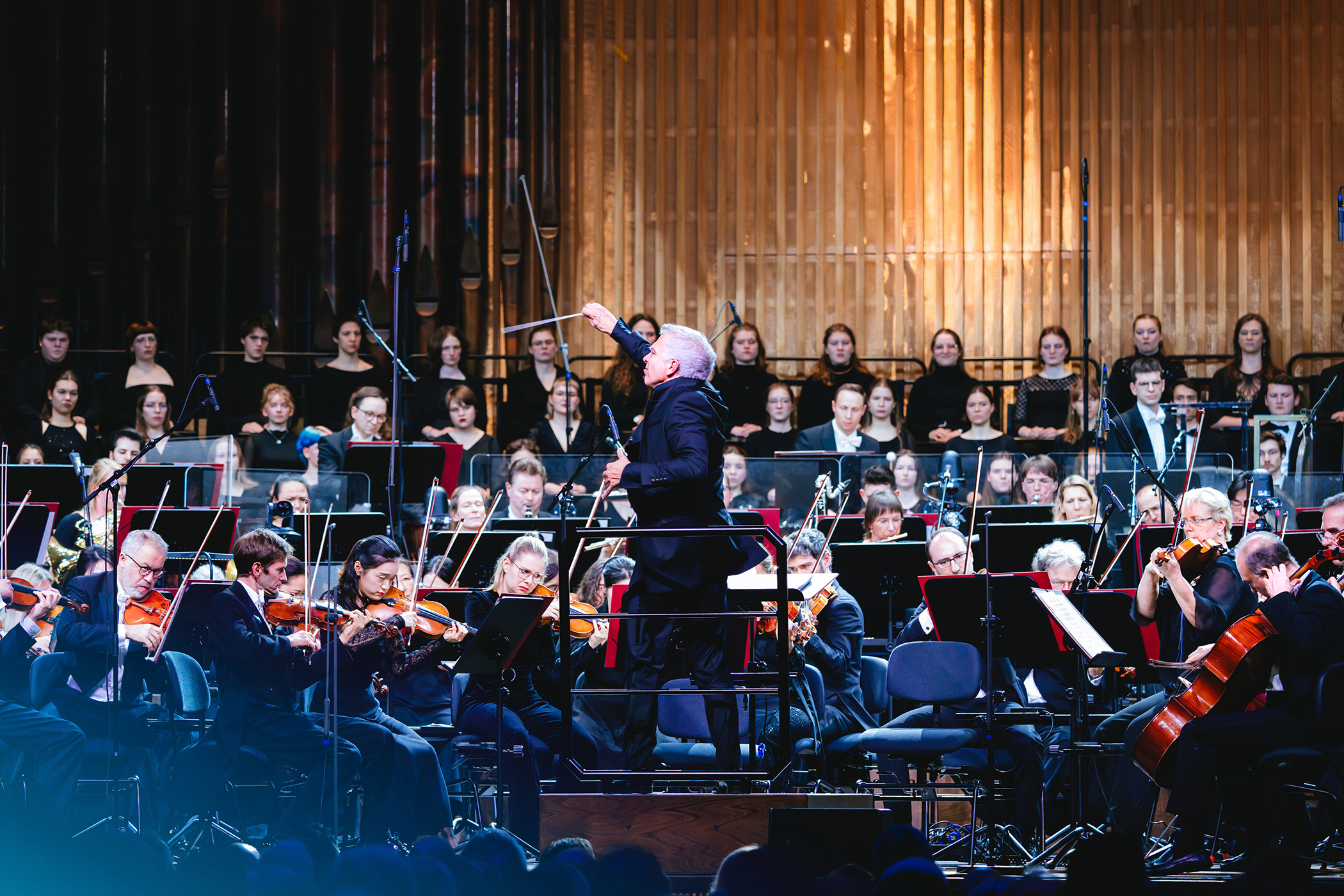


Question: when is a concert hall more than just a concert hall? Answer: when it’s the Beethovenhalle Bonn. So much more than mere bricks and mortar, this modernist monument rose from the devastation of war to represent a new dawn of democracy on the banks of the Rhine after the bitter years of Nazi dictatorship.
Last week it was born again, after nine years of painstaking restoration: a time in which the Beethoven Orchestra Bonn had no permanent home and the people of the city were deprived of what the ensemble’s music director, Dirk Kaftan, calls their “musical living room”. At £200m, this was no quick hoover behind the sofa, but an almost total rebuild while preserving its distinctly 1950s aesthetic.
It shares with London’s Royal Festival Hall, architecturally and philosophically, the ambition to put years of war behind it, but the Beethovenhalle had another purpose. Here, music and politics go hand in hand, because this was where the federal assembly met when, for five decades, Bonn was the capital of the Federal Republic: the place where democracy found its feet again; the place where the country’s president was chosen.
Today, many Germans believe that liberal democracy itself could do with some serious restoration work, now that the far right is once again casting its dark shadow over the country, emboldened by Donald Trump’s recent explicit support for “patriotic European parties”.
Today, many Germans believe that liberal democracy itself could do with some serious restoration work
Today, many Germans believe that liberal democracy itself could do with some serious restoration work
In 1954, the city’s choice to design its hall was 29-year-old Siegfried Wolske, a man who – like so many of his contemporaries – had been conscripted into Hitler’s military machine and emerged from a prisoner-of-war camp determined to create a new democratic Germany. After the country’s long years of isolation, Wolske built using Swedish granite, Italian marble and glass, and timbers from west Africa and Japan, a statement of intent that this should be an international building – an ambition reflected today. As the president of Germany, Frank-Walter Steinmeier, told Tuesday’s packed opening-night audience, 2,200 workers from 22 nations brought their skills to the restoration.
This revitalised mid-century monument now houses a technologically enhanced acoustic, startling in its directness, warmth and balance, and tested to the limit by the Bonn orchestra on their return home. Mirroring the young age of the Beethovenhalle’s architect, they chose to play works written when their composers were in their 30s, opening (in the titular composer’s birthplace) with a brisk, no-nonsense reading of Beethoven’s overture to his ballet The Creatures of Prometheus, followed his Piano Concerto No 4, in a gleaming performance by Fabian Müller.
We were promised a new work by the interesting Croatian composer Sara Glojnarić, who is described as having a “committed engagement with the major issues of our time”. Would her new work, Knock on Wood, Honey, say something about modern Germany? Er, no. It was replaced without explanation by a piece she wrote three years ago, Everything, Always, for string orchestra and tape, in which her recorded voice narrates the process of composition while the orchestra plays her experiments in sound, breezily letting the audience into the creative process in real time. All very amusing, but a lost opportunity to say something significant.
We might have expected Beethoven’s triumphant Ninth Symphony to be the main attraction at this event, but he was 53 when it premiered in Vienna so he missed the concert’s age criteria. Instead, we had another fitting major work with a choral final movement, Gustav Mahler’s gigantic “Resurrection” Symphony. There’s a whole universe in this overwhelming work, serene and terrifying in turn and explored with verve and commitment by Kaftan and his players, aided by soprano soloist Katerina von Bennigsen, mezzo-soprano Gerhild Romberger and the deeply impressive German National Youth Choir, who were alert to every detail.
The 35-year-old pianist Müller brought much personality to Beethoven’s fourth piano concerto. There’s a pearlescence to his playing that is almost unreal in its graceful delicacy. He’s a native of the city, and the good burghers of Bonn are rightly very proud of him. He made his Wigmore Hall debut this year; the UK needs to hear more of him. For his encore he chose an arrangement of the Ode to Joy theme from Beethoven’s Ninth, the anthem of the European Union – and suddenly grumpy Brexit Britain seemed a million miles away.
Photograph by nodesign
Newsletters
Choose the newsletters you want to receive
View more
For information about how The Observer protects your data, read our Privacy Policy