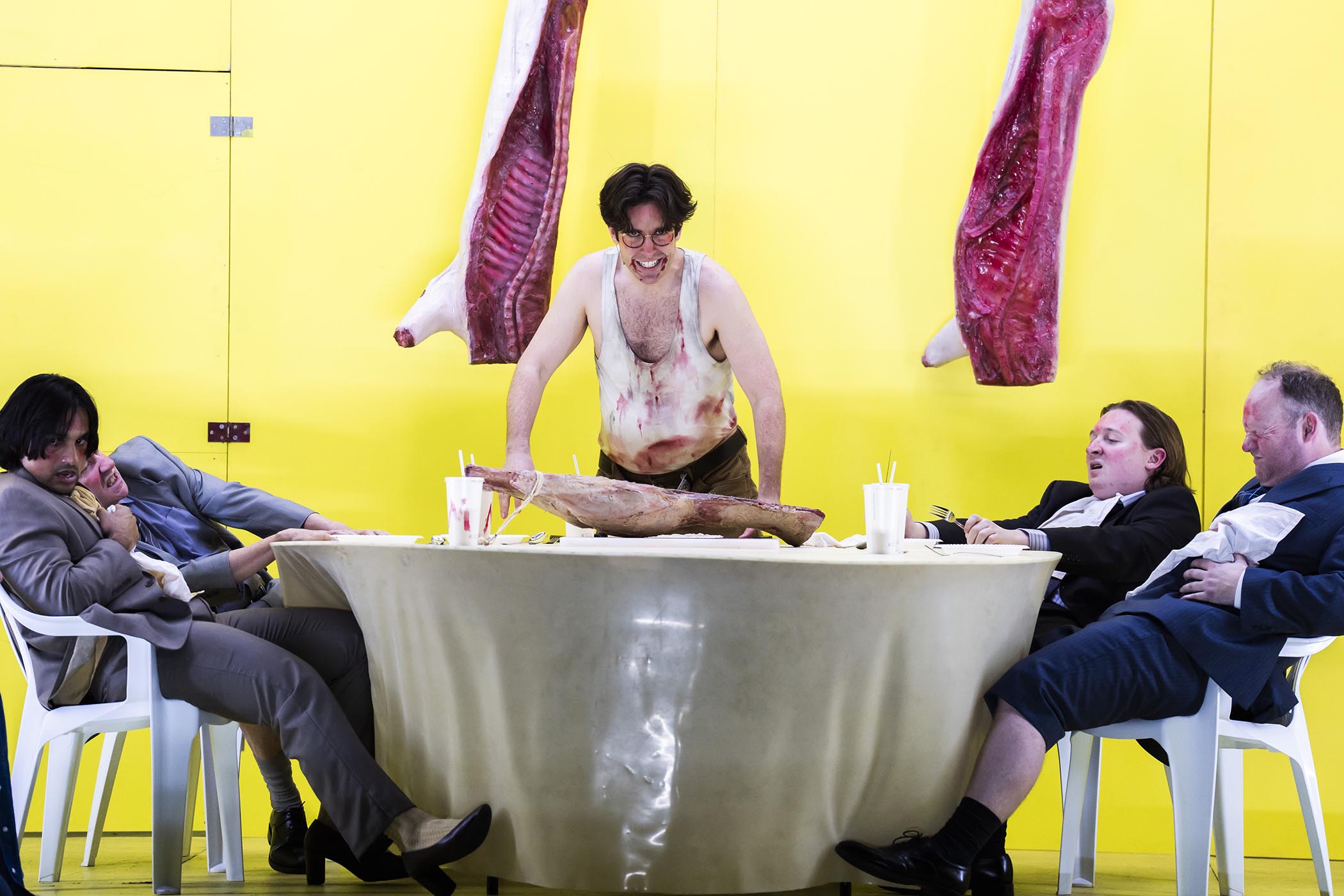

Mahagonny, built on sewage under a carpet of smog, is a trap to snare the greedy. In this fictional city, money rules. Sex sells. Nihilism bangs the loudest drum. “No hope, no glimmer, the lights grow dimmer,” sing the chorus, who also tell us, repeatedly, charmingly, they drink until they “spew”. As metaphor, Rise and Fall of the City of Mahagonny (1930), composed by Kurt Weill with words by Bertolt Brecht, is as subtle as a headbutt. Little happens. The text goes round and round with the obliviousness of a pub bore. You know you’ve heard it all before, but unfortunately lost the subject of the sentence early on. Never mind. The gist yells at you. Capitalism and excess, whether in boom-bust late-1920s America or in the tottering Weimar Republic, are under attack.
English National Opera’s new production, put together swiftly under the direction of Jamie Manton, does a smart job in honouring this untameable epic. Weill’s score is the star attraction. It flows without let-up, a sooty river of different styles, from saxophone-driven jazz, ragtime and cabaret to spiky baroque, full-bodied religiosity and lament. ENO’s music director designate, André de Ridder, who arrives properly in 2027, is a Berliner who has known this work since youth. On the basis of this fiery performance, we should cheer his appointment. Orchestra and chorus, together with onstage Hawaiian guitar and banjo soloist (Justin Quinn) and honky-tonk pianist (Murray Hipkin), excelled.
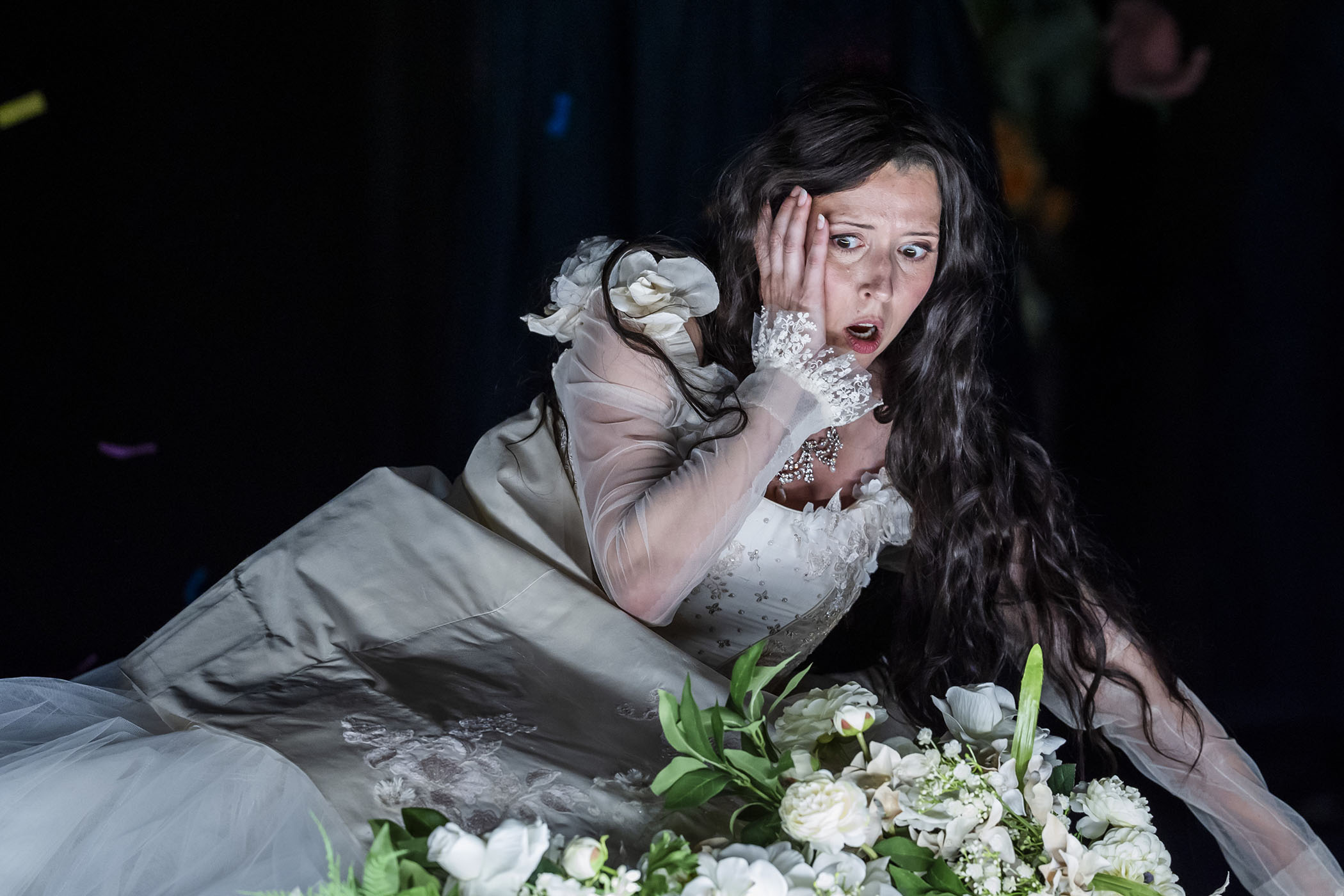
With only a three-night run, Manton and designer Milla Clarke (lighting: DM Wood) kept matters simple. A shipping container, a few other props, a nearly empty stage. The focus was on the way the large ensemble cast moved, together, apart, nimbly choreographed (Lizzi Gee). The beloved soprano Danielle de Niese sang the role of Jenny, leader of the prostitutes, who gets the one big, recurring tune: the Alabama Song (“Oh show me the way to the next whisky bar”), taken up by everyone from the Doors to Bowie to – especially well – Marianne Faithfull. De Niese needed more volume to cut through in company ensembles, but she is always a charismatic stage presence.
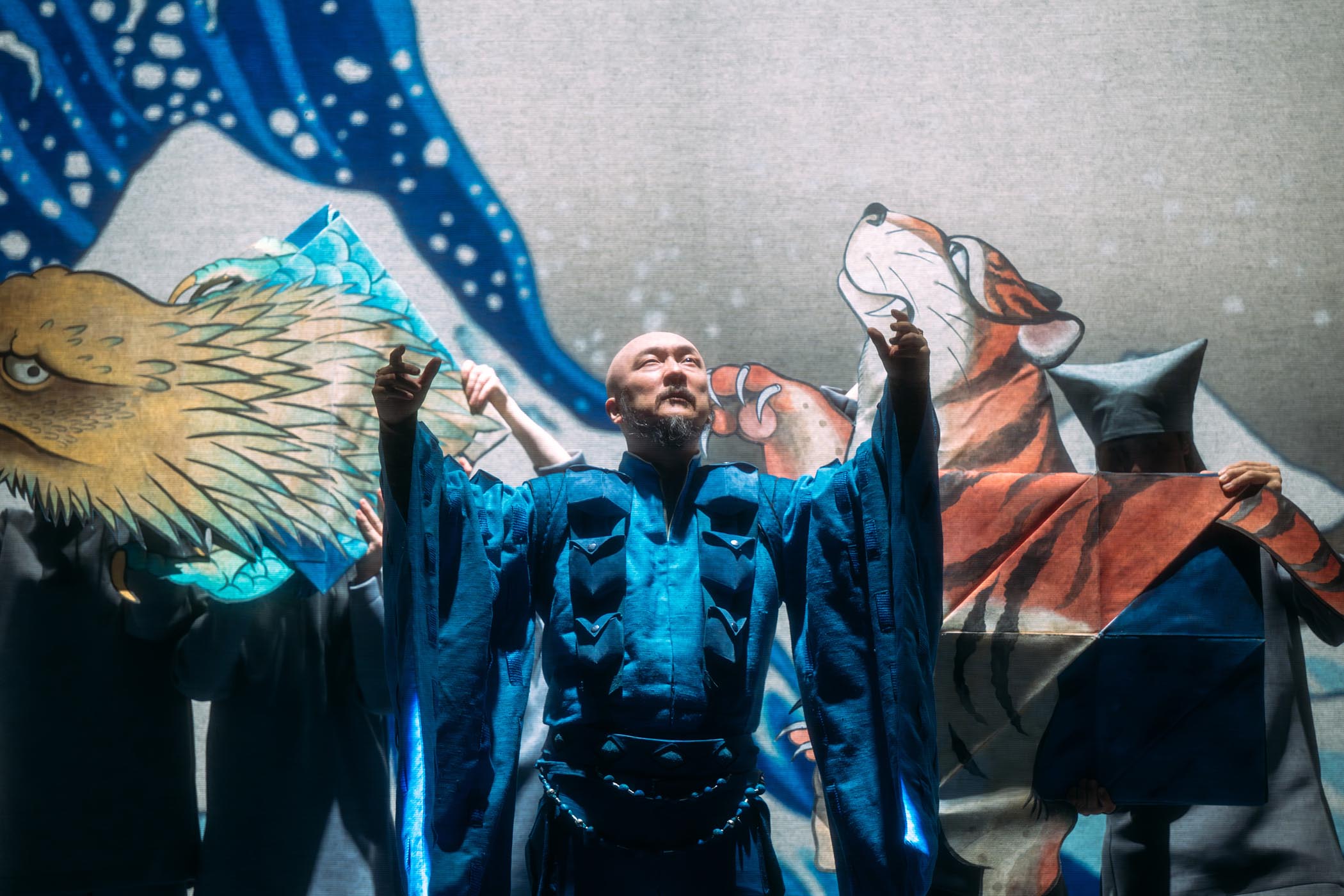
Daisuke Ohyama as Katsushika Hokusai in The Great Wave. Main image: Rise and Fall of the City of Mahagonny is ‘not an easy evening’
The trio of admirable and seedy criminals were played by mezzo-soprano Rosie Aldridge, meaty-toned and assured as Widow Begbick, bass Kenneth Kellogg as Trinity Moses and tenor Mark Le Brocq as a wittily slim Fatty. Among many smaller roles, the bass David Shipley, as Joe, caught the work’s rare moment of pathos. The night’s exceptional performance was that of Simon O’Neill as crime boss Jimmy MacIntyre. Best known for his heldentenor roles in Wagner, O’Neill sang this demanding role with accuracy, stamina and a piercing, pure tone. Nothing makes this opera an easy evening. Paracetamol came in handy after. Yet a performance of this quality and commitment, from across the company, cannot fail to move us, and did.
“Seek no gold. Find your peace.” This line from The Great Wave, by the composer Dai Fujikura and librettist Harry Ross, could have been a tip for the chancers of Mahagonny. Commissioned by Scottish Opera and given its world premiere in Glasgow and Edinburgh, the opera’s starting point was the woodblock print by Katsushika Hokusai (1760–1849). That image of a blue-and-white wave, frozen in time at its majestic peak, remains one of the most famous examples of Japanese art, part of his Thirty-six views of Mount Fuji, which were thoughtfully given context at the Theatre Royal in an accompanying exhibition.
The five-act opera explores Hokusai’s long life via non-linear episodes. Attractive tableaux came and went. A Japanese production team, led by the director Satoshi Miyagi and scenographer Junpei Kiz, conjured the “floating world” (ukiyo-e) of the Japanese Edo period (1615-1868) with origami tigers and dragons, cycloramas and costumes of graphic stylishness. The work opened with the artist’s funeral, beautifully solemn, and ended, full circle, with his death, mystically elevated. This bookending provided a solid structure, but what occurred in between was diffuse. An exciting life – struck by lightning (twice, say some), losing work in a fire, the transformative acquisition of Prussian blue pigment – became passive and static. Having the revelation of The Great Wave image felt, after 90 minutes, like an ending. It was, in fact, the interval.
Fujikura – born in Japan in 1977 but brought up in Britain – writes approachably and atmospherically. He added the traditional shakuhachi flute, breathy and sensuous, to the orchestra of Scottish Opera, superbly conducted by Stuart Stratford. Choruses, well sung, added momentum. Solo vocal lines were carried skilfully by the Japanese baritone Daisuke Ohyama as Hokusai, and the Colombian soprano Julieth Lozano Rolong as the artist’s daughter, in a strong cast. This whole enterprise was a fine example of cross-cultural collaboration. The creators need to be brave. With radical cutting and reshaping, this work could release its hidden vitality.
Photographs by Tristram Kenton/Mihaela Bodlovic
Newsletters
Choose the newsletters you want to receive
View more
For information about how The Observer protects your data, read our Privacy Policy