
Deep sleep is interrupted three times in Siegfried, the third opera in Wagner’s four-part Der Ring des Nibelungen. The giant Fafner, hoarding the Nibelung gold, bellows in annoyance when wokena by Wotan. The flawed god, on form, then brutally awakens Erda, Mother Earth, asleep for all time. Old lovers, they fight. Last, climactically, Siegfried, the hero, stirs Brünnhilde from her forced slumber. Her enforcer? Wotan, the great meddler, her father.
In Barrie Kosky’s new production, these key episodes offer some of the most compelling moments in the Royal Opera’s cycle so far. Visually, dramatically, musically, they act as load-bearers in the work’s ambitious structure.
The conductor is Antonio Pappano, making a zestful and much cheered return to the Covent Garden podium where he spent 22 years as music director. Try to find a better pairing, now referred to by fans as “Barrietony”. Their mutual understanding makes each moment of the four-plus hours alive and absorbing, music and action working as one.
Wagner reputedly wasn’t much of a sleeper himself, favouring micro-naps and experiencing hypnagogic dreams – that condition between wakefulness and sleep when the body twitches or the head jerks back – which he thought aided his creativity.
Even those of us dedicated to the cause (of staying awake) in his operas will recognise that state, when you might fleetingly think you are on a beach, not in a theatre. Was he in such a daze when he came up with one of his more dubious, if not meaningless, statements: “Music is a woman”?
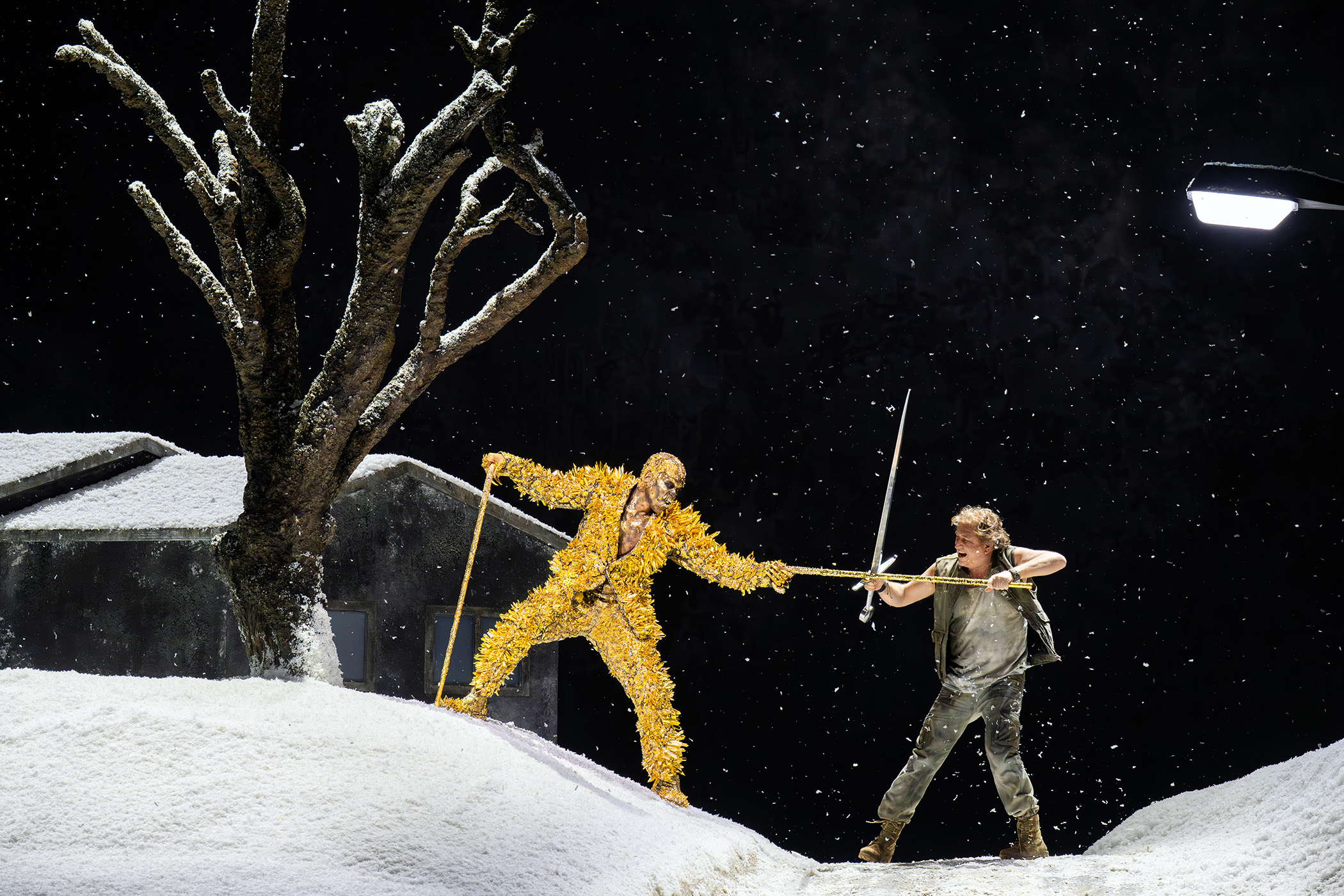
Solomon Howard as Fafner and Andreas Schager, ‘one of the finest Siegfrieds in the world’
It’s as easy to be infuriated by Wagner as to be enthralled. Fortunately, and resoundingly, the Royal Opera’s Siegfried falls into the second category.
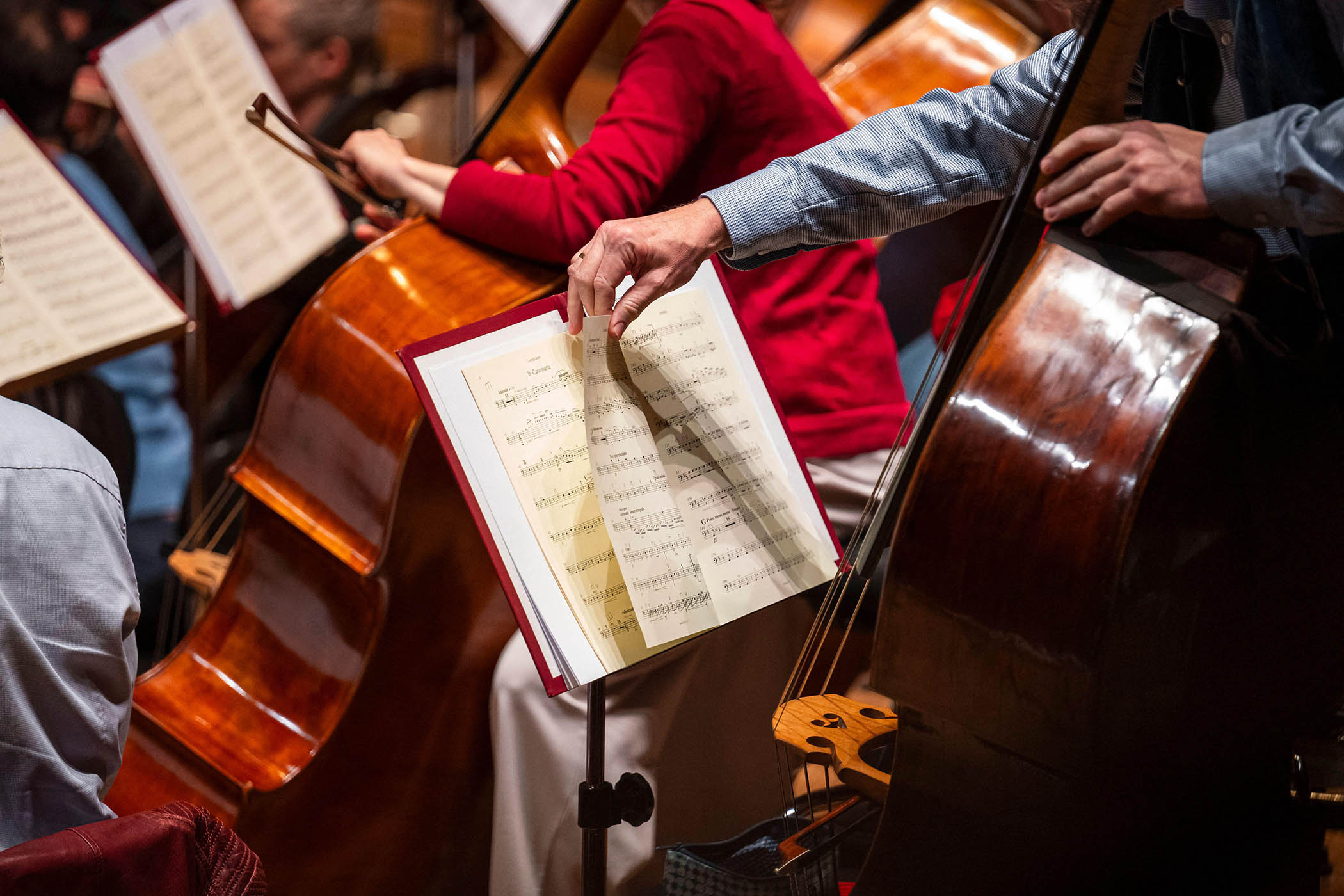
The orchestra, collective stars at the top of their game, play with fiery might, but also with shadow and beauty, never overwhelming the singers. A well-chosen cast, led with near-inhuman energy and vocal brilliance by the heldentenor Andreas Schager, pulls with equal strength. This is Schager’s house debut. He is now one of the finest Siegfrieds in the world (proving the point in Calixto Bieito’s Paris Ring cycle earlier this year).
There are few at any one time who can sing this near-impossible, high-lying, mostly fortissimo role. How can you not love someone who can shimmy up a ladder at top speed or sprint around the stage, or bang rhythmically and correctly on an anvil while singing flawlessly?
Christopher Maltman’s Wotan-Wanderer is humane, broken, troubled; the archetypal solitary figure of world literature, isolated and in exile from all he hoped for and loved. Christopher Purves sings his nemesis, Alberich, wily and grasping: the scene in which the two sit bickering on a park bench, Waiting for Godot-style, in a snowy landscape is sharp and effective. Wotan breaks the tension by offering Alberich his bag of crisps.
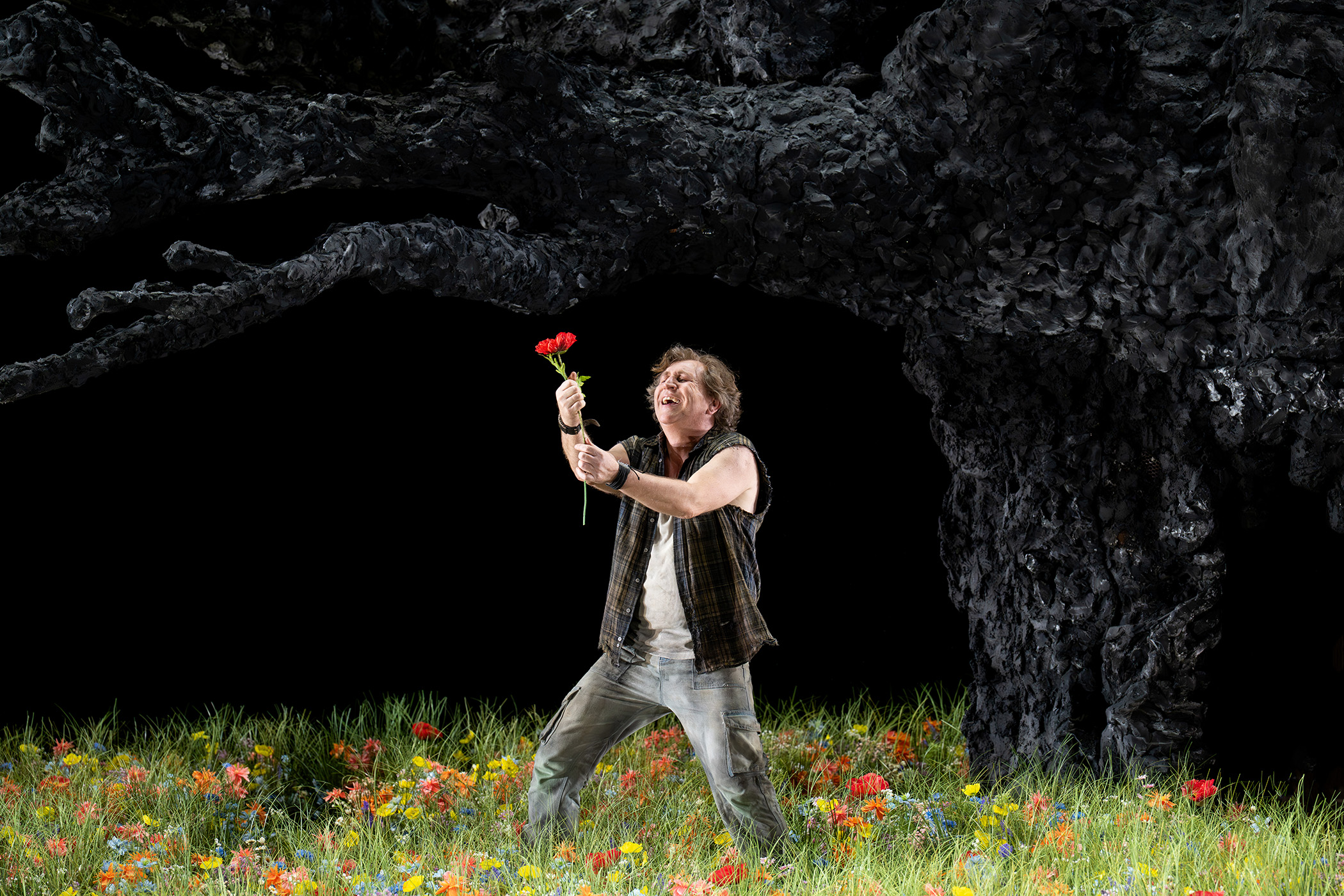
Kosky, with his designer Rufus Didwiszus (lighting Alessandro Carletti, costumes Victoria Behr), is clear-eyed and probing. Continuing the ideas already displayed in Das Rheingold and Die Walküre, nature is devastated. The sky is black. The sacred world ash tree, centre stage, is leafless, lifeless. At the start, Mime – snivellingly, wrigglingly but touchingly delivered by Peter Hoare – lives in a burned-out treehouse with his overgrown charge, Siegfried. The vision of Fafner (Soloman Howard, big-voiced and terrifying) staggering out on two sticks, weighed down by all the world’s gold woven on to his glittering suit, was a moment of theatrical genius. So too was the appearance of Erda (Wiebke Lehmkuhl, announced as unwell but singing eloquently) crawling out from the voluminous skirts of the ever-present older woman (Illona Linthwaite), who represents an unspecified divine feminine.
Newsletters
Choose the newsletters you want to receive
View more
For information about how The Observer protects your data, read our Privacy Policy
The vision of Fafner weighed down by all the world’s gold woven into his suit was a moment of theatrical genius
The vision of Fafner weighed down by all the world’s gold woven into his suit was a moment of theatrical genius
Diverging from the script, Kosky has staged the last act, when Siegfried finds Brünnhilde, not on a rock surrounded by fire but in a prelapsarian wildflower Eden – all the profusion of Klimt’s Bauerngarten but with an even bigger packet of seeds. Elisabet Strid, in virginal blue dress, and Schager romp in the blooms, eventually uniting. This paradise looks heavenly but the magnetic attraction between the pair is relatively low-key, frolicsome rather than manic or urgent.
That desperate vitality comes from the pit. Once again, the sky darkens, presaging tragedy to come in the final opera of the cycle (Götterdämmerung next year, with a full Ring in autumn 2027). I can’t wait.
Wagner said that, without Beethoven, there would be no Wagner. Never modest about his own importance, he would surely have argued the reverse if logically possible. Beethoven was his aesthetic ideal. He even thought, back to those hypnagogic episodes, he had met him, together with Shakespeare: “In ecstatic dreams I met both of them, saw and spoke to them, and on awakening found myself bathed in tears.”
The Elias String Quartet’s engaging and spirited Beethoven concert at Wigmore Hall – part of a cycle begun last November – might have prompted him to further weeping. It included Op 135, and Op 59 No 2 (in that order). True, it’s thrilling to have a massive orchestra, international cast, elaborate staging, sparks flying, snow falling. But four players, eight hands and 16 strings can also make a universe.
Photographs by Mihaela Bodlovic
Siegfried is at Royal Ballet and Opera House, London until 6 April