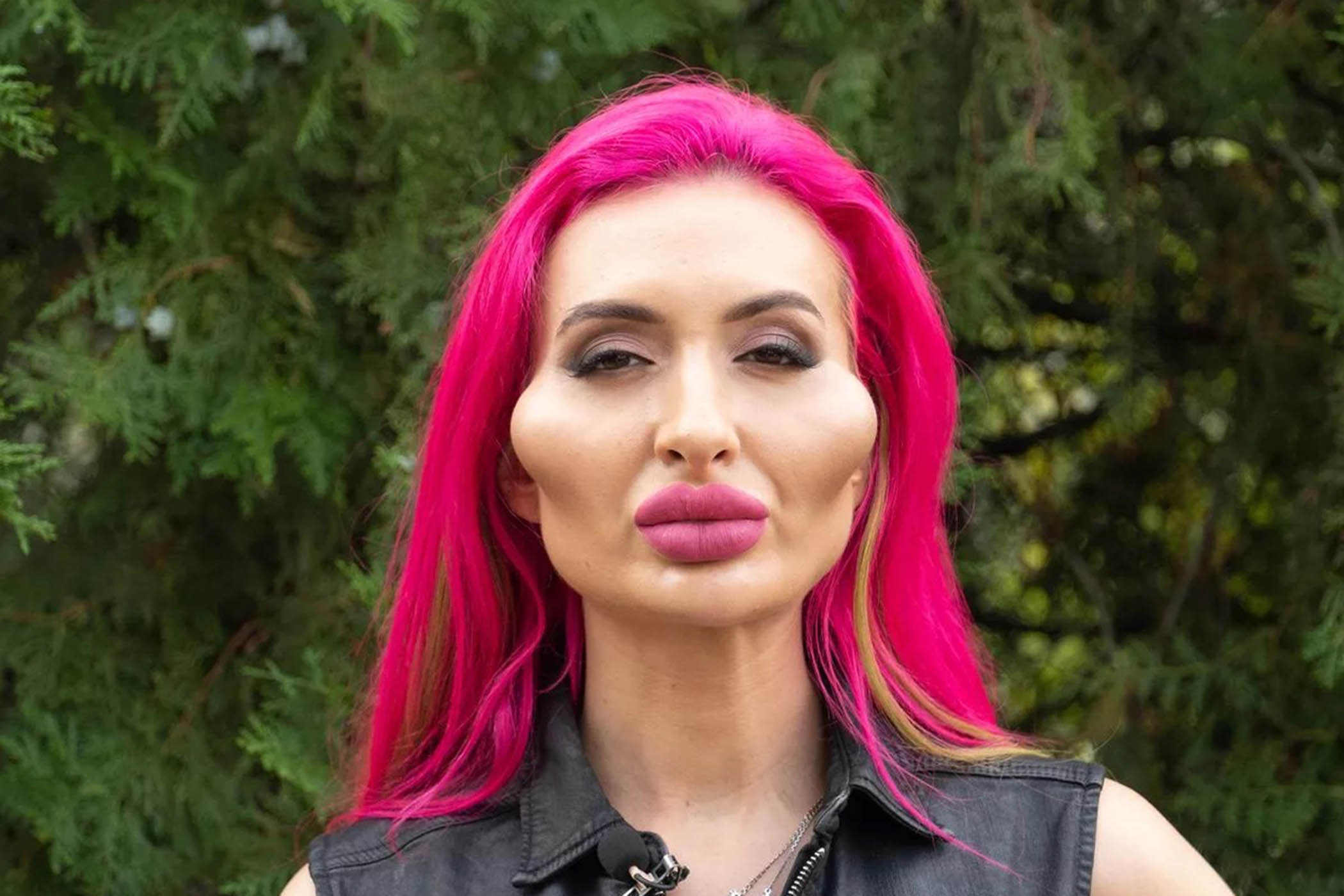

There’s a Ukrainian model called Anastasia Pokreshchuk who, having first injected facial fillers a decade ago, is now known for having (according to the Sun) “the world’s biggest cheeks”. To spend time with her on Instagram as she rotates before a ring light is to feel yourself sliding in real time through the cultural lifespan of filler itself.
First, horror. Yes, a quick and gasping horror, at the realisation that fluids can be injected into a human head in order to manipulate it into a caricature of femininity. She looks like a fable made flesh, as if the wind has changed mid-filter.
Fillers are one of the most common non-surgical aesthetic treatments worldwide – injected into the face, they’re used to immediately add plumpness and volume, lifting the cheeks, inflating the lips and inspiring, following the initial horror, some sobering lofty debate. Is war to blame for this woman’s cheeks? This is the next stage. Are the women who choose to inflate their faces dramatising some kind of patriarchal trauma? Questions, well-meaning, judgmental. Then, of course, a familiar shame descends – who are we to comment on what a woman does to her own body? In our brittle glass houses etc, with our shaved legs etc, our nails, our Botox. Suddenly, we are glancing at our own reflection in the darkened screen and considering whether we too might benefit from a drizzle of filler ourselves, just here, and here.
It doesn’t take long, after that, to find our eyes glazing, our thumbs swiping quite casually away from Anastasia, a face that once held our interest for its planes and oddness and carved lamination, and on to the next video, something maybe with meat or cats. In the 40 to 50 seconds you had been looking at this face it had become normal, is what had happened, it had lost its freakish, beautiful gleam. This is the way it works.
Last year, after a huge rise in fillers, with younger and younger customers folding them into their routines of regular beauty maintenance, a series of shifts led suddenly to deflating demand. Between 2019 and 2022, the number of patients receiving hyaluronic acid fillers had increased by 70%, but by 2024 the number of new procedures had levelled out. One reason was the discovery that, rather than dissolving as promised, filler was remaining in customers’ bodies years after it had been injected, migrating slowly, drunkenly, around their faces. Another reason was an epidemic of cheap, roughly injected fillers that gave customers an uneven confused look, meaning trust in the project waned.
‘This is how fashion goes. What comes in must go out, whether a trend for skinny jeans or inflated lips’
‘This is how fashion goes. What comes in must go out, whether a trend for skinny jeans or inflated lips’
The third reason was, of course, this is how fashion goes. What comes in must go out, whether a trend for skinny jeans or inflated lips. The same has happened with every other trend in aesthetic treatments and surgery, from breast implants to, more recently, bum implants which, after a major boom in arses, women are now dissolving in favour of a more “natural” silhouette. Once a trend becomes accessible to everybody, those with more power and money will inevitably reject it and move on, to the next, less accessible thing. What’s interesting now, though, is how the pharmaceutical industry is attempting to reverse their customers’ increasing “filler fatigue”.
Last week the Business of Fashion reported on such companies’ frantic machinations as they try to keep customers injecting. One genius plan is to rebrand the stuff by changing its name. The word “filler” suggests a bodge job to fix a problem, while “hyaluronic acid or bio-stimulatory injectables” offer the sheen of efficacy and science. Another company is encouraging filler providers to make their brand name synonymous with the product, like Botox, and attempting to remove what they’re now calling “the f-word” altogether. Elsewhere, companies are aggressively targeting people on weight-loss drugs with fillers to correct skin sagging and newly invented problems like “Ozempic face”, as well as filtering information about customer satisfaction on to social media, and “learning how to better address patient hesitations with data and empathy”.
This marketing shift is yet to reach the suburbs. Last week, my high street was alight with deals on fillers for Black Friday, including, with extensive packages, a “free lip flip”. It’s yet to reach the internet, too – the Business of Fashion reported an unprecedented 400% spike in searches for “Black Friday Lip Filler” this month. My high street, once a parade of betting shops and Persian grocers, is now 60% beauty salons, offering new lips, brows and cheeks to those in the correct phase of exhaustion or acceptance. As I battled along the road, glancing only briefly at the women in the warm white salons, a recent meme rattled in my head: “Remember when back in the day you all thought Pete Burns looked weird? Now everyone’s missus looks like him.”
Newsletters
Choose the newsletters you want to receive
View more
For information about how The Observer protects your data, read our Privacy Policy