

France usually prides itself on its status as a champion of the arts. It’s a place where the media flourishes, philosophers are national celebrities, and the film and book industries remain both fiercely independent and deeply original.
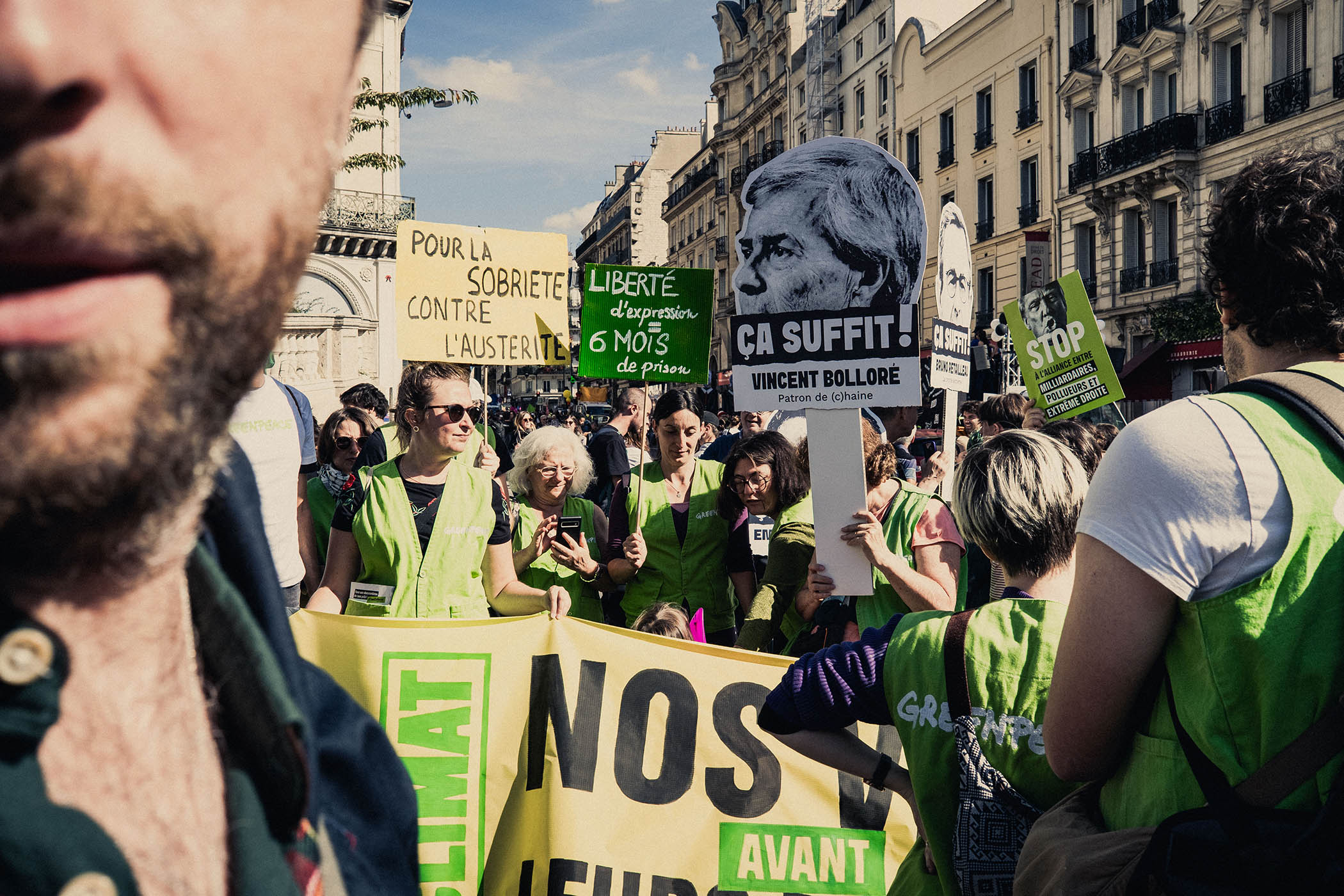
How curious, then, for the country to have recently been at the centre of not one but two global controversies, both hinting at ideological repression and a muzzling of creativity. Crucially, both stories happen to centre on the same man: 74-year-old billionaire Vincent Bolloré.
On the eve of the Cannes film festival, more than 600 French film industry professionals – from actor Juliette Binoche to newer stars Swann Arlaud and Adèle Haenel – published an open letter seeking to oppose his takeover of UGC, the country's third-largest cinema chain.
In the same week, several prominent international authors, including Nobel prize winner Han Kang and award-winning novelists Colm Tóibín and Ali Smith, penned another letter to the press, this time announcing that the French translations of their books would no longer be published by Grasset, a publishing house owned by Bolloré.
Both missives have a lot in common. In the former, signatories warn that “by leaving French cinema in the hands of a far-right CEO, we risk not only a homogenisation of films, but a fascist takeover of the collective imagination”. In the latter, they wrote: “We refuse to allow our work to be used for political ends that we do not share. The far right operates beyond borders; it must be fought beyond borders.”
‘The far right operates beyond borders; it must be fought beyond borders’
‘The far right operates beyond borders; it must be fought beyond borders’
It was written to support yet another letter, signed by more than 100 French authors, many of whom have little in common. Still, pompous public intellectual Bernard-Henri Lévy, radical punk feminist Virginie Despentes and bourgeois shock jock Frédéric Beigbeder had banded together to “refuse to be hostages in an ideological war aimed at imposing authoritarianism everywhere in culture and the media”.
Anyone wishing to understand recent events in France has two choices. The first is to focus on events at the Éditions Grasset, one of the country’s most illustrious publishing houses, which has been running since 1907. Last month, it was announced that Olivier Nora, who had run the imprint for 26 years, would be abruptly leaving the company. The details of what happened remain unclear.
But those details are mostly irrelevant: what matters is that Bolloré, whose company acquired Grasset in 2023, had a direct hand in the firing. Nora was a popular figure in the book world, and was seen as the only person able to protect Grasset’s staff from the bracingly rightwing views of their new owner. Nora was made to leave; his authors followed; end of story.
There is another way to look at it, however, which requires taking a longer view. Bolloré was born into an old Breton bourgeois family, and headed the 200-year-old Bolloré Group for decades. Under his rule, the company became an international conglomerate which, by 2018, was present in 127 countries and employed more than 80,000 people.
In the early 2000s, he decided to widen the company’s horizons, and make his presence felt on the French media landscape. By 2026 he owned, among others, major TV channels Canal+ and CNews; prominent radio stations Europe 1 and RFM; popular magazines Gala, Voici, Télé-Loisirs, Femme Actuelle and Paris Match, as well as Le Journal du Dimanche, the country’s main Sunday newspaper, along with several publishing houses. Most importantly, he reshaped many of those in his image.
Newsletters
Choose the newsletters you want to receive
View more
For information about how The Observer protects your data, read our Privacy Policy
The process has been dubbed “Bollorisation” by the French press, and involves, quite crudely, driving out anyone who doesn’t align ideologically with the new ownership. In the year following the acquisition of Le Journal du Dimanche, more than 90% of journalists left the paper. Over at iTélé, 100 out of 120 journalists left the channel in the 12 months after Bolloré took over.
The businessman’s desire for control often extends past his own companies, as he enjoys personally suing any publication he dislikes. This led a few years ago to the editorial staff of agency AFP, the centre-left daily Libération, its centre-right equivalent Le Figaro and several others to write a joint statement denouncing his attempts to silence them “by trying to financially ruin journalists”.
‘Bollorisation’ involves, quite crudely, driving out anyone who doesn’t align ideologically with the new ownership
‘Bollorisation’ involves, quite crudely, driving out anyone who doesn’t align ideologically with the new ownership
It has also long been known that Bolloré isn't merely after power but is seeking to actively tip France towards the populist right. A Catholic conservative, he was once close to former president Nicolas Sarkozy, lending him his yacht in 2007, but is now flirting with the extremes. These days, his closest ally is probably Éric Zemmour, a far-right politician with multiple convictions for incitement of racial discrimination, religious hatred towards Muslims and racial hatred.
According to Vincent Beaufils, who wrote a book on the media mogul, Bolloré happily says in private that “I use my media to wage my civilisational battle”. His goal, according to the French press, is to build an alliance between the right and the far-right in France, ensuring that the coalition eventually wins an election, and governs on a reactionary, extreme anti-immigration platform.
So far, it is working. France has spent much of the past decade sliding ever further towards the far right, and it isn’t clear that anyone knows how to stop it. The only hope is that, buoyed by such an easy ride, the billionaire will eventually take it too far and make a mistake even he cannot recover from.
Was Grasset that mistake? It is too early to tell, but one thing is for sure: France will elect a new president in less than a year, and Bolloré has spent a lot of time and money on ensuring he gets the result he wants.
Photograph by Bastien Ohier/Hans Lucas/AFP/Getty Images