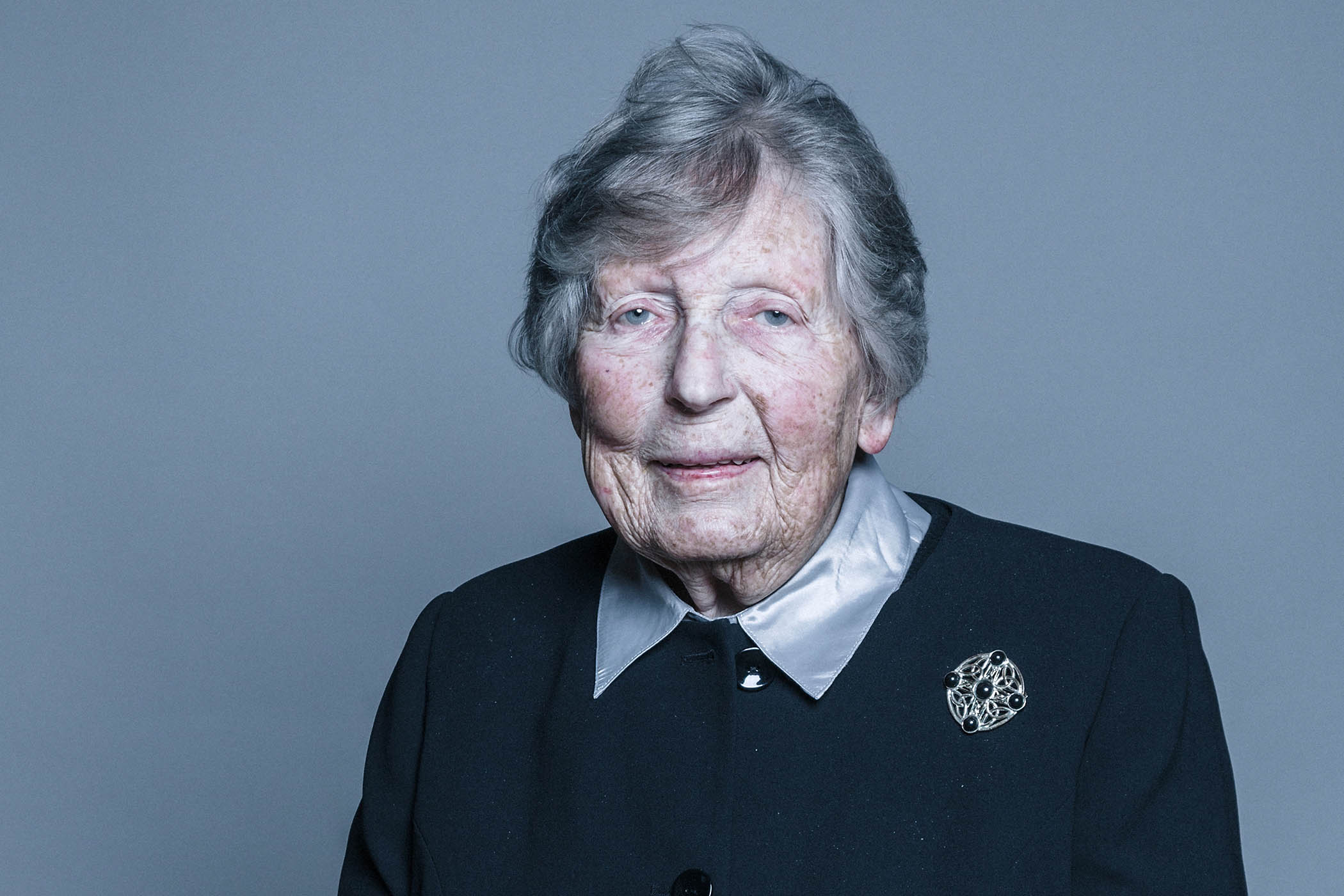

When Baroness Audrey Emerton was four, she contracted measles then whooping cough, which led to bilateral mastoiditis, a severe bacterial infection in the ears. She almost lost her hearing and during three months in hospital in 1940, in which her parents could visit only twice a week, she temporarily lost the ability to walk. However, she gained something precious from her confinement: a vocation. That long reliance on the care of nurses planted in her a desire to join their profession.
At the age of 11, Emerton joined St John Ambulance as a cadet. “It was the making of me,” she later said. The organisation, which trains 250,000 people a year in first aid and provides treatment at thousands of events, will mark its 150th anniversary next year. Emerton was a volunteer for more than half its existence and rose to become its chancellor and chief commander. Professor Mark Compton, Lord Prior of the Order of St John, which traces its roots to the Knights Hospitallers in the 11th century, described her as “a true icon of our order, dedicating her life to serve others”.
“I have a lot to thank St John for,” Emerton said. “They equipped me with my bossiness.” That was something many could attest to, generally with affection, for after being a ward sister and then teaching nursing students she became a formidable administrator. She spent 18 years as chief nursing officer for the South East Thames regional health authority before entering the House of Lords as a crossbench peer in 1997.
There she spoke only on health issues, assiduously and passionately, often moving amendments to improve legislation. At the age of 77, in 2012, she did not miss a day of debate on the health and social care bill. When she retired from the Lords seven years later, Lord Patel, a former consultant obstetrician, said that he always called her “matron” because he was petrified of her, while Lord Hunt of Kings Heath, former head of the NHS Confederation, called her “an undoubted tour de force”.
As an administrator, she was most proud of overseeing the closure of Darenth Park Hospital in Kent in 1988. This asylum for people with severe learning difficulties had opened in 1878 and was no longer fit for purpose. Of the 1,500 residents, 40% had lived there for more than 25 years, and Emerton took the time to develop individual plans to place them in the community, ensuring that they got suitable accommodation and support. It made her realise the crucial importance of social care within the NHS.
She was fond of reminding peers of Florence Nightingale’s saying that “the very first requirement in a hospital is that it should do the sick no harm”
She was fond of reminding peers of Florence Nightingale’s saying that “the very first requirement in a hospital is that it should do the sick no harm”
Audrey Caroline Emerton was born in Tunbridge Wells. The headteacher at her grammar school told her that nursing was not a suitable job for a girl of such delicate health, but she applied to six London teaching hospitals and was offered a place by them all. She chose St George’s in Tooting and qualified as a state registered nurse in 1957.
After four years, she got engaged to the brother of one of the senior sisters and left London to be a ward sister in Tunbridge Wells. The relationship did not last and she was invited back to Tooting to become a nurse tutor in 1964. She was later asked to run nursing at the Kent and Sussex hospital in Tunbridge Wells.
Emerton was the only woman selected for an NHS management training course at Henley before being appointed in 1973 to run the South East Thames region, in charge of 30,000 nurses from Guy’s in central London to Dover. She was also president of the Association of Nurse Administrators, formerly the Association of Hospital Matrons, and chief nursing officer of St John Ambulance. She became a commander of the order in 1978 and chief commander 20 years later.
In the 1990s, she was a lay member of the General Medical Council and chair of the Brighton NHS trust, where the medical school bears her name. She was later elected chair of the charity Attend, formerly the National Association of Hospital and Community Friends.
In her maiden speech in the Lords, she spoke about the importance of providing healthcare for homeless people. She was fond of reminding peers of Florence Nightingale’s saying that “the very first requirement in a hospital is that it should do the sick no harm”, arguing that poor standards of nutrition or cleanliness were inexcusable. She often spoke against allowing assisted suicide. While she admitted that all six of the major reorganisations of the NHS she had experienced in her career had good points, she lamented the decline in authority of ward sisters and the loss of matron.
Newsletters
Choose the newsletters you want to receive
View more
For information about how The Observer protects your data, read our Privacy Policy
Baroness Watkins of Tavistock, a fellow nurse, described Emerton as “a warm and generous mentor, well respected for her knowledge and skill at raising important healthcare issues … Audrey was a formidable nurse who led the development of the profession to ensure that fully registered nurse’s qualifications became recognised at degree level. She had a ready wit which many of us enjoyed over a cup of tea or a glass of wine in her company.” Professor Nicola Ranger, general secretary of the Royal College of Nursing, called her a “trailblazer who represented the very best of the profession”.
In 2020, the college gave Emerton its first lifetime achievement award, an honour that surprised and humbled her. “I have only spent my career doing what I had been trained to do and what I wanted to do,” she said. That is to honour the motto of the Order of St John: Pro Fide Pro Utilitate Hominum, for faith and the service of mankind.
Audrey Emerton, nurse administrator and crossbench peer, was born on 10 September 1935 and died on 27 February 2026, aged 90
Photograph by Chris McAndrew/UK Parliament