Love and loss. David Attenborough began to explore these themes in 1954 and he’ll still be hard at it on his 100th birthday on 8 May. But always in an understated way: never luxuriating in joy nor wallowing in gloom, never for an instant straying from the certainty that life is the most glorious thing on this planet. And that its dominant species is in the process of trashing it.
It’s 1961 all over again, for I’ve been watching Zoo Quest to Madagascar on BBC iPlayer. I hadn’t seen it since it first came out – in black and white, naturally. I was officially a pupil of Sunnyhill junior school in Streatham, south London, but the great teacher of my childhood was not Mrs Holland. It was Mr Attenborough.
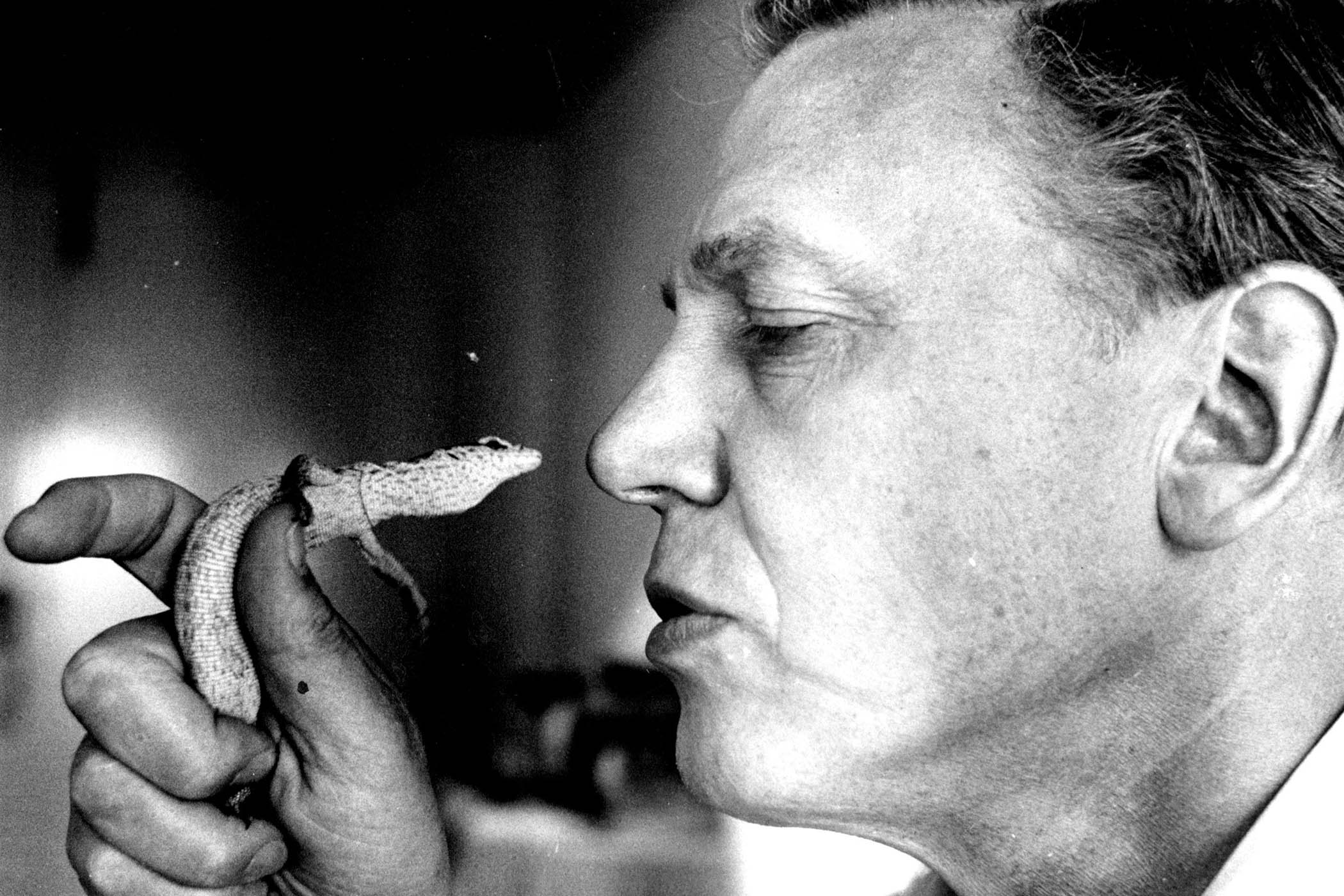
By then I was already a Zoo Quest veteran, having travelled with David in search of armadillos, birds of paradise and even dragons. But something about the Madagascar series has haunted me ever since. The love I got at once, obviously: he had me at “zoo”. But the series was the first time I understood loss, newly aware that sadness is part of every wildlife experience, however wonderful.
There are five episodes of Zoo Quest to Madagascar, each one bookended by David in his best suit in the studio in London as he introduces the filmed footage from Madagascar and, with it, his other self – his real self – in khaki shorts.
Slow dissolve… It was 20 years ago and I was in the Linnean Society building in London, in Burlington House, Piccadilly – the same complex as the Royal Academy of Arts. At the heart of the place is a spectacular double-decker library with columns rising dizzily to a glass roof. But I wasn’t perusing the 100,000 natural history books. I was there for a drink.
And so was Sir David Attenborough. I’d been attending a council meeting of the World Land Trust (WLT), a charity that buys land in the developing world on behalf of top-quality conservation organisations. David is patron of the WLT and has supported the organisation since its foundation in 1989. At last I was going to meet him.
I filled David’s glass as a helpful council member should and soon enough we were talking about Madagascar. “And what was the lemur you spent so much time looking for? The one you thought you’d never find?”
“Indri!”
Of course! It all came back. And so, as a 100th birthday treat, I watched the episode again and I was back in Streatham, learning about such things as geographical isolation, allopatric speciation and adaptive radiation: all stuff I was to read about years later. And when I did so, I realised I had laid down the foundations in childhood.
David talked about lemurs, the extraordinary group of primates that evolved in Madagascar after the island was cut off from the rest of Africa. He wanted to find the largest and finest of all of them: the indri. It wasn’t easy. “It was maddening… infuriating… I began to despair.”
Newsletters
Choose the newsletters you want to receive
View more
For information about how The Observer protects your data, read our Privacy Policy
Indris are great singers, filling the forests that remain with an eerie, far-carrying song. The song rang out as David searched for them. He recorded their music and played it back, and huzzah! The lemurs showed themselves. For the first time in history they were filmed and their family life was there for us to revel in.
There were two parents, two adolescents, and finally the mother revealed that she was carrying a baby and all was rejoicing: oh brave old world that has such creatures in it! David then brought the great series to an end: “Of all the creatures we saw in Madagascar this, the largest of the lemurs, was the rarest, the most interesting, the least known scientifically and the most enchanting. These forests are their last home in the world and their numbers now must be very restricted.”
I spent four years in Hong Kong, from 1978 to 1982, living the life of the gonzo journalist and it was great, though by then I had lost my childhood sense of the central importance of nature. I also got rid of my television after they put an ad break in the middle of the car chase in The French Connection.
But they made the audacious decision to run a 13-part series without any ads at all and I watched every one of them at my friend Jude’s house. And it changed my life: or rather changed it back to what it always should have been. It took me back to the love and loss of nature, but now with added intellectual depth.
This was Life on Earth, the first part of David’s 1979 masterwork The Life Trilogy. Who else could make a clump of wet stubby pillars of rock so enthralling, let alone explain them with such clarity? They were stromatolites, clumps of blue-green algae: “As close we may ever get to a scene from the world of 2,000 million years ago.”
He explained: “The arrival of the blue-greens marked a point of no return in the history of life.” That was because they take in carbon dioxide and push out oxygen. Oxygen! All the wonders that followed in that series – squids in disguise, a frog leaping into life from its father’s mouth, the revelation that birds are flying dinosaurs, and, of course, David’s romp with the gorillas – are underpinned by the fact that it began with those miraculous pillars of oxygen-exhaling life.
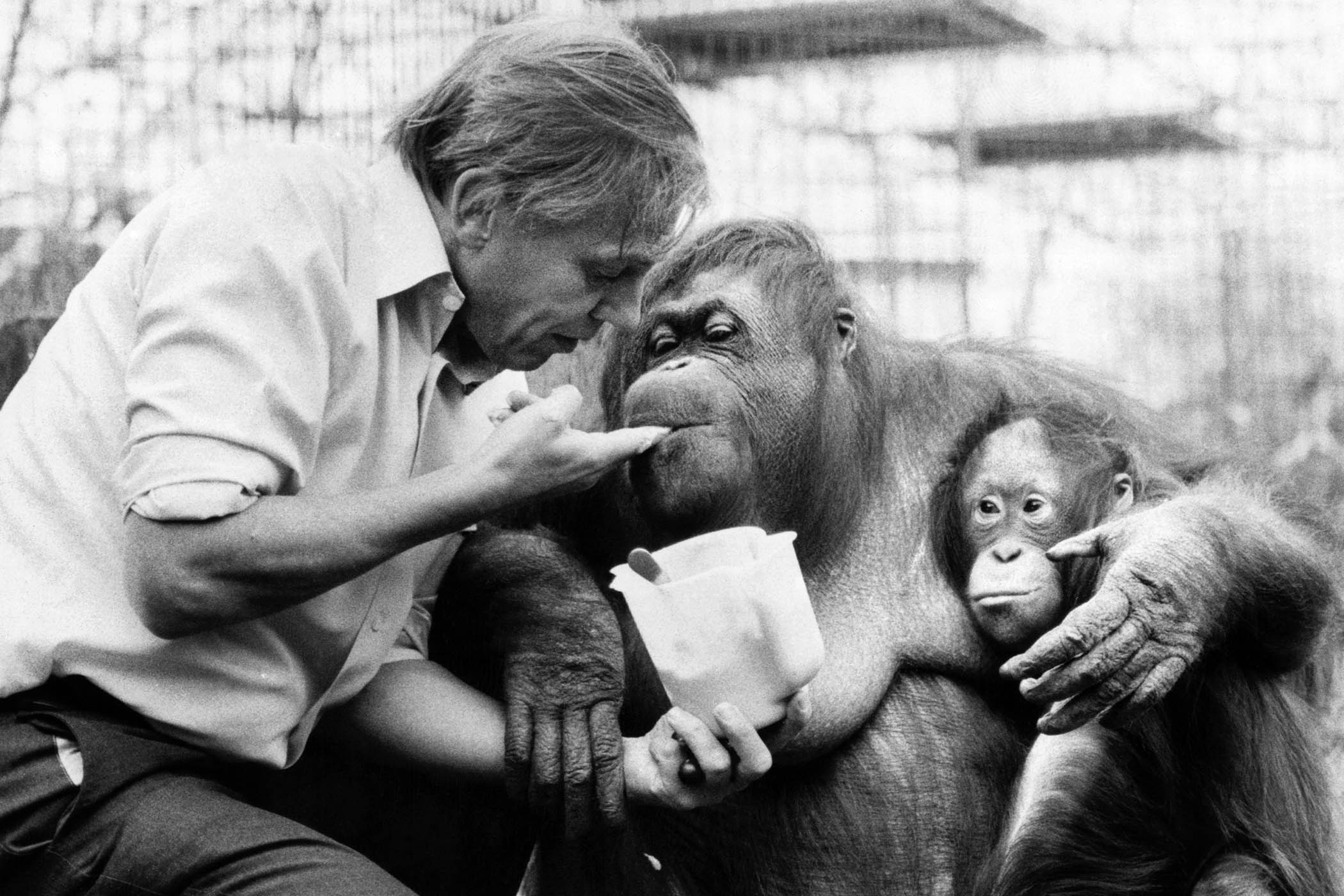
David Attenborough meets an orangutan and her baby at London zoo, April 1982
Life on Earth was about evolution. It was followed by The Living Planet, about ecology, and The Trials of Life, about ethology, or the science of animal behaviour. This is the tripod of life sciences and I’ve been enthralled by them ever since I regained the faith. I’ve written about them all in many books and many more pieces of journalism: and at the back of every one of them has been the twinned theme of love and loss.
I had the pleasure of talking about such things to David over the course of two six-year stints with the WLT. There was nothing mystical about it. David is not the kind to get soppy. For him it’s always the story and the life that generates the story. Always. Well, almost always.
Once, I was supposed to be interviewing David for a newspaper, but the conversation veered away from my prepared questions. “I’m not a deeply introspective person, really,” he said, “and I don’t have a mystical view of nature particularly… But I remember a particular occasion on a billabong in northern Australia in Arnhem Land. It was very wild, and there was a marvellous lake, a big billabong covered in wildfowl of one sort or another, magpie geese and crocodiles.
“In order to get the shots we wanted we put up a hide and then went there in the dark so that the birds wouldn’t be aware that you were there. And the sun began to rise over this wonderful lake, with lilies – purple lilies, pink lilies as well as white lilies, and the magpie geese, egrets and crocs, and you suddenly had a vision of the natural world without humanity. That was a… I was going to say a holy moment, but you know what I mean?”
We’ve all seen television interviewers more interested in the questions they ask than the answers they receive. We’ve all seen presenters more interested in how cool they look than the subject they are supposed to be presenting. David’s the antithesis.
He’s had a lifetime of people telling him he’s marvellous, and yet he’s always held to the soul-deep belief that the marvellous part of every single one of his programmes is not the presenter but the subject. David is never the star; the star is always the stromatolite, the lemur, the gorilla, the armadillo or the bird of paradise. He coaxes it into the limelight to be appreciated and understood, not just as a momentary spectacle but as a living being, packed with profound meaning.
But at the end, we come back to love and loss. These things are inseparable from the Life of Dave. We could just as easily talk about the Loss trilogy or the Love trilogy. Again and again he has made it clear that in trashing the planet we are compromising the future of humanity as well as that of uncountable millions of other species.
There’ll be a vast ocean of tributes to David as the tide of his birthday celebrations advances, and quite right too. But behind it all is a single terrible unspoken and almost unspeakable truth. If we all believe that David is so marvellous – so wise, so all-seeing, so terribly right – why haven’t we done what he’s spent his life suggesting?
Why has the loss not stopped? We listened to David, agreed with David, loved with David. But we haven’t done the job that David so urgently and so vividly outlined for us.
Is despair the only option left to us? Let’s ask David: “Politicians have to listen because [young people] are their future voters and they must take control of these matters. This is not about a few eccentrics with straw in their hair, worried about the plight of some rare bird. It’s young people concerned about the future of their planet – and they are the inheritors of the earth.”
Photographs by Julian Kevin Zakaras/Fairfax Media via Getty Images, Mirrorpix/Getty Images