1954
After studying the natural sciences at university and doing my national service in the Royal Navy, I joined the infant BBC Television Service. My job was to produce nonfiction programmes of all kinds, but as the number and variety of programmes shown each evening increased I started to specialise in natural history.
To start with, we showed animals brought to the studios from London Zoo. But I yearned to let viewers see them in their proper surroundings – in the wild where their varied shapes and colours made sense – and eventually I worked out a way in which I might do that. I made a plan with Jack Lester, the curator of reptiles in the London Zoo. He would suggest to the zoo’s director that he might go to Sierra Leone in west Africa, which he knew well, and that I would go with him with a cameraman to film what he did. It would be excellent publicity for the zoo, and the BBC would get a new kind of animal programme. We called it Zoo Quest. So, in 1954, I set off for Africa with Jack and Charles Lagus, a young cameraman who had worked in the Himalayas and used the lightweight 16mm film camera that we would need.
The first programme was transmitted in December 1954.
Unhappily, the day after it appeared Jack was taken to hospital with a disease so serious that it would eventually kill him. There was no way in which he could appear in the studio for the second programme the following week. Only one person could do the job, and that was me. So I was instructed to leave the control gallery from which I had directed the live cameras, and instead stand in the studio grappling with the pythons, monkeys, rare birds and chameleons that the expedition had brought back. So began my career in front of the camera.
The series turned out to be very popular and I started to travel the world making Zoo Quest programmes – Guyana, Borneo, New Guinea, Madagascar, Paraguay. It was some time before I acquired the skills that I needed to become reasonably competent at living and working in the wilderness.
The programmes became extremely popular. People had never seen a pangolin before on television. They had never seen a sloth.
We showed them the largest lizard, the so-called “dragon” that lives on Komodo, a small island in central Indonesia, and filmed for the first time birds-of-paradise dancing in the New Guinea forest.
The 1950s were a time of great optimism. The second world war which had left Europe in ruin was beginning to fade in the memory. The whole world wanted to move on. Technological innovation was booming, making our lives easier, introducing us to new experiences. It felt that nothing would limit our progress.
The future was going to be exciting and bring everything we had ever dreamed of. Who was I, travelling the globe with the task of exploring nature, to disagree.
Newsletters
Choose the newsletters you want to receive
View more
For information about how The Observer protects your data, read our Privacy Policy
That was before any of us were aware that there were problems.
1971
I knew of only one place where great discoveries were still being made by explorers travelling entirely on foot – New Guinea.
The interior of this 1,000-mile-long island lying north of Australia is filled with steep mountain ranges covered with tropical forest. Even in the 1970s, there were still patches of it that no outsider had yet entered, and walking with a long line of porters was still the only way that anyone could do so. Such an expedition would surely make a fascinating film.
My plan was simple. We found a small government station called Ambunti on the Sepik, the great river that runs roughly eastwards, parallel to the north coast of the island before emptying into the Pacific.
The government officer who would lead the expedition, Laurie Bragge, was based there and he would recruit some porters. We would charter a float plane that would land on the river alongside his station and join him.
It turned out to be the most exhausting journey that I have ever made. Laurie had managed to assemble 100 porters, but even that was not enough to carry all the food that we would need.
We would have to have an air-drop of more supplies after about three weeks. We also had to travel across the grain of the country.
Every morning soon after dawn, we started walking, cutting our way through the densest forest I have ever encountered, hauling ourselves up steep muddy slopes to the crest of a ridge and then slithering down the sodden undergrowth on the other side, to wade across a small winding river and then do the same thing, over and over again.
After six weeks of walking, our supplies were running low. It seemed the expedition and our film would have no satisfying conclusion.
And then, one morning, I woke up beneath my tarpaulin and saw outside a group of small men, standing within a couple of yards of me. None of them was more than about 1.5 metres tall.
They were naked except for a broad belt of bark into which they had pushed a bunch of leaves, at the front and the back. Several had what I later discovered were bats’ teeth stuck through holes that they had pierced in the sides of their noses. Hugh, the cameraman, was already recording. The men stared at us, wide-eyed, as though they had never seen our like before. I doubtless did the same.
They pointed to their mouths, nodded and opened their string bags to show us roots, probably taro, that they had been gathering. I pointed to cakes of salt we had brought with us. It is used as currency all over New Guinea. They nodded. We had started to trade. Laurie then asked them the names of the nearest rivers.
That was more difficult to explain, but they eventually understood what he wanted and they began to list them. How many did they know? They counted them, touching first their fingers one by one, tapping places up their forearm, their elbow, and continuing up the arm and ending on the side of the neck. In fact, Laurie was not particularly interested in the actual names of the rivers, or how many there were. He wanted to know what gestures they used to indicate number. He knew the counting gestures used by other groups in the area, and the ones used by these little people would tell him what trading contacts they might have.
After 10 minutes or so, the men started to wave their arms and roll their eyes, indicating that they were going to leave. We waved back in response, trying to invite them to return in the morning with more food. And they left.
I had had a vision of how all human beings had once lived – in small groups that found all they needed in the natural world around them. The resources they relied upon were self-renewing. They produced little or no waste. They lived sustainably, in balance with their environment in a way that could continue effectively, for ever.
A few days later, I was back in the 20th century and behind my desk in Television Centre.
1978
One of the key sequences planned for Life on Earth describing the evolution of monkeys and apes concerned the development of the opposable thumb. This is the anatomical characteristic that enables a monkey to grasp a branch – or a human being to wield a tool and eventually hold a pen – an ability that played a crucial part in the rise of our own species and our civilisations. We could have chosen any species of monkey or ape to illustrate the point, but John Sparks, the director of the episode, decided that it would be most dramatic to do so by filming gorillas. He had discovered that an extraordinary American biologist, Dian Fossey, had been living with a group of rare mountain gorillas in the central African state of Rwanda, and had so accustomed them to the presence of human beings that even strangers – providing Dian accompanied them – could get quite close to them. He contacted her. The animals with which she worked were seriously endangered.
The human population of Rwanda was growing extremely swiftly and the mountain forest in which the gorillas lived was being felled by the local people to make way for cultivated fields.
Less than 300 mountain gorillas were left. Their appearance on television might draw the attention of the world to their plight.
With that in her mind, she agreed to help us, and in January 1978 we set out for Rwanda.
We landed at Ruhengeri [now Musanze], a tiny airstrip as close as we could get to Dian’s camp. From there we would have several hours walking up the volcano’s flank to reach the high-altitude forest where Dian lived. We were met by Ian Redmond, a young scientist who was working with Dian. He had very bad news. A young male gorilla that Dian had known since his birth, and was particularly fond of, had been found dead and horribly mutilated. Poachers had shot him. They had cut off his head and his hands to sell to traders who would turn them into souvenirs. Dian was grief-stricken. She was also seriously ill with a lung infection so she had been unable to leave camp. Nonetheless, she would do her best to help us.
The next day she was still very frail so it was Ian who led us into the forest. We came to a clearing and Ian called a halt. We must now sit out in the open so that the gorillas could see us. Once they knew we were with Ian, they would be unlikely to take fright.
After a few minutes’ rest, we set off again and soon caught up with a family group of them. They were feeding, ripping up the vegetation by the handful. We sat and watched enthralled until, after a few minutes, they got to their feet and leisurely strolled away. We had been accepted, Ian said. Next time, we could film.
The following day, with Ian as our guide, we filmed the gorillas foraging, from a respectful distance. They took virtually no notice of us. Eventually John suggested that I said something directly to camera, explaining what it was like to be sitting near them.
We moved slowly towards a group busy feeding, and I cautiously moved closer to them until I thought that they would be visible in the background. I looked back at the camera and spoke.
“There is more meaning and mutual understanding in exchanging a glance with a gorilla,” I said quietly, “than with any other animal I know. Their sight, their hearing, their sense of smell are so similar to ours that they see the world in much the same way as we do. The male is an enormously powerful creature but he only uses his strength when he is protecting his family and it is very rare that there is violence within the group. So it seems really very unfair that man should have chosen the gorilla to symbolise everything that is aggressive and violent, when that is the one thing that the gorilla is not – and that we are.”
When we found them the next day, they were not far from where we had left them. They had settled on a slope on the far side of a small stream. Martin Saunders set up his camera, Dicky Bird, the sound recordist, fixed a small radio microphone to my shirt.
The time had come, John said, for me to say something about the evolutionary significance of the opposable thumb.
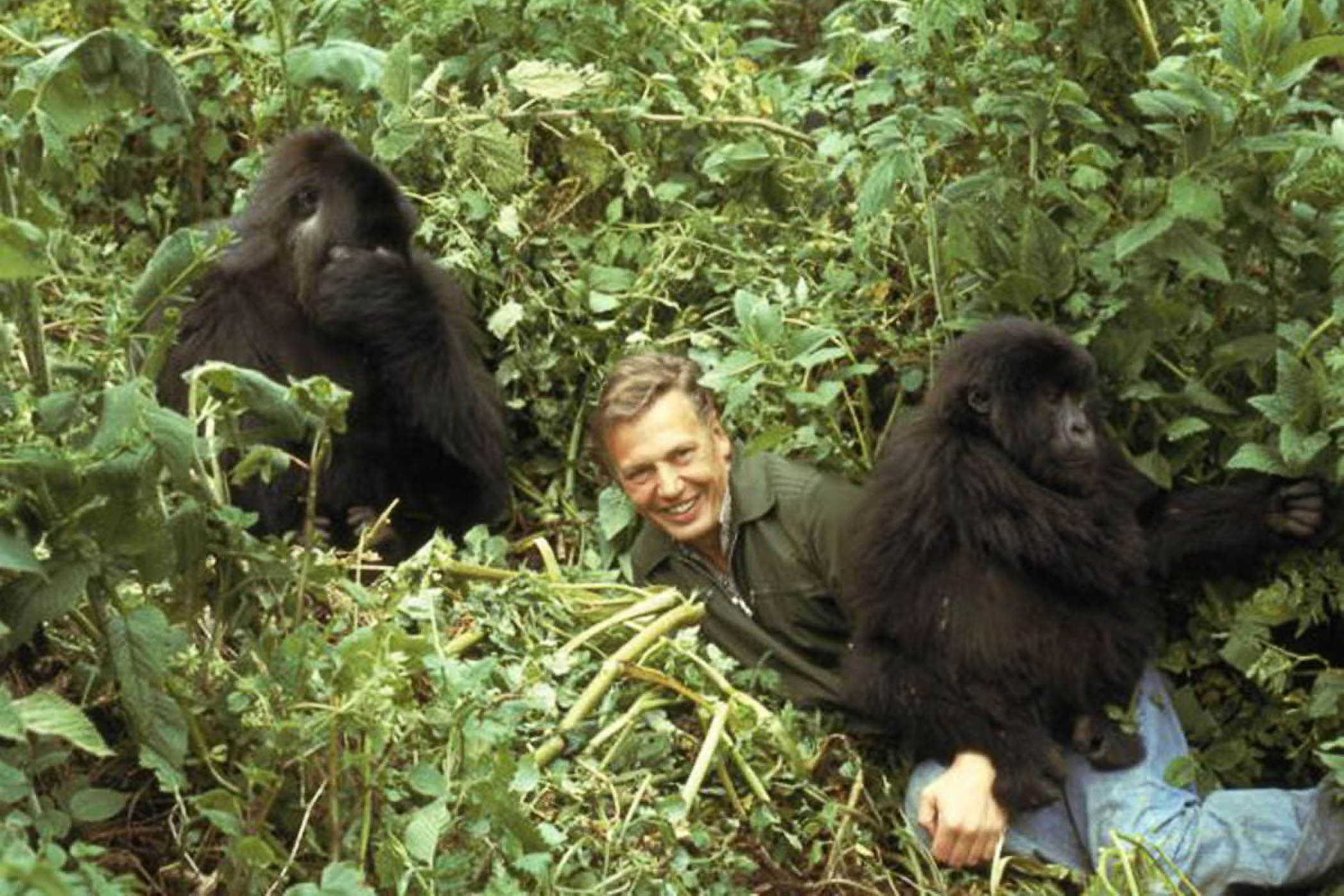
I crept down a slope to a small stream, crossed it and crawled up the opposite slope to a point where I thought that Martin and his camera would be able to see both me and them. John gave me the thumbs-up. But before I could say anything, something landed on my head. I turned and found that a huge female gorilla had emerged from the vegetation immediately behind me and put her hand on my head. She looked straight at me with her deep brown eyes. Then she removed her hand from my head and pulled down my lower lip to look inside my mouth. This was not, I thought, the moment to talk about the evolutionary significance of the opposable thumb. Something then landed on my legs. Two infant gorillas were sitting on my feet and fiddling with my bootlaces.
How long, in terms of minutes and seconds, this interaction continued I have no real idea. It was certainly several minutes. I was in a delirium of happiness. Then the youngsters got bored with my bootlaces and ambled away. Their mother watched and heaved herself to her feet to lumber after them.
I crept back to the film crew overwhelmed with a feeling of extraordinary privilege.
We had to leave the following morning. As we said goodbye to Dian, she made me promise to try to raise money to help protect the wonderful creatures for which she cared so much. And so I did, the day after we got back to London.
Extract from A Life On Our Planet: My Witness Statement and Vision for the Future by David Attenborough (Witness Books, £12.99). Order a copy at observershop.co.uk for £11.69. Free UK standard P&P on online orders over £25
Photograph by BBC