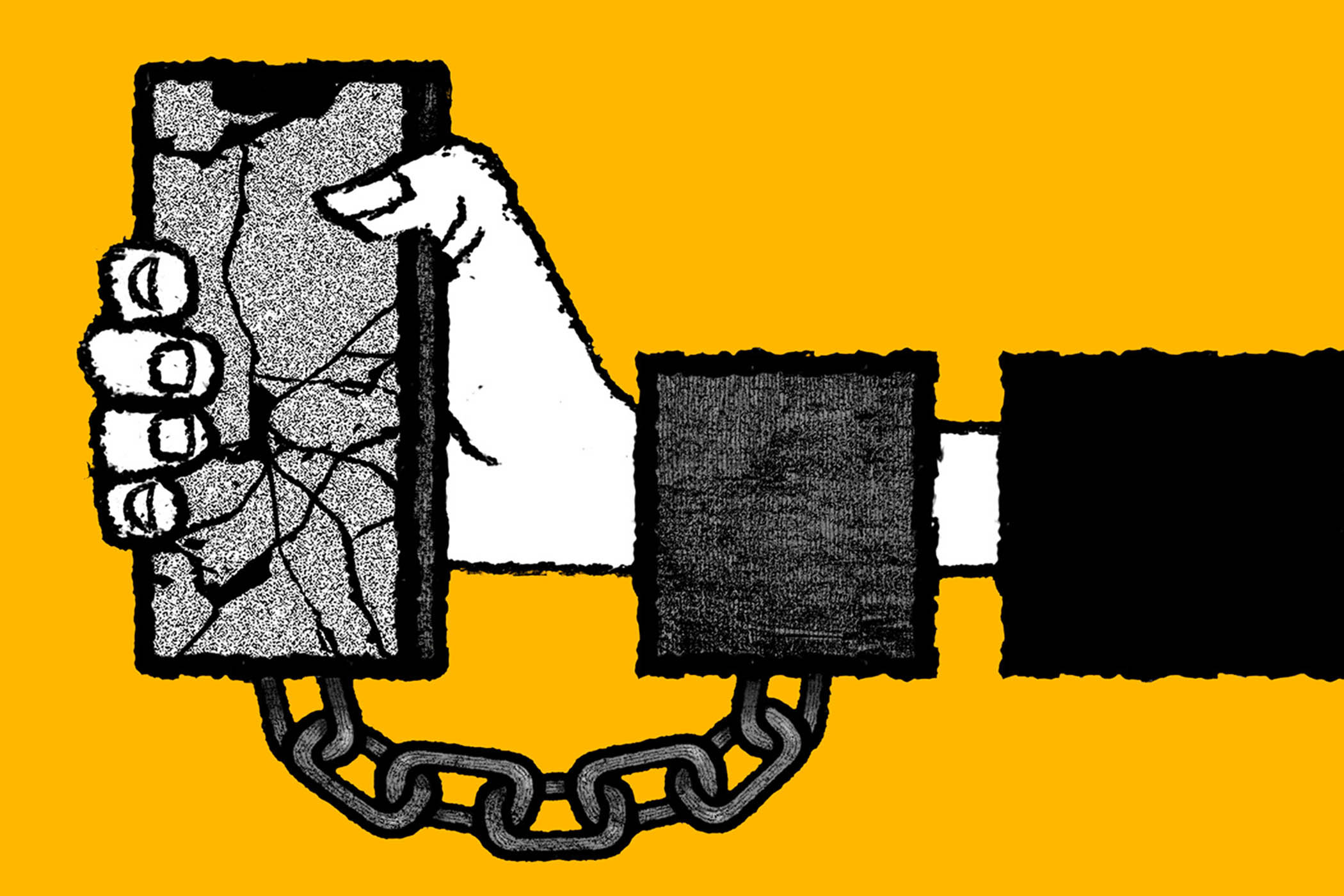



Illustration by David Foldvari
You’ve probably felt it: the moments after your phone drops into the bath or is swiped from your bag, and you feel the cord connecting you to everyone and everything sever. You know you can’t text or call anyone to tell them, and yet muscle memory keeps you reaching into your pocket to check if anyone has contacted you. Each time you acclimatise to being unable to plan your journey or check your bank balance, you discover some other essential life function you are locked out of.
The experience of being suddenly without a phone is a sense of dislocation that feels both profound and mundanely relatable in its swift isolation. Perhaps this is why it has become such an effective device in storytelling recently; a shorthand that allows us to imagine a character unmoored from the world and cast into chaos.
In Paul Thomas Anderson’s One Battle After Another, which won best picture at the Oscars last weekend, Leonardo DiCaprio’s one-time countercultural rebel Bob Ferguson spends much of the film running around trying to charge his phone to contact his daughter, Willa (Chase Infiniti). The stakes here could not be higher: the device in question is an untraceable 1G analogue phone that is therefore safe to use while on the run from the US government. Now without a way to reach her, Bob then finds himself unable to remember the password that his former group of revolutionaries need in order to give him the location of the designated safe place she is being taken to.
It’s not your average low-battery nightmare, and yet there is something entirely recognisable in Bob’s increasingly deranged attempts to find a power supply, hissing frantically into payphones and plummeting from a rooftop as his state of disconnection drives him over the edge. Here, a dead phone helpfully keeps Bob and Willa apart, but that broken line between them ultimately leads to emotional connection. When they are finally united and speak face to face, it is of their love for each other.
Newsletters
Choose the newsletters you want to receive
View more
For information about how The Observer protects your data, read our Privacy Policy
Human communication is also the upshot of a water-damaged device belonging to musician Herb McGwyer (Tom Basden) in last year’s hit film The Ballad of Wallis Island. Herb has agreed to play a private gig on a remote island for Charles Heath (Tim Key) in exchange for a large sum of money that will help fund his fledgling experimental career, but a disastrous arrival by boat sees his phone dropped into the sea. Unable to harass his manager from the privacy of his room, Herb goes in search of a bag of rice to absorb the water from his phone; instead the local shopkeeper offers him pasta. “Has to be rice, apparently,” Charles says, shaking his head while looking at the floor.
Herb thinks these people are ridiculous, but as he trudges off to the payphone with a plastic bag full of 20p pieces, he is plainly the fool. Herb is a walking embodiment of our myopic reliance on phones; machines that lead us to believe nothing is more important than our own immediate needs. But after being unplugged from his phone for a few days, Herb is finally able to see beyond himself.
So it also proves in Ben Lerner’s novel Transcription, released next month, which opens with the unnamed narrator dropping his phone into the sink at a hotel while travelling for an interview. Walking around his university town, he feels “an unusual experience of presence”, as memories from the streets he is walking and the people he knew revisit him, even as he continues to take “the corpse of my phone” out of his pocket over and over again. But without his phone to distract him, he is pulled abruptly and without interruption into his past.
The broken-phone plot was already shafting characters in horror movies, where problems such as a dead battery in Get Out, or a lack of phone signal in a slew of films, including Bodies Bodies Bodies, Bird Box, The Menu and The Cabin in the Woods, ensure no easy escape from terror. But this new wave of stories speak more to a desire for connection after disconnecting than a trick to solve plot holes.
Being without a phone is alienating, but you experience the world in harsh real time as if anew
Being without a phone is alienating, but you experience the world in harsh real time as if anew
Being without your phone is alienating, but in reality, you are no longer alienated from the world but experiencing it in harsh real time as though anew. With more and more people exploring ways to be apart from their handset, such as screen-free weekends or “bricking” their phone with an app-blocking device so they cannot access social media for hours at a time, it’s unsurprising that fiction is reflecting that desire to break away from technology.
Without a phone, at first, you are vulnerable, but if you stick with it for long enough, you feel yourself changing. It reminds me of what the American academic Cal Newport, who has written extensively on digital technology and living offline, once told me in an interview about giving up Instagram. “Solitude is our time where we make sense of things we’ve encountered in our lives, and try to fit them into our story of ourselves. It’s painful – I think we all remember this from our teenage years – but it’s how you grow and have self-awareness.”
Any time my phone has abandoned me, I have rushed to replace it, but years ago I was in Berlin and, without warning, it went to sleep for ever. After feebly searching for an Apple repair shop nearby, my friends told me in no uncertain terms that this was not the way to spend a long, hot Saturday, and I left the cord severed.
It helped that I was in a city that encourages you to get lost and behave in a way that you may not want documented, but sitting with the discomfort of being untethered for a few days, it soon felt instead like being cut free. Nobody could reach me, nobody knew where I was – it felt exciting. These days, perhaps a broken phone represents not horror, but the fantasy of freedom and adventure.