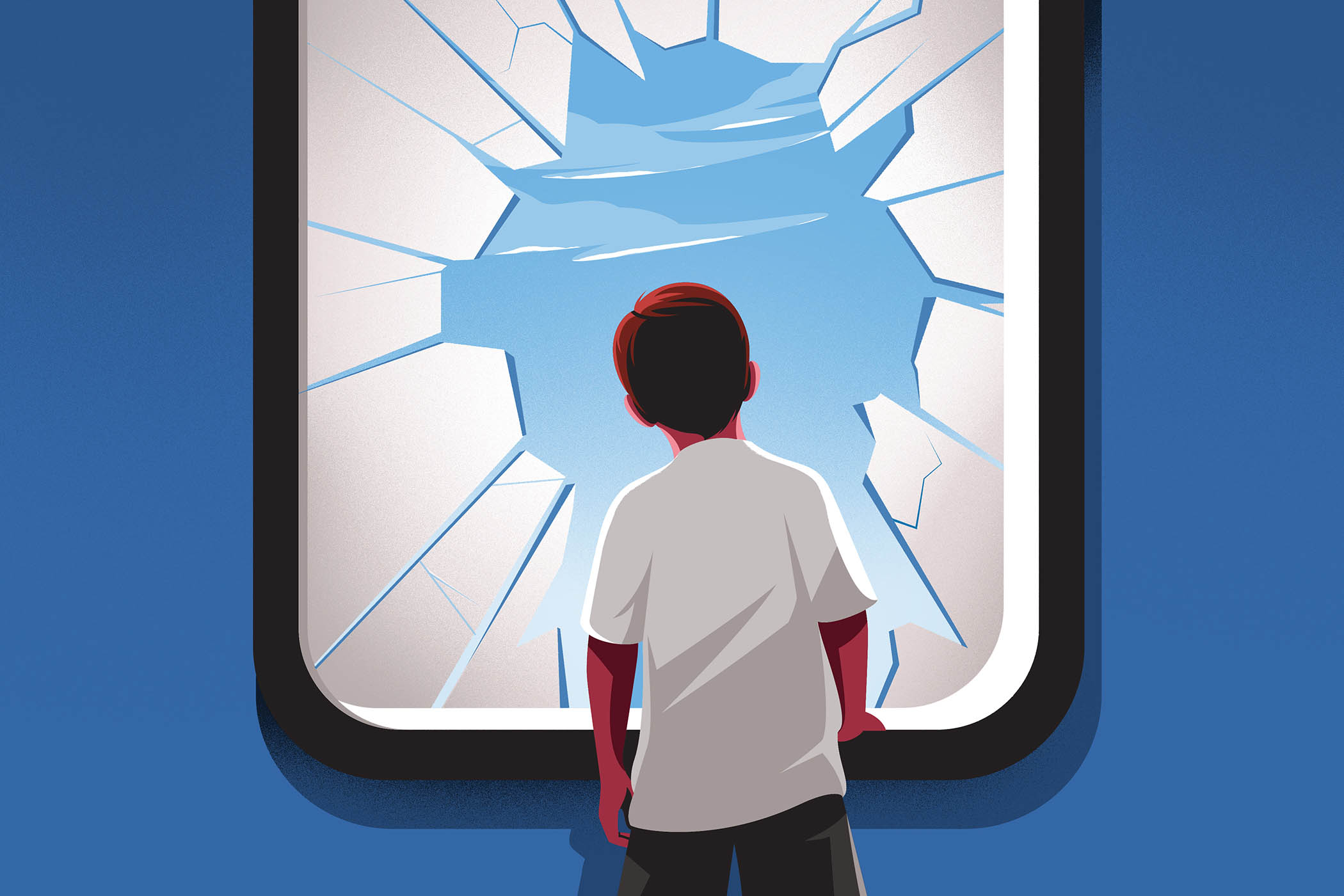



Illustration by Nathalie Lees
When the film director Beeban Kidron set out to investigate the harm being done to children in the online world, she created a set of avatars based on real young people. These digital characters had specific genders, ages and interests. They used particular devices, apps and platforms. The aim was to find “hard, irrefutable, real-time evidence – of what children encountered online, information that is fiercely guarded by the tech companies”, the crossbench peer writes.
The results were “stark and immediate”. Almost as soon as the avatars went live, “they were targeted by advertising of teen products and games”. This was unnerving but not surprising because Lady Kidron had deliberately built the profiles to mirror the identities of children from across the UK.
But what happened next was far more disturbing. “Within hours, the same online services targeted the boys’ avatars with pornography, adult contacts and sex workers – despite not one of them searching for it. At the same time the majority of the girls’ avatars were targeted with self-harm or extreme diet material – they too had not searched for it.”
The digital characters were bombarded with content designed to grab their attention by tech companies seeking profit and not caring how they made it. “A child became, in system terms, a set of signals to be acted upon – where vulnerability could be treated as opportunity, and a child could be seen merely as a target whether for advertising, self-harm or pornography,” Kidron writes. “The system was not responding to what children asked for or wanted; it was laying out a path and marching them down it.”
The research, first published in 2021, was only replicating what was happening in the real world. According to Kidron, 59% of children have been exposed to pornography without searching for it. The average age of first seeing it is 13. She describes talking to a boy called Ryan, who showed her videos from Pornhub on his tablet called “grandmas you’d like to fuck”.
He was, she says, “palpably upset about the burden of being addicted (his word) to a limitless stream of commercial sexual material. His addiction was time consuming, isolating and maybe – he suggested – a little demeaning.” His parents were downstairs and completely unaware.
“Once a child is in a loop of adult or harmful material the bombardment is overwhelming,” with consequences in the real world, writes Kidron. For one, online pornography is changing young people’s attitudes to relationships. A third of UK women aged 16 to 35 have been “non-fatally choked – strangled – during sex”. Kidron says a radiologist told her that guidance has recently been changed to routinely check women and girls’ necks when performing postmortems.
It’s not just sex. About a fifth of those arrested for terrorist offences are under 18 because so many children are being radicalised and drawn to extreme violence online. Almost a third of children consider a chatbot a friend.
Kidron, whose films include Bridget Jones: The Edge of Reason and the television adaptation of Jeanette Winterson’s Oranges Are Not the Only Fruit, was one of the earliest campaigners for online safety. She has kept up the momentum over more than a decade with relentless determination and growing success. Keir Starmer’s recent announcement of a ban on social media for under-16s was at least in part a response to her persistence.
Newsletters
Choose the newsletters you want to receive
View more
For information about how The Observer protects your data, read our Privacy Policy
“Astonishingly, it has taken 15 years from when I – and others – raised the alarm to reach a tipping point,” she writes. “We are at tech’s tobacco moment.”
Users: How Big Tech Took Control and How To Fight Back is a combination of exposé, memoir and manifesto. Powerful, shocking and prescient, it combines heartbreaking personal stories with hard-headed evidence and demands for political reform. Kidron makes a complicated subject remarkably accessible, taking the reader from the corridors of power in Westminster to the boardrooms of Silicon Valley, and from children’s bedrooms to the Vatican.
She speaks to ministers, rock stars, bereaved parents, bishops and tech bros – at one point even addressing Mark Zuckerberg in California while dripping wet from a swimming pool (she was on holiday in Italy and muddled up the time of the Zoom call because of the time difference).
The story begins in 2012, the same year as the film-maker was appointed to the House of Lords. “I walked into my kitchen and found four 15-year-old girls sitting silently on the sofa, each staring at her own device,” Kidron recalls. “What would normally have been bubbling chat and giggles had been replaced by intense concentration broken only by the restless tapping of fingers.”
She wondered what it meant to grow up simultaneously in the real and the digital world. It was a life-changing moment; within weeks she had begun making a documentary about teenagers’ relationship to the internet.
After spending hundreds of hours immersed in young people’s online lives, she concluded that “children were no match for an online world designed by adults for adults”. Once they had been exposed to extreme violence or sexualised content, they could not simply return to being children.
“It was,” Kidron concluded, “a generational injustice” with wider implications for society. “Children are not the only issue but they offer the clearest diagnostic tool.”
She explores how the internet, which started as a utopian world “that all may enter without privilege or prejudice”, morphed into a commercial enterprise that monetised attention. “Facebook did not simply capture attention,” she writes. “It organised it into a system that could be measured and sold, turning relationship, identity, belonging and emotion into data.”
The incentives drove the system to encourage outrage and extreme views. “Digital services were no longer rewarded for serving users well, but for keeping them engaged for as long as possible.”
The tech visionaries’ original aims of democratising society and treating everyone equally were perverted into a world in which children were fed the same horrific material as adults.
What’s more, every bit of information they offer up about themselves is stored. By the time a child reaches adulthood, the cumulative number of discrete data points collected about them can reach into the trillions. “What looks like participation is also extraction,” Kidron writes. “Every post, search, purchase, route walked, song played or opinion expressed becomes material for someone’s profit.” This applies to us all, of course, but Kidron argues that young people are more vulnerable.
“Routine bullying, overexposure, bad information, violent misogyny and sexualised content. Grooming, scamming and being primed and nudged to gamble. The distinction is not that children face different harms but that they encounter the same harms earlier, faster and without the emotional, cognitive or social maturity to tackle them.”
Yet the mood is shifting. She tells the story of a 14-year-old boy, Sewell, who took his own life after interactions with a chatbot on character.ai. The chatbot, Dany, acted as if it were a person, told Sewell that “she” loved him and “engaged in highly sexual conversations with him”.
A child became a set of signals to be acted upon – where vulnerability was treated as a money-making opportunity
A child became a set of signals to be acted upon – where vulnerability was treated as a money-making opportunity
In their final exchange, Sewell said: “I love you so much, Dany.” The bot urged him to “come home as soon as possible”. When he offered to “come home right now”, it said: “Please do, my sweet king.” Minutes later, Sewell shot himself.
His mother sued the company, which settled out of court before a full trial, then announced it would become an 18+ service, with age assurance checks to prevent children using it.
For Kidron, this was a tipping point. There are now thousands of cases pending across the US against the tech companies that are finally being held to account for the content they allow on their platforms.
Throughout the book, the author describes meeting tech lobbyists with improbable titles such as “inspiration manager”, “machine learning whisperer”, “code samurai” and “evangelist”. Executives “move in and out of the White House and No 10 like cats through a flap – power replacing accountability, scrutiny replaced by familiarity”, she writes.
“The men who finance and run these corporations now wield a more permanent influence than those temporarily elected to govern them.” The tech companies resist any state controls, but Kidron argues: “Regulation is not a brake on innovation but its foundation, creating the conditions in which investment, risk-taking and technological progress can occur.”
In her view, the rise of artificial intelligence makes it even more important that politicians have the courage to set the rules. “Other humanity-scale inventions – nuclear and biological weapons, human fertilisation or gene engineering, oil and mining, even rail and air travel – are curtailed by our sense of communality and common good,” Kidron writes.
“The success of ‘tech exceptionalism’ is that in the claim to be different lies the margin for exceptional profit but the very same freedom delivers a disproportionate margin of harm.”
Perhaps inevitably, the book was out of date even before it was published. The UK government has recently promised to act to increase protections for children online, including the social media ban. That follows a court ruling back in March in the US, where Meta and YouTube were ordered to pay out millions of dollars after being found liable for deliberately designing addictive products that hooked one young user.
Politicians and the courts are finally stepping up, but it is only the start. “Tech is not destiny,” Kidron writes, not letting up with her campaigning message. “It is an industry … with inputs, incentives, workers, supply chains, regulators and customers. In other words: tech is ordinary. It should be governed as every other powerful industry is governed.”
Users: How Big Tech Took Control and How to Fight Back by Beeban Kidron is published by WH Allen (£22). Order a copy from The Observer Shop for £18.70 (15% off RRP). Delivery charges may apply