

It was the witch’s finger that got us every time. My father would clamp it between his ring and little fingers and, with a wicked look in his eye, tell us the story of that wet and windy night, years before either of us were born, when he had pursued a witch through a forest. In the darkness he gave chase until, sensing he couldn’t go on much further, my father made one final leap, his arms outstretched to catch her. In desperation, he had reached for the witch’s shoulder but all he could grasp was her little finger. To his horror, he would tell us in an operatic hush, the finger snapped off, turning to stone in his hand. In a puff of black smoke, the witch was gone.
Every Christmas when we were children, my sister and I would sit, riveted, as the witch’s finger – in reality a crooked, tapering piece of flint the colour of a mouse’s back – along with other trinkets and tchotchkes, were produced from what was known in our family as the treasure box. Each item came with its own anecdote: some were brief, even throwaway; others were fantastical, baroque.
My father died suddenly in 2018, aged 75. He was a difficult man to love, though I did love him very much. But I found it far easier to lionise him. His quick wit and photographic memory masqueraded as an intelligence I so admired but which I now recognise as one that was narrower and more incurious than I would aspire to today. He was captious, often depressed and reticent, and possessed of a capacity for torpor that I am ashamed to see too much in myself. He was perhaps not the father I needed – I have spent untold energy in the years since his death seeking out and embracing father figures – but he was one who influenced and moulded me thoroughly, often in the scolding way maiden aunts and prospective wives are always threatening in PG Wodehouse stories, my love of which came from him.
Like many tricky people, he was capable of wild enthusiasm and uncharacteristic, beguiling displays of ebullience. These moments were more reliably evoked by books, music and objects than they were by people, but I came to see that the treasure box combined both; these were things that needed an audience. An auctioneer by profession, my father knew how to hold sway in a room.
The treasure box itself is black, rectangular, squat, and in my childhood it seemed always to be in need of dusting despite the 364 days a year it spent in a cupboard. It has a brass, curlicued handle in the middle of its lid, and where the word PRIVATE is embossed into the Morocco leather there are still ghostly flashes of gilding; above this word is a single ornate G. The inside of the box is lined with teal-coloured velvet and marbled paper, both somewhat war-torn. It was made by Thomas Powell of 341 Oxford Street, just about where Debenhams used to be. The box’s cylindrical lock was made by the 18th-century locksmith Joseph Bramah, which I only know because I once had to take the box to Bramah’s London shop, on a cobbled side street in Fitzrovia, when my father was convinced that one of his grandchildren had pilfered the key. It transpired he had somehow locked it inside the box.
Every year, the box’s contents could still surprise despite the fact that they never changed. Because there was no set choreography, each object took on shifting resonance depending on what preceded and succeeded it. The treasure always seemed slightly altered, like the iridescent feathers of an exotic bird.
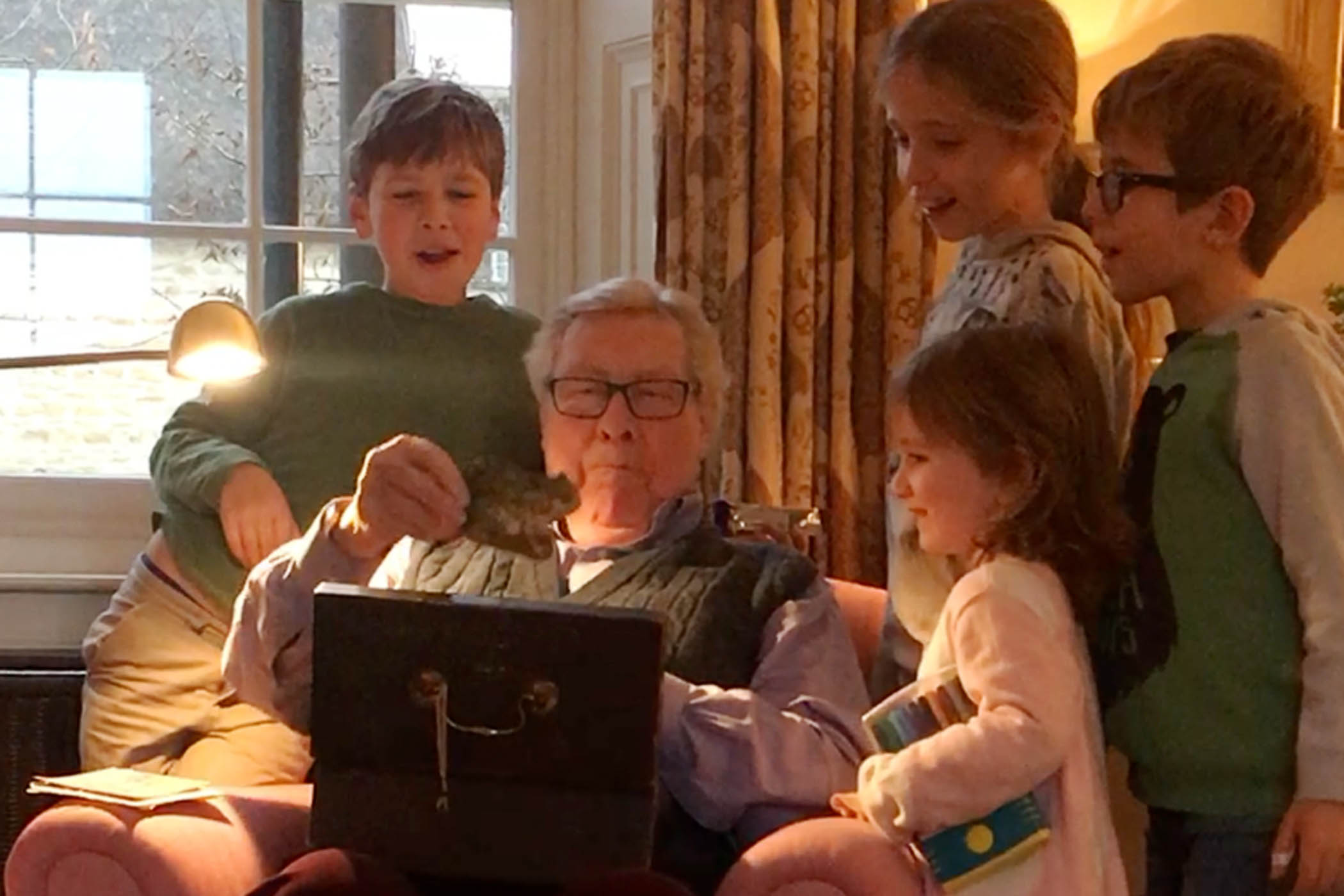
But then the annual ritual stopped. The treasure box was a part of my life until my parents’ divorce when I was nine – the box left, along with my father. In 2016, however, during the last Christmas we would all spend with him, the box made an appearance for the first time in two decades, surrounded by a phalanx of grandchildren and in-laws. I filmed all 20 minutes of the reveal, but had never watched it in full, until this year.
There was the world’s smallest Bible; a business card from a drilling company; a gold US dollar from 1852; and, of course, the witch’s finger
There was the world’s smallest Bible; a business card from a drilling company; a gold US dollar from 1852; and, of course, the witch’s finger
My father sits in a small armchair, his legs splayed awkwardly in front of him. Alice, at the time his youngest grandchild, stands expectantly to his left holding a pack of felt-tip pens. He begins with a small wind-up music box that plays the communist anthem, The Internationale, picked up on a business trip to the GDR. Next is the envelope in which he had been sent a letter from the USSR’s minister for culture, “addressed to me,” he adds with amused pride. Soon comes a coronation medal from 1952 and later there is a papal coin of some kind from 1950. “I don’t know why I got that,” he says, as if it had been pinned on him by the Holy Father himself rather than purchased in the Vatican gift shop, “but I suppose I was already on the road to sainthood.” There follow photographs of his mother and uncle as children in 1916; a Turkish officer’s cap badge, “straight from Gallipoli”; several Brotmärke, German government-issued bread coupons, to Alice’s great fascination; a letterhead stolen from the desk of “some duke or other … this stuff is mostly all nicked” (it turned out to have been from Blenheim Palace, probably while some unassuming tour guide’s back was turned); a pair of 18th-century pince-nez; a bone-handled fruit knife he claims to have found “fossicking in a golf bunker”; the world’s smallest Bible; a business card from a Crawley-based drilling company bearing the slogan “Rough Diamonds, For All Industrial Purposes”; a gold US dollar from 1852; assorted gaming chips; a lodestone in a shagreen box; various pieces of broken slipware; another business card, this one from a man with the same name as him who he’d sat next to on a flight to America; and, of course, the witch’s finger.
My father was, demonstrably, a magpie – a man whose many and catholic enthusiasms meant that he fell somewhere between a collector and hoarder. For the collector, a collection is a way of giving order to the randomness of the world, and of staving off anxiety. From the outside, a collection can come to seem more like a portrait of its keeper, each object a brushstroke.
A few years ago we finally cleared my father’s house and since then I have been the box’s keeper. In all that time, I have not opened it. To do so I think would have been to come face to face with what I’d lost. With every year that’s passed, I’ve felt more content to let the past – to allow the loss – to fester. It seemed easier than the alternative.
Newsletters
Choose the newsletters you want to receive
View more
For information about how The Observer protects your data, read our Privacy Policy
In August this year, while my partner and I were in Munich visiting friends, our house was burgled and the treasure box was ransacked. There was little of real monetary value in the box, save perhaps for the gold dollar. The burglar had made a midden of my room, rucking over rugs, emptying draws and boxes, breaking things for sport. Seeing the box cast aside, with only a few things left in it, was a moment of acute agony and shame – a loss repeated. A lifetime’s fascination had been undone in a few minutes of reckless vandalism.
It was a few weeks later that I watched the video for the first time. Filmed less than a decade ago, the footage felt much older. Many of my father’s grandchildren who are just young kids in the film are now young adults, studying abroad, even beginning to collect things themselves. Two more grandchildren have been born, neither of whom have yet heard of the treasure box, let alone heard their grandfather’s voice. Watching the film, I expected to be filled with sadness. But my overwhelming feeling was of a deep, nostalgic pleasure. I don’t mean to say that I’m glad I was burgled, but it has made me realise that the beauty of those things contained in the box existed not in the objects themselves but in an alchemy that required the box, my father, and all of us to be present. The film is at least a record of that, a more eloquent expression of what we have lost than a box full of curios and oddities could hope to be.
In my mind, the box had come to represent my father: closed off but packed with hard-to-access jewels. Both may now be gone, but the joy they brought remains. This is the way I want to remember the treasure box. This is the way I want to remember him.
Photograph courtesy of Orlando Whitfield