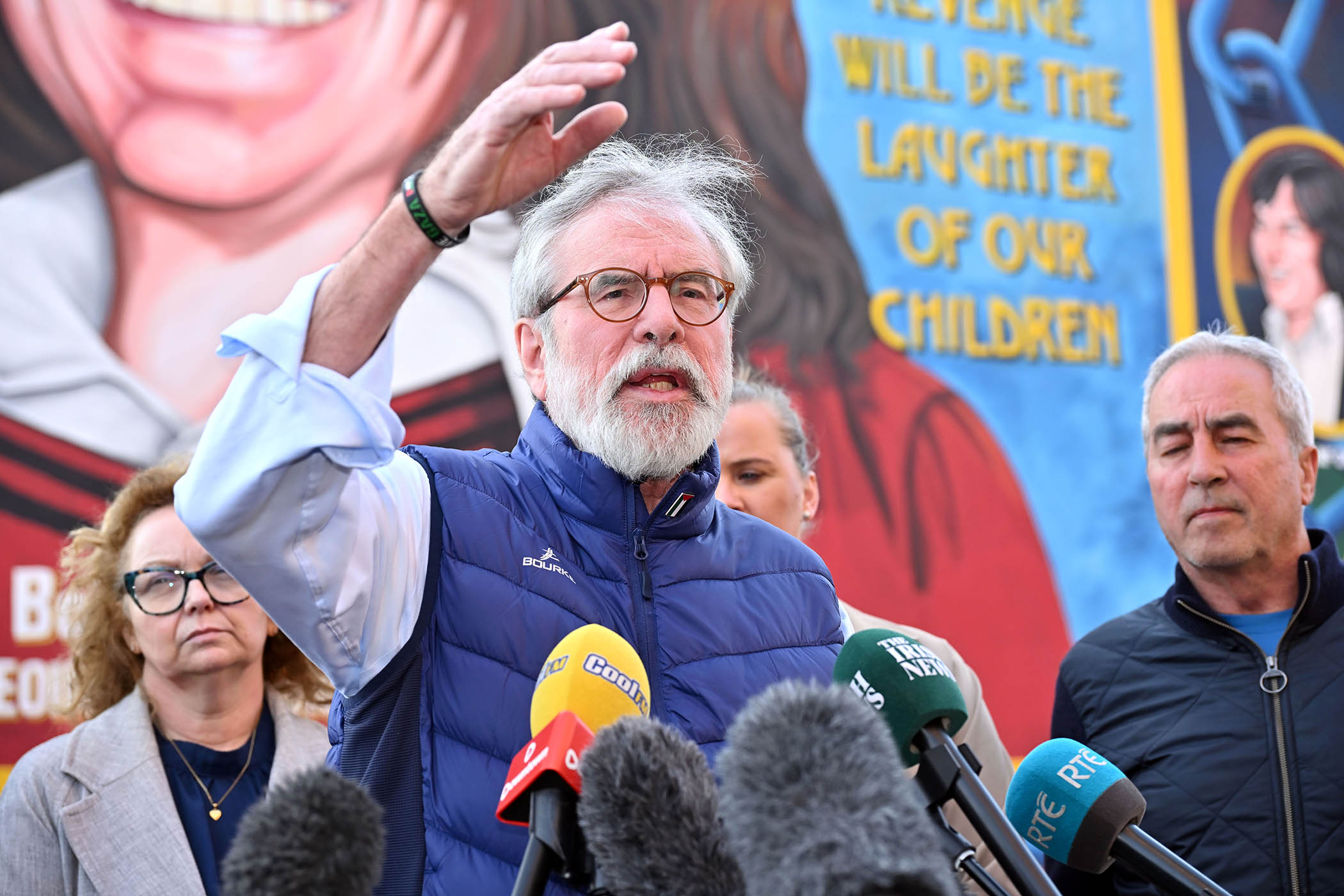


“I attended the case in London out of respect for the claimants,” Gerry Adams said after the civil case for damages against him collapsed.
Really?
At Adams’s side was Gerry Kelly, one of the IRA bombers who in 1973 inflicted a lifetime of grievous pain and suffering on John Clark, one of the claimants.
A large piece of metal tore into Clark’s foot when Kelly and others bombed the Old Bailey, killing one man and injuring more than 200.
Adams didn’t claim victory outright, but in welcoming the “emphatic end” of the claim by Clark and two other injured victims of IRA bombings in 1996, he came close.
Sinn Féin has spun the collapse as another defeat for “British establishment” attempts to secure a court judgment that he was the IRA’s warlord during the conflict, something Adams has always vehemently denied. “The case should never have been brought,” he said.
However, Adams didn’t get a judgment on the evidence.
Instead, after all the evidence had been examined, Mr Justice Swift said he wanted to consider a procedural point: whether the claimants had misused the courts by turning their claim that Adams was liable for the three bombings into a proxy for a quasi-public inquiry into his past.
It was sometimes hard to know whether Gerry Adams was floundering or playing for laughs
It was sometimes hard to know whether Gerry Adams was floundering or playing for laughs
The claimants’ legal team told the judge any suggestion of “abuse of process” was wrong in law and fact. Nonetheless he insisted on considering this possibility, however remote, even though Adams’s lawyers hadn’t pleaded this and had also made it clear at a preliminary hearing that they didn’t intend to.
Had the claimants lost on this point, they faced a potentially life-changing risk of being liable for Adams’s six figure costs whereas they’d been protected against costs had they lost on the evidence because they were only seeking £1 damages.
Newsletters
Choose the newsletters you want to receive
View more
For information about how The Observer protects your data, read our Privacy Policy
And on the issue that Adams has spent almost 50 years denying – not just IRA membership but also his dominant role in it – there was a rich evidential seam. Declassified government documents presented to the court refer to Adams having been “involved at the highest level in devising PIRA [Provisional IRA] strategy” and at “the nerve centre of the PIRA”.
Declassified Irish government papers told an identical story from their own well-informed sources.
The court heard that Adams’s lawyer Paddy McGrory had confided in Irish government officials that Adams’s influence was such that “whatever Adams says, the Provos will eventually do”. In 1988, McGrory also said Adams had “a firm grip on Sinn Féin and the IRA. Adams comes from the IRA and knows the IRA.”
Was that “an accurate description of the power that you had,” asked the former director of public prosecutions (DPP) Sir Max Hill KC.
A: “Not at all.”
Q: “If it’s not accurate, why would Mr McGrory, who acted for you, say something that wasn’t accurate?”
A: “Well, first of all, you don’t know if this is actually what he said. And Paddy McGrory has died since so …it’s not accurate.”
Q: “This is not a British government document. It’s a meeting in Belfast with the solicitor.”
It was sometimes hard to know whether Adams was floundering or playing for laughs. Asked if a newspaper photograph captioned “Gerry Adams the most important man in Ulster” was him, he replied: “I don’t know if I recognise myself.”
Asked if he recalled whether one of those arrested for the IRA’s 2004 £26.5m Northern Bank robbery was a “man called John Trainor”, Adams replied: “I don’t know.”
Q: “Do you know this John Trainor?”
A: “Not to my recollection.”
Q: “He’s the head of your private security team that accompanied you to this court.”
A: “Oh, Big John here?”
Q: “Big John. That’s John Trainor.”
Asked if eight named men and women well known to have been in the IRA were known to Adams as IRA members, he answered variously: “I don’t know” or “Not to my knowledge” or “I don’t know his status” – this despite the fact that three of them were convicted for the Old Bailey bombing.
Adams said he’d “always come clean” about his past, insisting he was “always a [Sinn Féin] political activist”, never the IRA.
If ever the full transcripts of his two-day cross examination are published, one possible explanation for Adams welcoming the “emphatic end” of the trial will become clear: he was spared a verdict on the evidence by a last-minute procedural point.
Photography by Oliver McVeigh/PA Wire