Azad was driving on the outskirts of Tehran when a car filled with plainclothes police officers suddenly motioned for him to pull over. The 37-year-old estate agent tried to keep his cool as he handed over the papers they asked for, until his phone pinged with a notification. Having internet access when a ban was in force instantly marked him as a potential dissident – and now a suspect.
Security forces seized his phone and saw he had subverted a state internet blackout, making use of the messaging app Telegram and even Instagram. Then they spotted videos of sites destroyed by American and Israeli bombs – material his loved ones fear could be used to brand him an enemy of the state. Azad was led away from the checkpoint and into the bowels of Iran’s detention system. His name has been changed for his protection.
When the US and Israel launched their attacks at the end of February, Donald Trump promised an end to the regime in Tehran that had killed thousands of anti-government protesters who rose up in January. Trump last week claimed victory, arguing that regime change had taken place: “We deal with a much different regime than before. We’re dealing with different people. They're smarter, I think they're sharper and far less radical,” he told reporters.
The reality is very different. Iranians interviewed by phone and over messaging apps fear an increasingly hardline version of the regime is now emerging, emboldened after surviving the American and Israeli assault, while discovering new ways to wield power in the Middle East and across the global economy. Several weeks before the war, Trump boasted he had prevented more than 800 protesters from being hanged in Iran, but last month in the seminary city of Qom three men arrested during the demonstrations were hanged as a crowd looked on.
“We are dealing with a regime that is not pretending it has any legitimacy and is struggling for political survival. The only thing it can do is increase the repression and create more fear,” said Mahmood Amiry-Moghaddam, director of the Norway-based non-governmental organisation Iran Human Rights. “From executions to this massive wave of arrests, targeting the kinds of people who wouldn't have been arrested a year ago. They are enacting their brutality openly.”
At least 1,500 people have been arrested in Iran since the war began, according to the US-based Center for Human Rights in Iran, citing Iranian government statistics. Human rights groups have reported waves of raids and arrests, targeting anyone from known activists and students to members of Iran’s many ethnic minority groups and ordinary citizens using the internet.
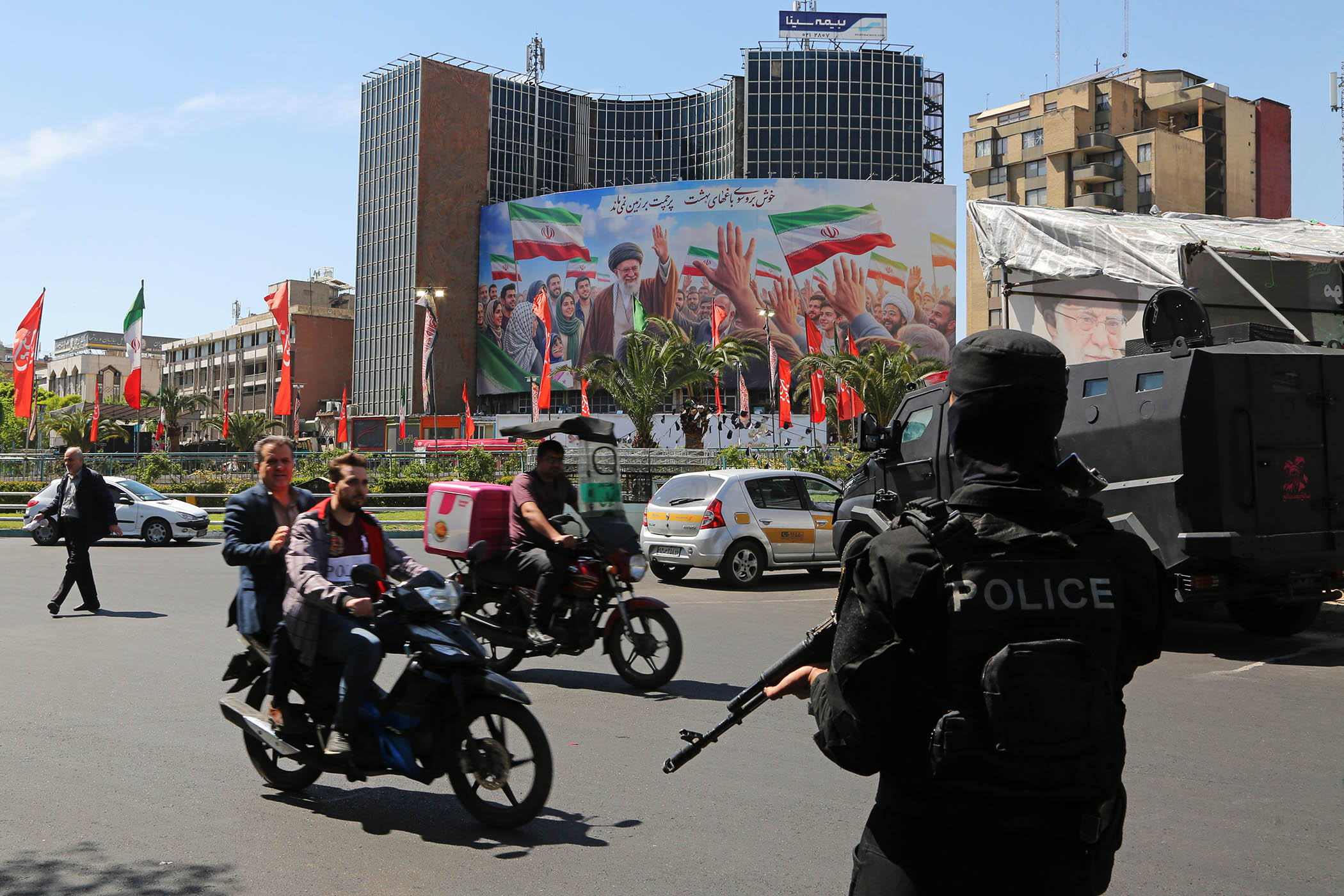
Members of the Basij, the paramilitary force of the Islamic Revolutionary Guard Corps (IRGC), now line checkpoints filling the streets – some even manned by children. Amnesty International cites eyewitnesses and video showing child soldiers deployed at IRGC checkpoints and in patrols, some armed with automatic rifles. Last month, Rahim Nadali, an IRGC official in Tehran, announced a recruiting campaign to swell numbers, declaring anyone aged 12 and above could register at Basij bases or in mosques to join “combatants defending the homeland”.
It took 10 days for Azad’s friends and family to learn he had been taken to the Greater Tehran Central Penitentiary – the largest in Iran and the same place he was held after joining protests in 2022. His bail was set at the equivalent of £26,000, a price far beyond what most Iranians can pay.
“We are very worried for him because he was also arrested in 2022, which increases the risk. As he has videos of the destruction on his phone and he was connected to the internet, they can easily accuse him of espionage based on what we see these days,” said Azad’s friend Ali Ghasemi, who met him in prison in 2022 and is now in exile. Ghasemi fears for his friend’s return to brutal prison conditions and that, in the current climate, he could easily face the death penalty.
At least 50,000 people were detained for protesting in January: the blackout has left monitors such as Amiry-Moghaddam unable to track them in Iran’s sprawling detention system, even as prisons such as the one where Azad was taken have been hit by airstrikes. At least 14 people have been executed in recent weeks, including protesters and six people accused of being members of the Mujahideen-e Khalq dissident group. “We estimate that hundreds of protesters are facing charges that carry the death penalty,” he said. “We fear the execution of more protesters and more political prisoners."
Newsletters
Choose the newsletters you want to receive
View more
For information about how The Observer protects your data, read our Privacy Policy
The Iranian authorities arrested 21,000 in the aftermath of the 12-day war with Israel last year. It was also a record year for executions: more than 2,000. With the regime reeling after recent protests, Amiry-Moghaddam fears this new round of reprisals. “This is a regime that’s incompetent, including at governing the country, but what it’s good at is asymmetric warfare,” he said. “They have nothing to offer people, and the only way to hold on to power is to escalate the repression: the death penalty is the main instrument to create fear.”
Even some who survived Israeli and US airstrikes said they feared what the aftermath of Trump’s ceasefire would bring for those living under the regime. Arash, a 26-year-old video editor, described how he had gone to a remote area outside Tehran during the Nowruz holiday to mark the Iranian new year when a building nearby was targeted without warning: he was trapped underneath the rubble for hours, periodically losing consciousness and fearing the extent of his injuries.
Living among checkpoints manned by heavily armed teenagers or even children was suffocating, he said, making it impossible to go from one part of the capital to another without being stopped multiple times for inspection. The idea that Trump could leave the Iranian people to deal with this on a daily basis appalled him. “Why would you start a war, saying you want to destroy the Islamic Republic, then declare a ceasefire with them still in power?” he said via a messaging app. “Their threat, not just to their own people but to the world, has only got bigger.”
Photograph by Fatemeh Bahrami/Anadolu via Getty Images