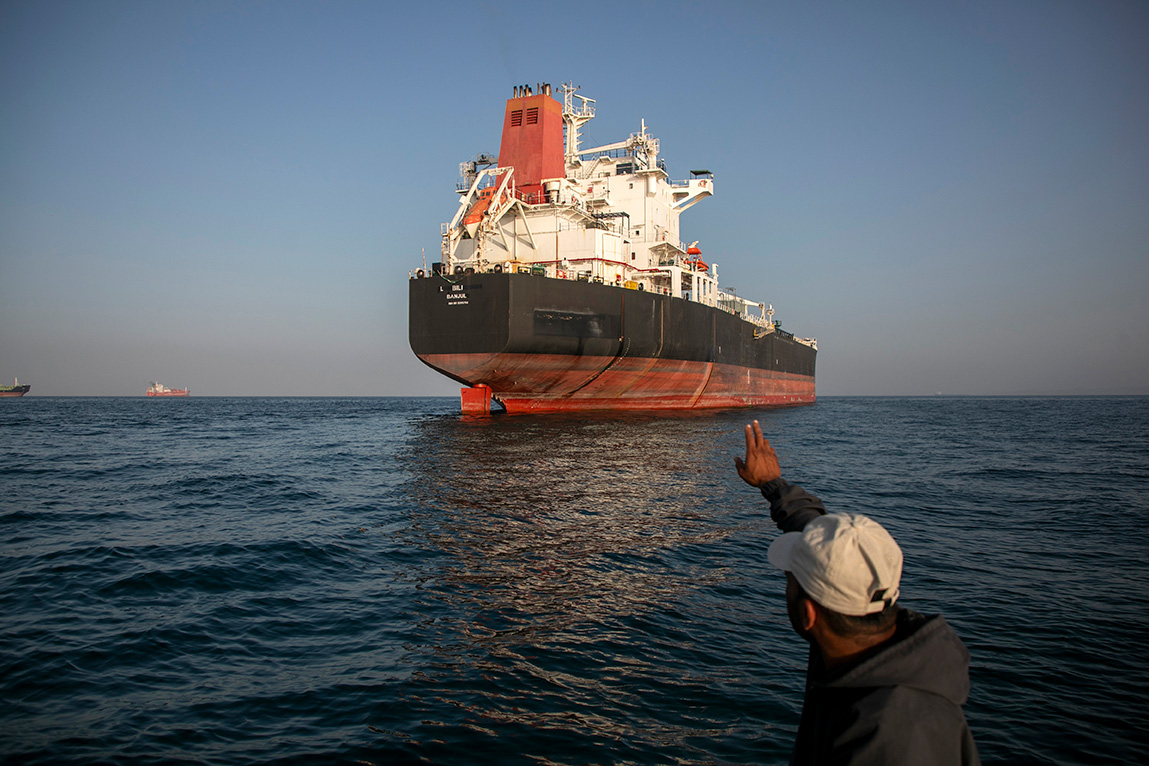

It took weeks of negotiations, a message passed via the South Korean embassy in Tehran and preparations inside Seoul’s largest shipping company for the Universal Winner to cautiously set sail. The South Korean supertanker had sat in the waters of the Persian Gulf, laden with Kuwaiti crude, for more than two months. Early last Tuesday morning, the 300,000-tonne vessel edged out of Qatari waters, carefully navigating around Larak Island in the Strait of Hormuz – and sailed for the South Korean port of Ulsan carrying 2m barrels of oil.
As talks between Washington and Tehran sputter forward without results, Iran is moving to cement its control over the strait – a waterway that normally carries a fifth of the world’s oil and liquified natural gas. Tehran is forcing countries to negotiate transit for their vessels, or face $150,000 in fees paid in Chinese yuan. Tehran is even eyeing control below the waterline, threatening to “charge fees” for key subsea internet cables that run through the strait.
Officials in Seoul insisted they did not pay for the Universal Winner to cross the strait, but foreign minister Cho Hyun told a parliamentary committee there had been “consultations with Iranian authorities”, and the tanker used a route out of the waterway set by Tehran. Iran claims to have established the Persian Gulf Strait Authority (PGSA) to formalise its grip on the waterway and is threatening to collect tolls. Last week the PGSA published an audacious map claiming control over a broad area that extends to the Omani and Emirati coastlines.
The Institute for the Study of War said such fees are “in reality part of a mafia-esque protection racket”. Iran is demanding payment to secure against attacks by its own navy, missiles or drones – which earlier this month struck another Korean tanker in the Persian Gulf, the HMM Namu, puncturing its hull and starting a fire. Such threats have proved effective at forcing Iranian control of the strait: at least 16 vessels including the Universal Winner used the Iranian-approved route to transit the waterway last week, but none admitted to paying a toll.
Dina Esfandiary, an expert on the Middle East at the thinktank Bloomberg Economics, pointed to the low cost to Tehran to “hold the strait hostage” using speedboats armed with guns, small wooden vessels, and cheap drones that have caused havoc across the Persian Gulf.
“It really doesn’t require much because commercial shipping is risk averse and companies don’t want to test what Iran has or hasn’t done – while at the other end it’s expensive for the US to open it up,” Esfandiary said. “It’s also easy for the Iranians to disguise payments under other agreements or bilateral deals – it doesn’t have to be a toll. If they can establish control by getting countries to coordinate with them, they may say no payment is required.”
Even the PGSA remains shrouded in mystery: it is unclear whether it is much more than a menacing social media account or an email inbox to send out spreadsheets of demands to ship
‘It’s easy for the Iranians to disguise payments under other agreements or bilateral deals – it doesn’t have to be a toll’
‘It’s easy for the Iranians to disguise payments under other agreements or bilateral deals – it doesn’t have to be a toll’
Dina Esfandiary, Bloomberg Economics thinktank
operators including details about their ownership, crew, cargo and insurance. When contacted by The Observer to ask about fees and transit requirements, the PGSA referred questions to its X account.
Esfandiary said there appears little need to make an effort to formally open and staff an office when the threat of an institution to control the strait works just as well – and is an easy way to test the limits of what they can get away with. “This is a war of words fought on X so why not add this to the mix?” she said.
This month Iran’s military spokesperson Ebrahim Zolfaghari added to this war of words, declaring in a post that Tehran would “charge fees on internet cables”, referring to five submarine internet cables that run through the strait. Tasnim, a news outlet with ties to the Islamic Revolutionary Guard Corps, suggested Tehran could charge licensing or other fees from internet companies such as Microsoft or Google, and demand exclusive rights to their repair.
Newsletters
Choose the newsletters you want to receive
View more
For information about how The Observer protects your data, read our Privacy Policy
The International Cable Protection Committee (ICPC), a consortium of cable operators and owners looking to safeguard the undersea internet infrastructure, attempted to preach caution in the face of Iranian threats – particularly because Tehran is unlikely to find a way to charge companies to use existing cables. John Wrottesley of the ICPC said that while the committee is forced to take Iran’s threats seriously, the cables are normally “well protected, buried and routed away from particularly hazardous areas”.
There is risk should anyone wish to lay new cables or repair existing ones – because this overlaps with Iranian efforts to physically control access in the strait. “It’s a wider maritime issue: if there are restrictions to all vessels in the strait then cable-repair ships fall into that category,” he said.
Esfandiary said Iran’s efforts to control the strait are part of its preparations in case fighting resumes. “Both sides are trying to lay out what kind of leverage they have and how far things could escalate, including what they can threaten in case negotiations don’t succeed,” she said.
Photograph by Majid Saeedi/Getty Images