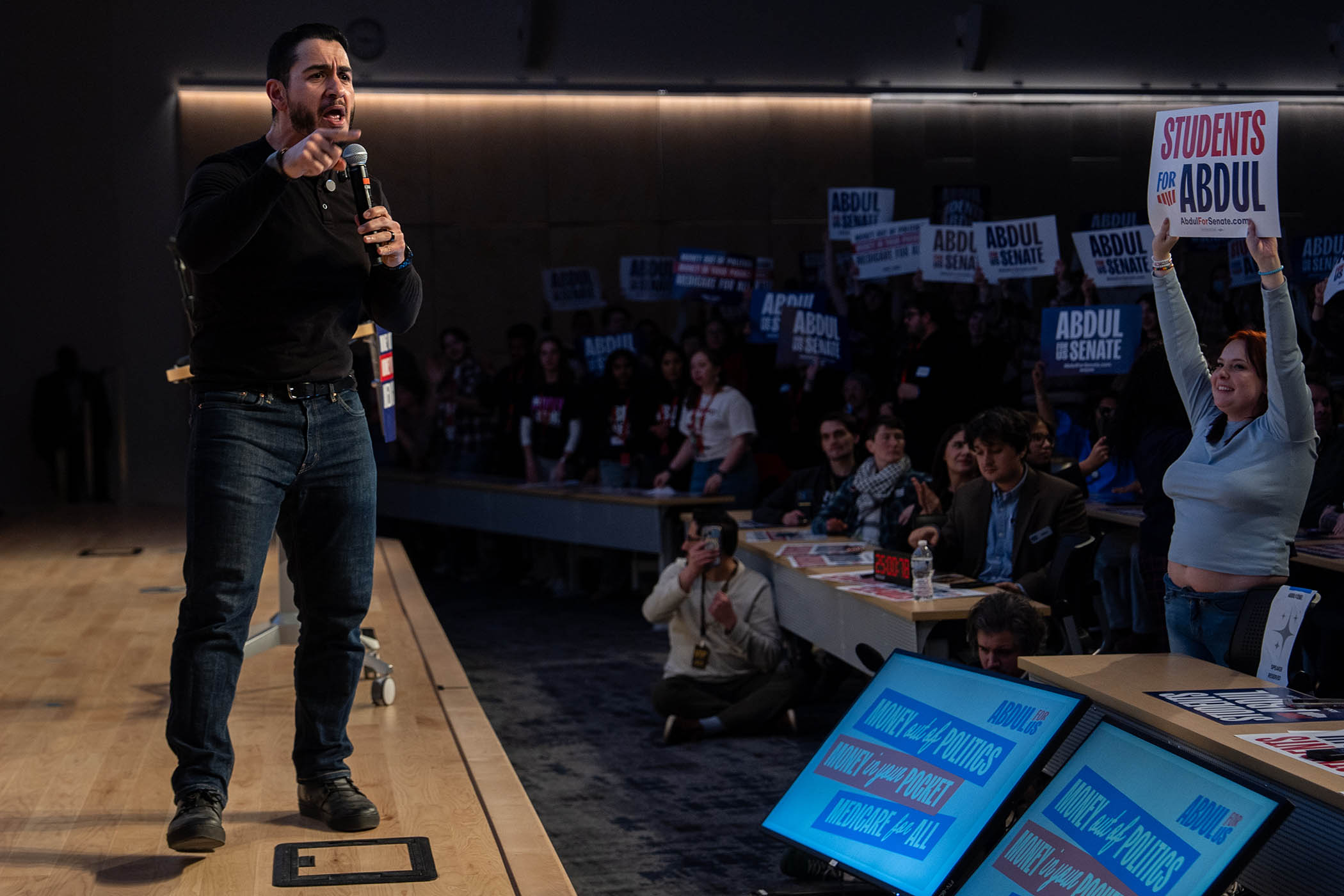



In a stuffy hall at a Michigan recreation centre last week, there was a burst of applause as Abdul El-Sayed addressed the money and political power arrayed against his upstart campaign for US Senate.
“I want them to torch 30m of their dollars and lose. And then I want them to torch another 30m dollars in the general and lose again,” he told the audience in Dearborn Heights, a suburb with a large Muslim population on the outskirts of Detroit.
“Because at the end of the day, you’ve got to choose between money and the truth,” he went on, turning on critics in his own party who fear his progressive agenda could jeopardise their slim hopes of taking back the Senate majority.
“Pick the truth, and if you do, people will follow,” he added. “Unfortunately, I think… that’s something Democrats haven’t figured out.”
The son of Egyptian immigrants, and a former Michigan healthcare official, Sayed has come up on the rail to lead a contentious three-way Democratic Senate primary, to the dismay of party leaders. If elected, he would be the first Muslim senator in US history.
His surge in the polls has drawn inevitable comparisons with another Democratic socialist, Zohran Mamdani, who defied the party establishment to become the first Muslim mayor of New York City in a landslide last year. Lacking Mamdani’s soaring rhetoric, Sayed compensates with bluntness and moral urgency.
In front of a sympathetic crowd of disillusioned Democratic voters in Dearborn last week, he fielded question after question on America’s political rot, waving away aides who tried to wrap up the event.
The primary pitches the leftwing policies of Sayed, 41, against centrist congresswoman Haley Stevens and state lawmaker Mallory McMorrow, who occupies the pragmatic, soft-left ground between them. All three have led in polls since the start of the year. The winner in August will face Republican Mike Rogers in November’s general election.
In another time, the high-profile contest between three young Democrats would have underscored the party’s wealth of emerging talent. Instead, the Michigan primary has revealed a party still at war with itself, unsure of the path forward almost two years after its crushing defeat to Donald Trump.
‘Trump has been the greatest gift to people who do not want the Democratic party to fundamentally change’
‘Trump has been the greatest gift to people who do not want the Democratic party to fundamentally change’
Abdul El-Sayed
All three candidates are backed by different Democratic factions, laying bare the unresolved schism between the progressive and centrist wings of the party. “This race could get very ugly between now and August,” one local Democrat operative said.
Newsletters
Choose the newsletters you want to receive
View more
For information about how The Observer protects your data, read our Privacy Policy
Sayed, who is endorsed by prominent progressives including Bernie Sanders, is scathing of Democratic leaders still cleaving to the political centre, hoping that opposition to Trump alone will return the party to power without offering a bold vision to voters.
“I hate to say it, but Trump has been the greatest gift to people who do not want the Democratic party to fundamentally change,” Sayed told The Observer in an interview in Detroit last week.
“They can always point to him and say, ‘Well, we can’t possibly think different, because how are we going to beat him?’ It’s exactly the same thing they’re trying to do to me in this race… because I actually offer something different.”
On the stump, Sayed campaigns for driving corporate money out of politics, hiking taxes on billionaires, Medicare for all and abolishing the US Immigration Customs and Enforcement (ICE) agency spearheading Trump’s mass deportation scheme.
Democrats remain favourites to regain the majority in the House of Representatives at November’s midterm elections. But Trump’s historically low approval rating has also raised their hopes of snatching control of the Senate. To do so, they must flip four Republican-held seats and hold all of their own, including the Michigan seat vacated by Democrat senator Gary Peters, who is retiring.
In an election that will be a referendum on Trump, holding Michigan should have been straightforward. But Democrat grandees fear that Sayed’s radical populism could scare off swing voters in a purple state that voted twice for Trump in 2016 and 2024.
Confronting the issue dividing both major parties, Sayed has condemned Israel’s war in Gaza and its current offensive in Lebanon as genocide, and pushed for the US to halt military aid to the Jewish state. He has campaigned with leftwing streamer Hasan Piker, who has faced allegations of antisemitism for declaring that Hamas is “1,000 times better” than Israel. Nothing so far has blunted Sayed’s rise in the polls.
Under the old political order, Stevens would have been a shoo-in. A three-term congresswoman who served in Barack Obama’s administration, she is backed by the big beasts of the party, including former House speaker Nancy Pelosi and Senate leader Chuck Schumer.
But those endorsements are no longer an asset to a Democratic base that has shifted left in the past two years, infuriated by the 2024 defeat and the timid leadership in Washington that has struggled to take on Trump since he regained the White House.
Schumer has reportedly urged party donors to get behind Stevens, arguing she is the stronger general election candidate. But his support has prompted its own backlash. At a Michigan Democrats’ convention in April, Stevens was roundly booed.
Stevens is also a vocal supporter of Israel in a state with the one of the highest concentrations of Muslims in the US. She has previously described herself as a “passionate Zionist” and said that “Israel comes to me in my dreams.”
While leaders in Washington fear Sayed, in the Dearborn region it is Stevens who is seen as the electoral liability. The area is scattered with mosques, Muslim community centres and restaurants from across the Islamic world. Many have family in Palestine and Lebanon. Some have lost relatives in the Israeli offensive.
Voters in communities such as Dearborn were pivotal to Joe Biden’s 2020 victory over Trump in Michigan. Four years later, tens of thousands turned against the Democrats in protest at Biden’s support for Israel’s destruction of Gaza.
Trump won Dearborn by six points as he flipped Michigan and took back the White House. Kamala Harris won only 23% of votes in Muslim-majority precincts, compared to Biden’s 88% in 2020.
“Hell will break loose if Haley Stevens gets even one vote from this community,” said Osama Siblani, the publisher of the Arab American News, based in Dearborn, and an outspoken voice on the Middle East. “Abdul El-Sayed is an Arab American. He is a son of this community and we support him 100%.”
Siblani admitted that some in the area regret” their protest vote against Harris as Trump and Israel drag the US into another Middle East war. But he said the anger at her refusal to distance herself from Biden on Gaza still simmered and the community is “disenchanted with the Democratic leadership”.
Proving his point, the Democratic National Committee released its long-awaited autopsy of the 2024 defeat to widespread fury in May. Suppressed for months, the report that finally emerged made no mention of Gaza or Israel, or their impact on the 2024 campaign.
DNC chairman Ken Martin now faces calls to resign, and the fiasco cemented the impression that Democrats still cannot agree on why they lost, let alone chart a united path forward.
Sayed told The Observer that Gaza remains “a Rorschach test for the party” with Aipac, the pro-Israel lobby group, set to funnel tens of millions of dollars into the midterms in support of its preferred candidates, including Stevens.
He laments that Democratic leaders are out of step with the base, which has shifted firmly away from Israel. A recent New York Times/Siena poll found that three-quarters of the party’s supporters now oppose US military aid to Israel. In a landmark shift, 60% said they were more sympathetic to Palestinians, while 15% were more supportive of Israel.
“Most Democrats won’t take a stand because they’re afraid… We send our money abroad to drop bombs on other people’s kids instead of investing it here in our schools,” he said. “That’s why it’s relevant, and I hear it everywhere.”
In his Dearborn rally, Sayed fielded a string of questions about Israel’s influence on US politics. He gave a withering account of Democratic colleagues who “pull me aside and are like, ‘You’re so courageous. I wish I could say what you say.’”
Sayed gained further momentum on 5 June when he secured the coveted endorsement of the United Auto Workers union, an influential voice in “Motor City”, still the heartbeat of America’s car industry.
“He’s got that in-your-face kind of style that appeals to a certain side of our members. He’s everywhere. He comes to every union function,” said Chad Fabbro, the UAW’s financial secretary.
“A lot of our members just feel like they’re forgotten or left behind by both parties. They don’t know how to vote any more. They feel like the rules have changed, so they’re ready to try something different.”
Sceptics point to polling earlier this month. All three Democratic candidates beat Rogers in head-to-head contests, but while Stevens led the Republican by 48% to 41%, Sayed led by a single point, 43% to 42%. That has crystallised fears among leaders that they are risking a Senate majority on an unelectable candidate.
‘He’s got that in-your-face kind of style that appeals to a certain side of our members. He comes to every union function’
‘He’s got that in-your-face kind of style that appeals to a certain side of our members. He comes to every union function’
Chad Fabbro, United Auto Workers
Those concerns have deepened as another progressive Democrat campaign threatens to implode in Maine, one of the party’s other must-win Senate seats.
Graham Platner, an oyster farmer and former marine, has already shrugged off a string of scandals, including an alleged Nazi tattoo, to secure the party’s nomination. But further lurid allegations by several ex-girlfriends in recent days could sink his candidacy and Democrat hopes of unseating Republican senator Susan Collins. In a poll last week, Platner’s lead over Collins had shrunk to a single point. A month ago, he led by as many as nine.
Sayed is braced for the same media onslaught in Michigan. Aipac released its first round of TV ads in support of Stevens last week.
“I know what’s coming for me. Aipac… is going to train fire at my face on TV,” he told The Observer. “My job is to make sure that people know who I am, so that when they hear those lies, they understand why those lies are being told.”
The hand-wringing over Sayed and Platner’s insurgent campaigns underlines the Democrats’ identity crisis and the rift between the base and the leadership. Supporters on the left are sick of leaders demanding they fall in line behind moderate candidates who ultimately disappoint.
“Democrats have failed to define themselves in the post-Obama generation and now they’re prepared to look at anyone or anything that could give them a new look,” said Hank Sheinkopf, a veteran Democratic strategist and former adviser to Bill Clinton.
“They’re focused on anti-Trump and anti-Israel because that seems to fit the moment. They don’t know who they are and the Republicans do. The Republicans are the party of Trump, the Democrats are the party of chaos.”
Photograph by Julia Demaree Nikhinson/AP Photo