
This article is part of the Rory Smith on Football newsletter – a guide to help understand what is happening on the pitch, off the pitch, and why all of it matters.
Throughout the tournament, Rory will be travelling across America, delivering daily commentary on the biggest World Cup ever direct to subscribers. His colleague George Simms will report alongside him. Never miss a newsletter, subscribe now here.
Hidden away inside the Seattle Stadium are seven seismic sensors. They were installed in January, when the city’s NFL team, the Seahawks, began their run to victory in the Super Bowl. The Pacific Northwest Seismic Network (PNSN), the scientists whose job it is to monitor geological activity, said it was a “fun way” to remind locals they live in “earthquake country.”
There is one sensor in each corner of the stadium’s third tier, one at the mouth of the tunnel, and another couple in the Hawk’s Nest, the diamond-shaped half-stand that sits at one end of the stadium. They will all be removed once the World Cup is over, but there is a permanent detection station not far away. This is, as the PNSN wants people to remember, an active zone.
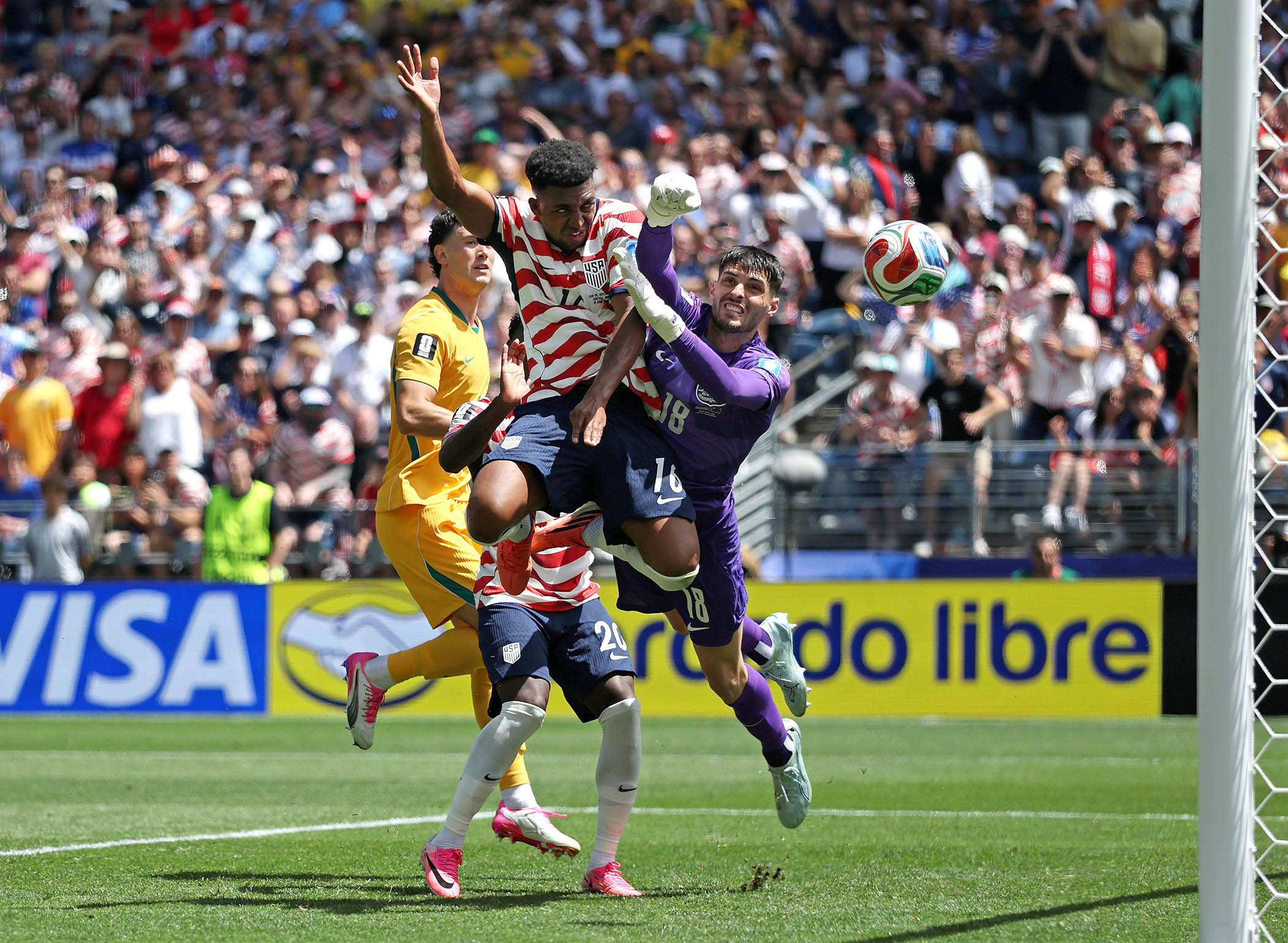
Yesterday, at 12.10 and 42 seconds, the seismograph recorded a sudden lurch. It was not assigned a magnitude, as Professor Harold Tobin of the PNSN explained, because it was technically not an actual earthquake. But a glimpse at the graph makes it clear that, in a very real way, the own goal that gave USA the lead against Australia did make the earth move.
There has been a tectonic mood shift around this tournament’s principal host over the course of the last 10 days. USA, in truth, arrived at the World Cup caught somewhere between natural anxiety and outright despair.
Results during Mauricio Pochettino’s tenure had been patchy. There had been a not insignificant tension with his star player, Christian Pulisic. The manager seemed to be casting his eyes elsewhere: back to Tottenham, for a while, and then AC Milan. There were genuine doubts over whether USA would get out of its group.
A week and a half later, they have won it with a game to spare, the second of the three hosts to make it through unscathed. They can start planning for their round of 32 game in San Francisco on July 1.
The style in which they have done it, though, is significant. The victory against Paraguay felt like a watershed, a moment when football indisputably captured the imagination of the broader American public: videos flowed in of celebrations in not just from the cities that are involved in the World Cup but Detroit and Columbus and Hartford, Connecticut, too.
Dispatching Australia, a performance not quite as spectacular or thrilling but just as impressive for its surgical efficiency, has compounded that effect. In Seattle yesterday, it was not just the 70,000 or so inside the city’s stadium who were transfixed by the game; red-and-white striped shirts, the pattern just asymmetrical enough to induce nausea, thronged bars and clustered in front of big screens. It felt like the whole place had come to a standstill.
Newsletters
Choose the newsletters you want to receive
View more
For information about how The Observer protects your data, read our Privacy Policy
That is, regardless of whether you have any personal affection for the USA men’s national team or the country it represents, probably in the best interests of the tournament itself. World Cups, as a rule, are improved by the continued engagement of the hosts.
It is an uneasy example to use now, but Russia’s run to within a whisker of the semifinals in 2018 illuminated that tournament, just as Germany’s adventure to the semi-finals in 2006 was a key plank in what remains probably the paradigmatic “good” modern World Cup.
But it is also important for those fans who made so much noise that it shook the ground. USA have not won a knockout game at a World Cup since 2002; reaching the quarter-finals, that year, was the country’s best performance in this tournament since its inaugural edition, all the way back in 1930.
For the last quarter of a century, USA have been trying – and failing – to build on that. Some campaigns have been more creditable than others: they performed well in 2010 and 2014, only to fall by the narrowest of margins in the last 16. For those supporters who believed 2002 was the start of something, that has been a source of considerable pain.
But it has been even more agonising for the far greater number who do not remember 2002, either because they were not old enough or because they were not interested. The football public has grown exponentially here since then; the landscape of the game has been utterly transformed by exposure to the major leagues of Europe on television.
The first week or so of this World Cup has given that generation – those two generations, perhaps – the moment of their own, a moment they have craved. They have seen a USA team that does not need to be a source of embarrassment or frustration or doubt; it is, instead, a source of hope, and excitement, and ambition.
All of that poured out in the noise that washed over the Seattle Stadium yesterday. They made the earth move, because they were watching the plates shift beneath their feet.
Photograph by Emilee Chinn/Getty Images