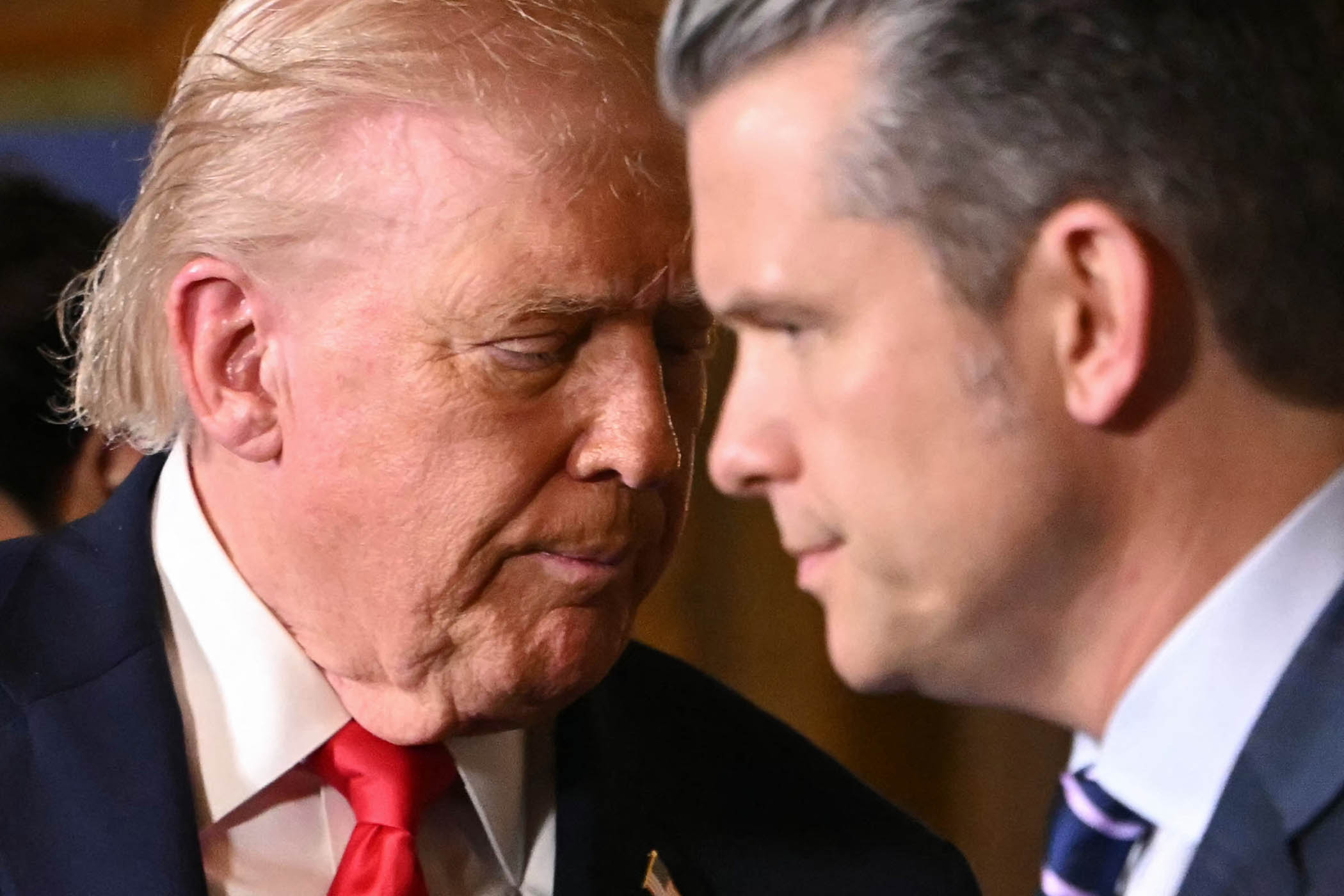



Donald Trump celebrated Christmas Day by launching Tomahawk cruise missiles against Islamic State jihadists in a remote corner of Nigeria, who were, he said, “viciously killing” Christians.
“I have previously warned these Terrorists that if they did not stop the slaughtering of Christians, there would be hell to pay, and tonight, there was,” Trump said, before wishing the “dead Terrorists” a “MERRY CHRISTMAS”.
The strikes were part of a broader pattern. Despite Trump’s promises to put America first and halt “endless wars”, during his second term he has enthusiastically projected American military strength into far-flung places.
Earlier this month, Trump authorised a “massive strike” against Syria, in retaliation for a jihadist attack against American forces in the country. He has also targeted Iran’s nuclear facilities, launched a bombing campaign against Houthi rebels in Yemen, and ramped up airstrikes in Somalia.
Then there is Venezuela, where Trump is threatening regime change. His administration alleges president Nicolás Maduro belongs to a terrorist group and it has assembled a vast armada in the Caribbean that includes the world’s largest aircraft carrier. US forces have seized two oil tankers and sunk at least 29 alleged drug boats off Venezuela, killing over 100 people.
Analysts are struggling to discern a strategic thread running through these actions. After all, Trump originally won the Republican nomination in 2015 by campaigning against America’s involvement in Iraq and Afghanistan.
“He starts out as this quasi-isolationist. Now he turns out to spend more time on foreign policy than domestic policy,” said Michael O’Hanlon, director of foreign policy research at the Brookings Institution in Washington DC. “Why is this purported Maga Republican interested in every corner of the globe?” One answer is that few American presidents can resist the urge to police the world and deploy military firepower at their disposal, said O’Hanlon. Another is that these moves are aimed at a domestic audience at a time when the president’s approval rating is flagging, rather than effecting change overseas. Targeting Venezuela’s regime plays well with Latin American voters in Florida, while killing Nigerian terrorists in the name of protecting Christians on Christmas Day pleases evangelicals.
In both countries, Trump’s approach has been impulsive. His administration has not clearly outlined what would come after Maduro in Venezuela, and a few cruise missiles will not address the causes of decades of insecurity in Nigeria.
“Force is being used in almost a performative way,” said Leslie Vinjamuri, president of the Chicago Council on Global Affairs. “Trump likes ... being seen as a strong man, and he’s using force to show America is tough, resilient. But there doesn’t seem to be any grand strategy to all this. He doesn’t seem to care about delivering objectives on the ground.”
In this sense, Trump’s use of military might resembles his peacemaking. The US president claims to have solved eight wars. One of these, between Cambodia and Thailand, broke out again a few months after a US-brokered peace deal was signed. Fighting also continues in the eastern Congo, despite an accord agreed in Washington between the Congolese and Rwandan presidents. Another conflict didn’t actually exist: Trump claims to have brought peace between Egypt and Ethiopia, two countries that were not at war.
Newsletters
Choose the newsletters you want to receive
View more
For information about how The Observer protects your data, read our Privacy Policy
Despite his America First agenda, Trump is no stranger to foreign entanglements. During his first term he escalated US strikes in Somalia to unprecedented levels, authorised the assassination of Iranian general Qasem Soleimani and backed Kurdish groups against the Islamic State in Syria.
“We’ve forgotten that wherever Trump inherited ongoing wars, he intensified the air campaign,” said Michael Hanna, of the International Crisis Group. “What makes the second term different is that the personnel in place are in no way a check on Trump’s impulses. In fact, they seem to magnify and amplify. There’s a heavy emphasis executing [his] wishes.” Striking targets from the air or sea without putting boots on the ground represents a low-risk, high-reward approach, even if parts of Trump’s Maga base are unsettled at the prospect of US-enforced regime change in Venezuela, and brokering peace deals burnishes the president’s self-image as a deal maker. “I’ve never seen Trump as an isolationist,” said Vinjamuri. “He’s certainly unilateral, and he’s transactional. But he’s always had a very big international agenda, despite the inconsistency of his approach.”
Photograph by Andrew Caballero-Reynolds/AFP via Getty Images