

When federal agents turned up in his Maine town to enforce President Donald Trump’s unsparing migration agenda, the Cumberland county sheriff, Kevin Joyce, was expecting somebody to get in touch with him.
He recalled the investigations into the failings that led to the September 11 terrorist attacks in 2001, and knew that a lack of communication between local and federal agencies could have devastating consequences.
Instead, there was silence from the new arrivals, and an ominous feeling on the streets that different law enforcement agencies were being pitted against one another.
“They don’t communicate with us because they think we’re the enemy,” said Joyce, whose constituency includes Maine’s biggest city, Portland.
Joyce understands the animosity. After the deaths of two US citizens in Minnesota, Maine is one of several Democrat-run states and cities that have passed laws and executive orders prohibiting or limiting cooperation between local police and the federal agents.
This has left local law enforcement scrambling to understand their role, creating a potentially combustible situation. “My biggest fear is going to be a blue-on-blue encounter – that is a police-on-police encounter,” Joyce said. “If we go crashing through the door and another police department, unbeknown to us, has somebody undercover and they pull their gun, we pull our gun, and, God forbid, we have a police shooting another police officer, that’s bad for all of us.”
There have already been close shaves. On 21 January, one of his staff – a corrections officer – was stopped in the street by Immigration and Customs Enforcement (ICE) agents and pulled from his car.
Video captured at the scene shows at least five agents in bullet-proof vests shouting and surrounding the car as the man struggles at first and then is pushed into another vehicle.
“In three minutes, they stopped him, got out, put him in their car, took off,” said Joyce, who said the man was “squeaky clean” and legally allowed to work in the US. “They left his car on the side of the road with the lights on and the windows down, and all of his belongings in the car.”
There have been other encounters between ICE and law enforcement: in at least two separate incidents in Minneapolis, ICE agents stopped off-duty police officers and demanded their papers. In one stop, a female police officer had her phone knocked out of her hands.
Newsletters
Choose the newsletters you want to receive
View more
For information about how The Observer protects your data, read our Privacy Policy
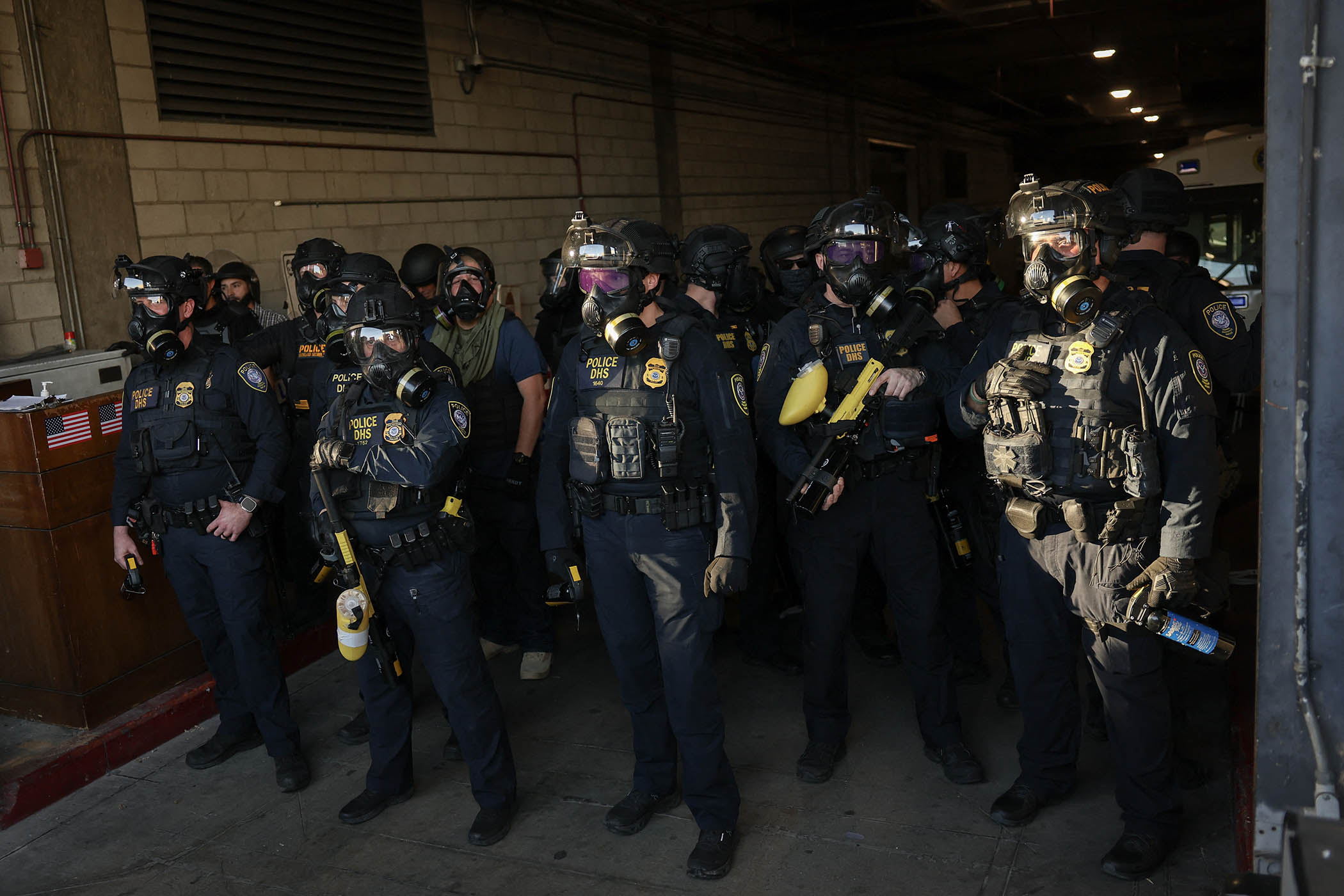
The same story is playing out in cities across the US as Trump sends unprecedented numbers of heavily armed federal agents to Democrat-run cities to hunt down anyone they suspect of being in the country illegally – with local police powerless to stop them.
These include ICE, Customs and Border Protection (CBP) and other federal agents, creating fear and confusion on the streets.
“You have CBP on major city streets doing what looks almost like military policing in a war zone,” said Peter Mancina, a visiting scholar at Rutgers Law School whose book On the Side of ICE: Policing Immigrants in a Sanctuary State was published in December.
The consequences of this overwhelming show of force have become clear in Minneapolis, where Renee Good and Alex Pretti were shot dead in separate incidents in January during interactions with ICE and CBP agents.
After Pretti was killed, armed federal agents denied local police and investigators access to the scene of the shooting.
Now, as tensions rise, there is growing concern about potential clashes between federal and local law enforcement. A 2024 war games exercise by the Center for Ethics and the Rule of Law at the University of Pennsylvania found that a clash between federal and state law enforcement could be a trigger for civil war-style scenes.
It’s a spectre raised in Minneapolis, where the surge of about 3,000 federal agents has dwarfed the approximately 600 police officers on the ground. The Minneapolis mayor, Jacob Frey, warned of the possibility of “two governmental entities … literally fighting one another”.
The stage is being set for such scenarios elsewhere in America.
Last Thursday, Trump’s border tsar, Tom Homan, announced that the surge of federal agents in Minnesota would end, and now other Democrat-run cities and states are making plans in case they are next in the firing line.
In Seattle, the Democratic mayor, Katie Wilson, issued an executive order stating that local police must document ICE activity and check the ID of federal agents. Chicago, Baltimore and Boston have implemented similar measures.
The question is whether police will enforce these policies. “The concept of pitting two armed law enforcement agencies against each other is ludicrous and will not happen,” said Mike Sloan, president of the Seattle police officers’ guild.
The White House has repeatedly blamed the deaths of Good and Pretti on the “chaos” created by the lack of cooperation from state and local government.
Mancina, however, played down the prospect of civil war-type scenes. He pointed to recent comments from the Minnesota governor, Tim Walz, about using the state’s national guard to protect citizens from ICE.
“That was part of this escalating rhetoric of ‘they’re going to bring in military people, well, we’re going to bring in military people,’” he said. “You know what the national guard was doing? They were handing out coffee.”
Mancina said there has also been behind-the-scenes cooperation from police in many of the sanctuary cities.
In Washington DC – the location of one of the first federal surges, which also included a national guard deployment – police cooperated with the ICE deployment, pulling over people for traffic stops, only to hand them over to ICE officers.
Paul Schnell, commissioner of the Minnesota Department of Corrections, said his department had always complied with requests to hand over undocumented migrants convicted of a crime to ICE once they had completed their custodial sentence.
So he was surprised when ICE demanded the handover of 1,360 individuals, a discrepancy with the approximately 300 undocumented migrants they had in custody.
He also said ICE was posting incorrect information on social media implying that they had caught dozens of criminals they deemed “the worst of the worst”, when in fact at least 68 of these individuals had been handed to them in routine prison transfers.
“We simply cannot allow wholesale, broad justification of these operations based on false data and false premises,” he said.
It’s unclear if and where federal agents will be deployed next. In Maine, the surge ended after pressure from the state’s Republican senator, Susan Collins. But Joyce remains furious at the impact it left on his community.
“When all these ICE people from out of state leave, we’re still going to be left here,” he said. “The police chiefs are going to be left here to try to clean up whatever mess has been left.”
Photograph by Patrick T. Fallon / AFP via Getty Images