On a grey and drizzly Saturday afternoon, a steady stream of people is making its way to an unremarkable event venue on the outskirts of Escaudoeuvres, a commune in northern France.
Despite the rain, the mood in the queue snaking around the building is festive. Inside, staff used to dealing with birthday parties and wedding receptions are herding a more eclectic bunch. Sharp-suited young men – many in or barely out of their teens – intending to stand in next year’s municipal elections, a first step on the far-right political ladder; women bearing gifts: soft toys, bottles of wine; and people sporting heavy crucifixes and religious medals.
The event is billed as a book signing, but the atmosphere is that of a faith meeting. “Like a messiah,” one French journalist remarks. The faithful have all happily paid €23.90 (£20.70), the cost of the book in question and a small price to pay for a chance to shake hands with the man who could, next year, be president: 30-year-old Jordan Bardella.
Suddenly a tall, slim figure as sharp as a new pin strides into the room. “Jordan president, Jordan president,” chants the crowd. He is what your grandmother would call suave: urbane in a grey rollneck and expensive-looking blouson jacket in navy blue.
Bardella’s latest book, Ce que veulent les Français (What the French Want), is his second literary offering. Like the first, his autobiography, it is a bestseller. Bardella sits on a bar stool at a high table and inscribes each book with an exaggerated left-handed flourish. He smiles, engages in small talk, agrees to the obligatory selfies.
A decade ago Bardella was an unknown boy from the banlieues, the child of an Italian mother and Franco-Italian father with Algerian roots who divorced when he was a toddler. He grew up in a housing block at Drancy in Seine-Saint-Denis, the most infamous of the outer Paris suburbs.
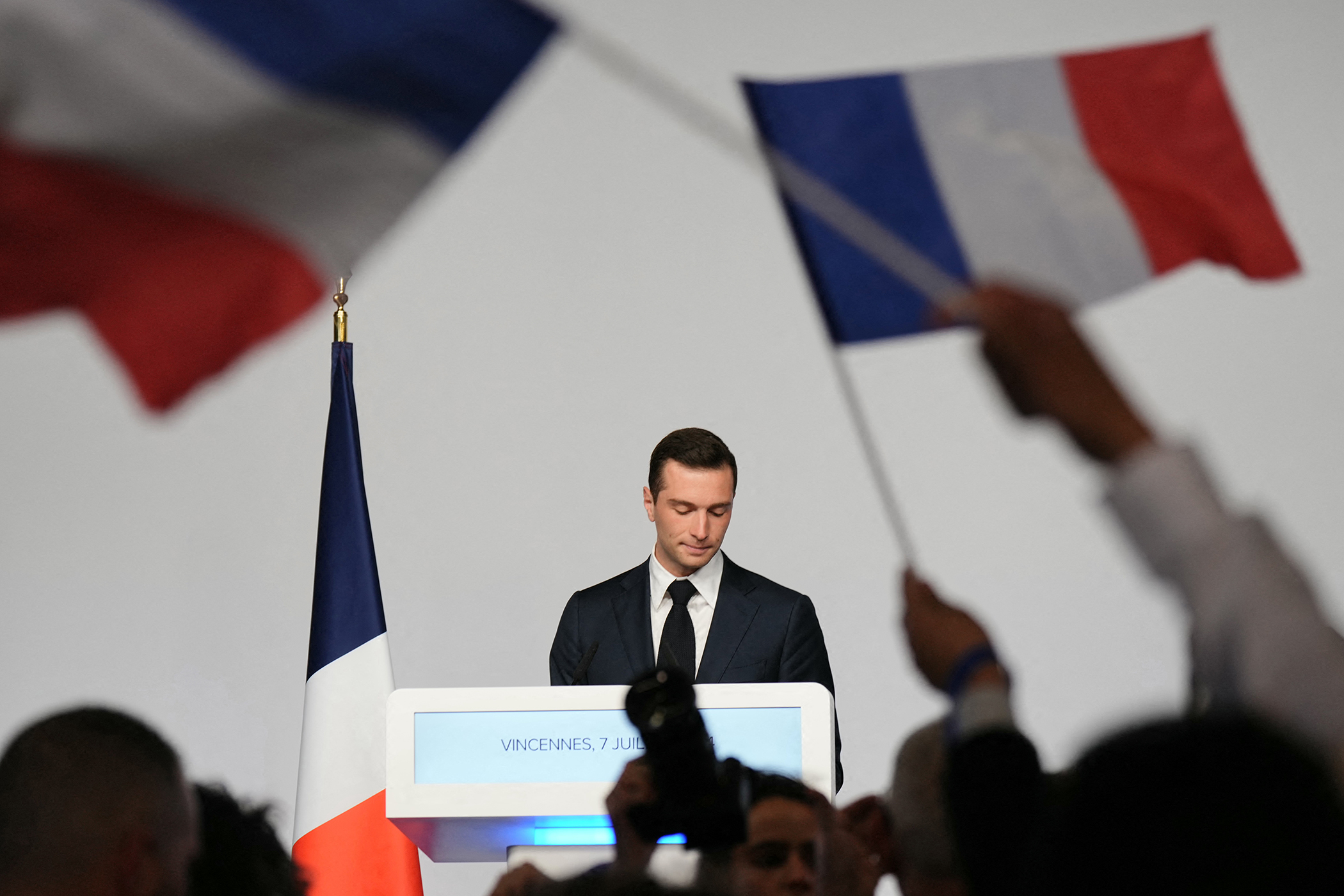
Today Bardella is plan B – the far-right National Rally (RN)’s back-up if its matriarch Marine Le Pen’s conviction for embezzling EU funds and the ban on her standing in the 2027 presidential election are upheld. Her appeal began last week.
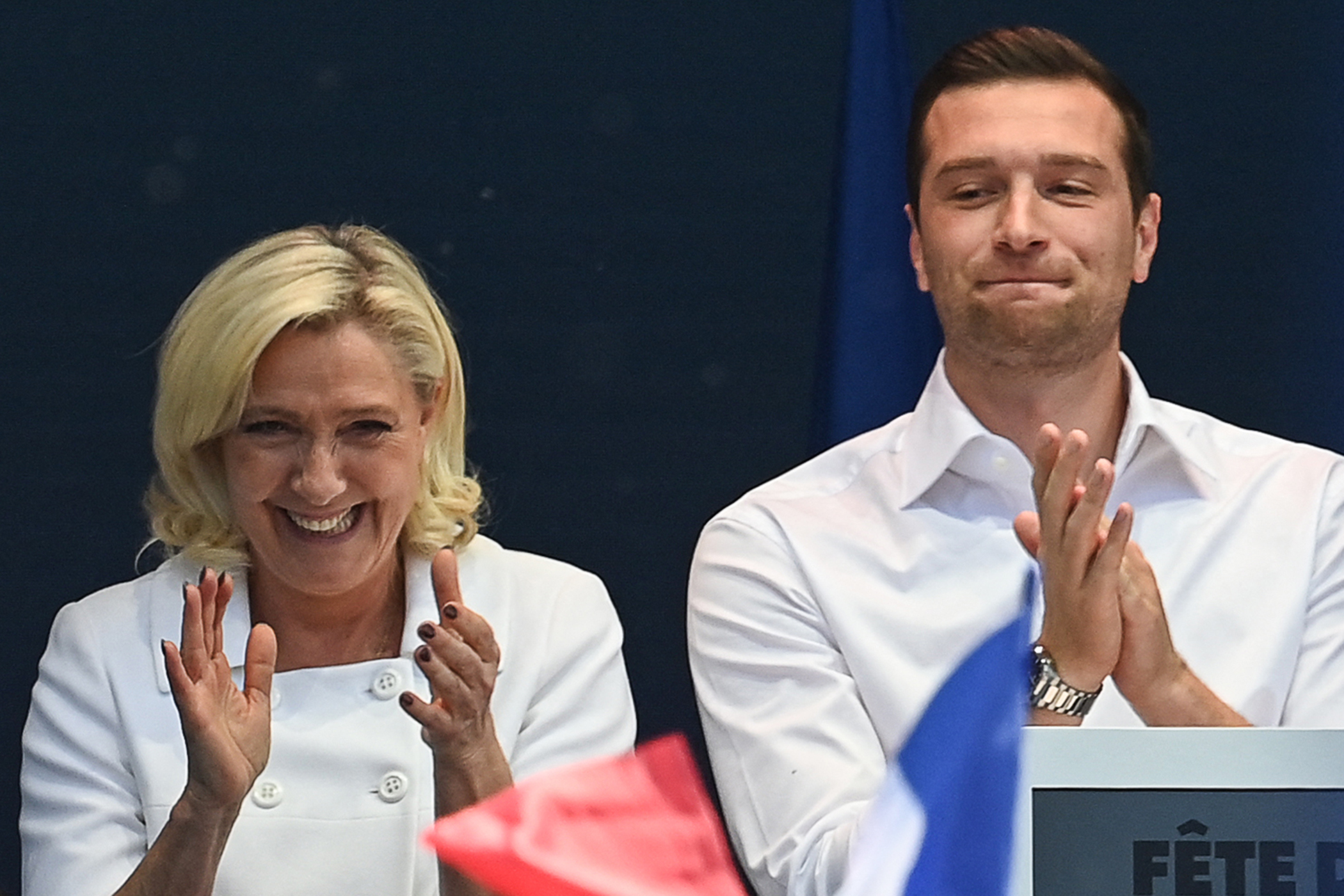
Marine Le Pen and Bardella on stage last June at a meeting of the European parliament group Patriots for Europe
The “if” is a cast-iron caveat: Bardella will only run if Le Pen cannot. “I am her number one supporter. I always have been. And she is my number one supporter,” Bardella says when asked. It is the only response that will satisfy the conflicting demands of loyalty and limelight and ensure that he still has a political career to write books about.
But many in the RN are increasingly coming to the view that plan B may be better than plan A. Some suggest that it is a generational thing – Bardella has 2.3 million TikTok followers – but looking at the crowds flocking to these weekend events, Bardella’s populist appeal to the “ordinary” non-metropolitan French struggling to make their money stretch to the end of the month and wound up about immigration from west and north Africa – even in areas where there is none – appears to span all ages.
This is about more than charm, charisma and youthful confidence. A Bardella government would “restore order”, he has said, blaming France’s ills on migration. Those he terms “foreign delinquents” would be deported while “strategic state positions” would be reserved for French nationals.
Newsletters
Choose the newsletters you want to receive
View more
For information about how The Observer protects your data, read our Privacy Policy
Bardella paints his childhood as one coloured by hardship. “I am one of a generation who could die for the refusal to hand over a cigarette,” he said of life on a working-class housing estate. His mother Luisa, a nursery school assistant, struggled to make ends meet, he says.
In reality, the rags-to-riches narrative is more nuanced, said François Debras, a political scientist and professor at the Sorbonne Nouvelle University, who is sceptical of the “boy from the banlieues” legend. Bardella went to a private Catholic high school, and his father Olivier, who reportedly bought him a Smart car for his 19th birthday and an apartment for his 20th, ran a successful business specialising in drink vending machines.
“There’s a whole narrative about his background that’s been put in place,” Debras said. “It gives him an image of being close to the people.”
Pierre-Stéphane Fort, an investigative journalist and author of the book Le grand remplaçant (The Great Replacement: The Hidden Side of Jordan Bardella), says this story legitimises Bardella’s populist, anti-immigration stance. It also complements the wealthier and grander Le Pen, allowing the RN to claim to “speak to the common people”.
The teenage Bardella spent his spare time playing Call of Duty or chatting on video game forums and his YouTube channel, Jordan 9320. François Le Pourhiet, his then best friend, told Le Monde that Bardella wanted to be a police officer and did an internship in a Saint-Denis police station.
Aged 16, against his mother’s wishes, Bardella joined the National Front, the party founded by Le Pen’s father Jean-Marie before Marine put it through a radical clean-up and rebranding as the National Rally.
Bardella is criticised for not being educated, for not being competent, for not having a degree. The stigma becomes a resource
Bardella is criticised for not being educated, for not being competent, for not having a degree. The stigma becomes a resource
Prof Sylvain Crépon, sociologist
Bardella passed his baccalauréat with a très bien note and applied to study at the elite Sciences Po university but failed the entrance exam. Instead he studied geography at the Sorbonne but dropped out after the first year without graduating to concentrate on politics.
His rise within the party was swift. In 2015, at 20, he became France’s youngest regional councillor; shortly afterwards Le Pen invited him to be part of her 2017 presidential campaign, which he called “the chance of a lifetime”. In 2019 he was elected to the European parliament, and in 2022 was voted RN president by 85% of the party membership. Within a decade he had risen from teenage activist to far-right figurehead in a party whose leadership until then had been strictly a Le Pen family affair. Bardella appears to have shown little interest in being an MEP. European parliament data suggests that he has asked only one oral question in the last two years, produced no report and proposed only a handful of amendments to legislation. “Most of the time he’s at the parliament he’s on his telephone. He doesn’t mix with officials or ambassadors, and most of the questions he asks are prewritten and delivered with no flair,” an opposition political adviser at the European parliament told The Observer.
Professor Sylvain Crépon, a sociologist and specialist on the far right, said: “The Jordan Bardella phenomenon is a media phenomenon and a social media phenomenon. He has handled it very, very well. There is definitely a generational aspect to it. It’s something that Marine Le Pen is less adept at.”
Crépon believes that Bardella is also a figurehead for the large swathe of disgruntled voters who do not have a degree or baccalauréat and who live in small rural communities. Polling analysis after the 2024 legislative elections showed that 49% of RN voters had not passed the high-school diploma and 40% of those living in villages of fewer than 2,000 people had voted for RN candidates.
“When he is criticised for not being educated, for not being competent, for not having a degree, for having failed at university, I wonder to what extent that is a factor. The stigma becomes a resource,” Crépon added.
Others believe Le Pen’s “de-demonising” of the party has been a public relations exercise but that it remains the same far right in a new shiny suit. “Bardella is profoundly extreme right… Everyone around him proves it; everyone who has supported him up until now proves it,” Fort said.
Le Pen and Bardella have been vocal in their condemnation of waves of antisemitism in France, saying the party has moved on from the Le Pen senior era of downplaying the Holocaust and France’s wartime Vichy regime of Nazi puppets. Bardella, who visited Yad Vashem at the invitation of the Israeli government last year, has also distanced himself from the party’s flirting with Moscow, saying in an interview that he saw Russia as a “multidimensional threat to French and European interests”.
However, the RN has endorsed a number of candidates seeking closer ties with Russia and accused of antisemitic views as well as conspiracy theories, climate and vaccine scepticism.
Bardella previously expressed support for the “great replacement” conspiracy theory, though he does not use the exact words: a white nationalist far-right notion that ethnic French and white Europeans are being deliberately replaced by non-whites, particularly Muslims, through mass migration. He is a fan of Nigel Farage; they met in London in December.
In 2024 the investigations team at Complément d’enquête on public broadcaster France Télévisions claimed Bardella had an anonymous Twitter account on which he had posted racist and homophobic posts. Bardella denied this and threatened to sue, but no writs were issued.
Crépon believes Bardella’s eventual achilles heel will be his failure to grasp policy details. “We can see it in many interviews that as soon as the issues and questions become a little technical, as soon as he is asked how he will finance his programme or he is asked questions about the constitutionality of the National Rally’s programme, he falls apart. He loses his composure and he starts stuttering; he doesn’t know what to say. He’s very, very uncomfortable.”
Do voters care? “The opinion polls suggest not,” Crépon says.
Back in rainy northern France, the ambitious young men in sharp suits are making their way to the front. Unlike older party members loyal to Le Pen, these youngsters have fully signed up to Bardella’s anti-immigrant, France-first agenda.
“It’s a generation thing,” one says. “Older people will want Marine Le Pen, younger people Jordan Bardella.”
As Le Pen’s appeal trial opened last week, France’s national financial prosecutor’s office confirmed it is probing Bardella’s MEP expenses after a complaint by an anti-corruption organisation.
If Le Pen cannot stand in 2027, some analysts believe Bardella may not be the RN’s automatic choice to replace her. Whatever happens, the decision will be hers.
“I still have my doubts that they’ll let him have the spot if she’s ineligible,” Crépon says. “I think he’s not close enough to her. He is the party president, but she’s still the one with the whole apparatus behind her. Jordan Bardella doesn’t have a very structured team around him that would be willing to die for him as Marine Le Pen does. Overnight she can press a button and Bardella is out. I’m not entirely convinced she’ll hand him the keys.”
Fort believes that, whatever happens to Le Pen, Bardella will be patient. “Ten years ago he was unknown. He is now RN president, and is popular and strategic… He can wait until 2032. He will not defy Marine Le Pen because he has everything to lose.”
Photograph by Dimitar Dilkoff/AFP via Getty Images, Jean-Francois Monier/AFP via Getty Images