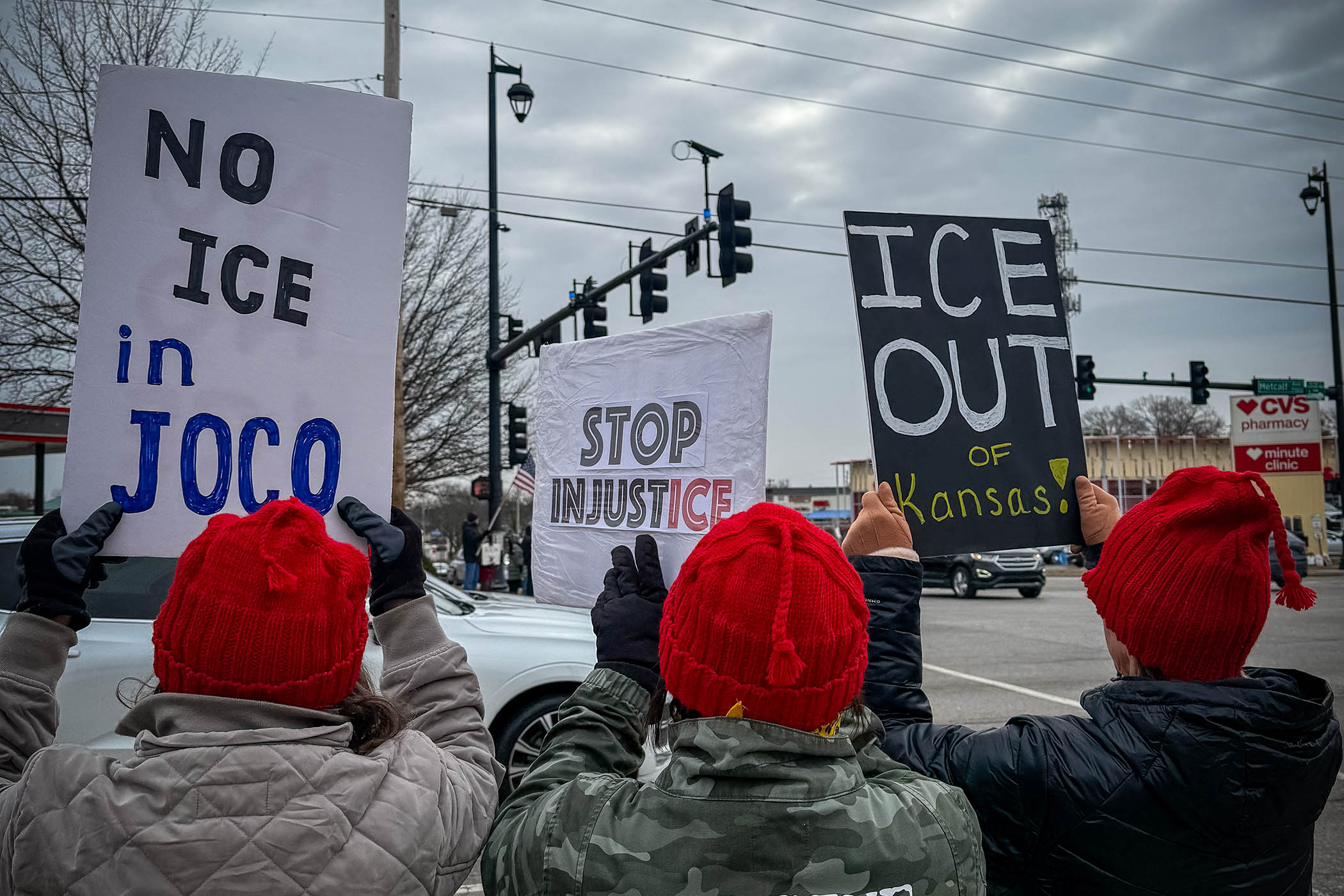



Make America Great Again baseball caps have become a common sight in the US since Donald Trump’s first presidential bid. Now a different kind of red hat is appearing in Minneapolis. These red woolly hats with a tassel at the top bear no overt slogans – but they are a symbol of resistance against US Immigration and Customs Enforcement (ICE) crackdowns in the city.
The “Melt the ICE hat” is a knitting and crochet pattern released by Minneapolis yarn shop Needle & Skein in January to protest against Trump’s mass deportation campaign, dubbed Operation Metro Surge, which saw 3,000 federal agents descend on the city. All funds raised from the $5 pattern are donated to local immigration aid organisations. So far the pattern has been sold in more than 48 countries and raised $700,000 (£520,000).
The image of a red hat in a city under siege is potent: particularly in Minnesota, where a third of residents claim Nordic ancestry. The pattern was inspired by the red hats crafted in Norway during the Nazi occupation in the second world war as a motif of civil resistance. Paperclips pinned to lapels, signifying togetherness, were also popular. After the invasion in 1940, Nazis soon began cracking down on dissent, including symbols of resistance, or anything deemed patriotically Norwegian. Thus the hats, inspired by the “nisse” – a porridge-eating gnome-like spirit from Nordic folklore – was outlawed.
But does wearing or knitting a hat change anything? I asked Mats Tangestuen, director of Norway’s Resistance Museum, about the criticism from certain corners of the internet that the hats are purely performative. He said it reminded him of how the hats and paperclips had been dismissed in the 1980s and 1990s. Critics would say “you can’t blow up a German tank with a red hat”, he explains. “Everyone knows that, but cultural resistance, civilian resistance and military resistance are dependent upon each other.”
When the museum opened in 1970, its contents were curated by 25 veterans of the military and civilian resistance. Two red hats were chosen for display. “It’s no coincidence that you have these two red hats together with submachine guns, explosives and radio equipment,” Tangestuen says.
The hats were also a “vaccine” against something else, Tangestuen tells me: treachery. They became popular before the battle of Stalingrad, when many feared Germany would be victorious. The message being telegraphed by those wearing the hats was: we’re still here, we’re still fighting. And seeing peers don such symbols may make others reconsider becoming turncoats.
***
The portmanteau “craftivism” was coined in 2003 by the writer Betsy Greer. Examples of textile-based craftivism includes the Aids Memorial Quilt, which was displayed on the National Mall in Washington DC in 1987 and has since travelled the world; the “pussy hats” worn to protest the 2016 election of Trump at the 2017 Women’s Marches held across the US; the artist Alexandria Masse’s ongoing birth control tapestry, which she describes as “a comment on freedom, bodily autonomy, informed consent, and how women’s rights are arduously fought for”; and the work of the Australian environmentalists the Knitting Nannas, who knit protest signs urging politicians to tackle climate change.
Craftivism is about using your “head, hands and heart together”, says Sarah Corbett, founder of the Craftivist Collective. Corbett encourages people crafting as a means of protest to use the time they spend making to meditate on questions surrounding what it is they are campaigning for. The useful questions to think about while knitting the red hat, for instance, might include: what’s happening in America? Where do I fuel inequality with what I buy? What does my pension pot fund? The intention behind the crafting is, for Corbett, just as important as the finished piece.
She tells me that crafting is a useful tool for bringing people together, too. In her workshops, eye contact isn’t essential, and as everyone is more relaxed, they’re more likely to listen to each other and disagree respectfully. “In Stockholm, I had an anarchist sitting next to someone who worked for the embassy, and they had to share embroidery scissors. It might not have changed their minds, but it softens them to each other, to listen to each other and their points of view, and to see each other as human,” she said. “I wouldn’t do my form of gentle craftivism if it didn’t make a difference.”
For Minnesotans, crafting did indeed bring them together. Two days before the 23 January demonstrations against ICE in Minneapolis, Needle & Skein hosted a protest stitch-along. In an Instagram post, Nadia Mohamed, the mayor of St Louis Park, playfully chants: “When ICE comes to SLP we say…” Then a chorus of crafters wielding red yarn and knitting needles responds: “ICE out!”
***
The red hat pattern was written by Paul Neary, who works at Needle & Skein; Sarah Sward created the crochet version. I speak to Sward on Zoom. We’re both wearing colourful woolly jumpers; in my eyeline behind my laptop is my own stash of tangled red yarn, soon to be made into Sward’s hat. She lives on the outskirts of Minneapolis, has been crocheting for four years and is a regular at Needle & Skein. “I think the crafting world was waiting to do something,” she said.
The Trump administration claims it has focused on deporting immigrants in the blue state of Minnesota due to “the problems associated with unchecked Somali refugee resettlement”, citing a local fraud scandal. This rhetoric was repeated in the president’s Davos speech, where he made the racist remark that Somali people have low IQs. “I hope more people will see that this isn’t actually about being illegal. It’s about not being white,” Sward said.
In the Twin Cities of Minneapolis and Saint Paul, more than 4,000 people have been detained. The White House calls these people “criminal illegal aliens”, claiming the sum includes “violent killers, rapists, gang members, and other public safety threats”.
Those detained include five-year-old Liam Conejo Ramos. Wearing a Spider-Man backpack and blue bunny hat, Ramos was taken along with his father, Adrian Alexander Conejo Arias, who is originally from Ecuador and had a pending asylum claim. It’s claimed that ICE officers used the child as “bait” by making him knock on the door to make his mother come outside. The Department of Homeland Security rejects the claim. The boy and his father were later taken to a detention facility more than 1,000 miles away in Texas.
Ramos was the fourth child in his school district to be detained, and about 20 families at his school have had a parent taken away by ICE. Minnesota school districts have since filed a lawsuit in a bid to stop ICE agents patrolling near schools and bus stops. Some families are too afraid to send their children to school, and absences are increasing, according to the teachers’ union Education Minnesota. Congresswoman Ilhan Omar warned the trauma inflicted by ICE “will haunt our communities for generations”. In the meantime, the community does its best: some of Sward’s friends are on “school watch” to help escort teachers, parents and children in case ICE agents appear.
Living in a city impacted by an ICE crackdown feels like a “liminal space”, Sward says. Thousands of people are being detained, yet you still have to go to work to pay your bills. Normal life continues despite the anger, the injustice.
I ask her if there’s a risk the hats, which are worn in obvious opposition to Maga hats, could push people further apart. “Everything can quickly become a binary,” she says. “People want to have a clear black and white morality that doesn’t exist in the world for the most part. But the rage in me says I don’t care because this is just wrong… This is not a moment to say, ‘Where is the grey area?’ This is a moment to say, ‘What side are you on, in history, right now? If you don’t pick a side you’re passively condoning these atrocities.”
For a second time in recent years the world is protesting with Minneapolis: first in 2020 after George Floyd’s murder; now against Trump’s mass deportation policy. The president’s border czar, Tom Homan, announced the Minnesota operation will end. In the meantime, we stitch.
More from The Observer
Photograph by Boots on The Ground Midwest
Newsletters
Choose the newsletters you want to receive
View more
For information about how The Observer protects your data, read our Privacy Policy