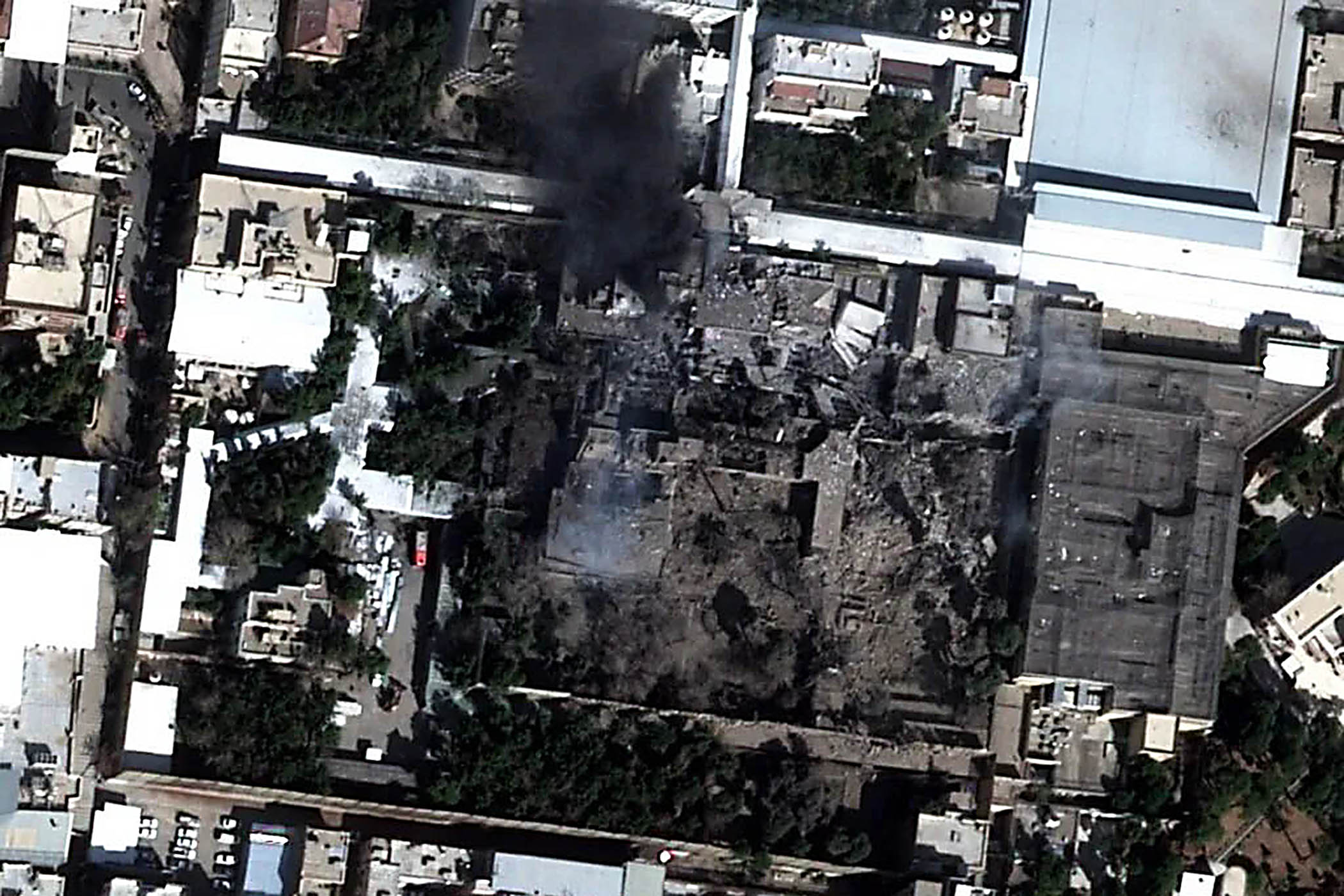
It was shortly after 9.30 last Saturday morning in Tehran when a towering column of pale grey smoke billowed from the compound housing Iran’s supreme leader Ali Khamenei. Israeli fighter jets dropped 30 bombs onto the complex containing Khamenei’s office and residence, as well as the cavernous Imam Khomeini Hussainia mosque where he often gave speeches to rapturous crowds. The attack targeted not just Khamenei but at least one other gathering of Iran’s highest officials, decimating the Iranian regime and leaving only a broad black crater marking the compound the supreme leader rarely left.
“From a purely technical perspective this is one of the greatest intelligence successes in modern military history, without exaggeration – to reach that kind of depth of penetration and that precision is extraordinary,” said Thomas Juneau, a former Canadian defence ministry analyst and expert on Iran at Chatham House.
The attack marked the first time that Israel has assassinated a sitting head of state, normally regarded as a breach of international law. The compound, with its mix of offices and residences, said Juneau, “was the nerve centre of the Islamic Republic” hosting at least seven other top Iranian defence officials for a secret meeting that morning. These included Ali Shamkhani, the powerful head of the national defence council, Mohammad Pakpour the commander of the Iranian Revolutionary Guards Corps, defence minister Aziz Nasirzadeh, as well the armed forces chief of staff, Iran’s intelligence chief, the head of the military bureau and the head of Iran’s advanced weapons programme. Subsequent attacks also targeted other powerful figures in the Iranian regime, including former president Mahmoud Ahmadinejad.
“The other takeaway here is the unfathomably poor operational security on the Iranian side; that Khamenei and a large number of not just senior but the most senior people like Shamkhani would all sit together unprotected – not in a bunker 20 metres below ground,” said Juneau. “That they chose to meet above ground in large numbers is extraordinarily careless on their part.”
Former Israeli military officials pointed to the staggering requirements of the attack, all of which needed to work in perfect harmony: precise real-time intelligence that the high-level meeting was taking place, before Israeli jets flew the two hours to Iranian airspace without being spotted by either incoming radar or other nations across the Middle East, as well as confidence to send a dozen jets capable of carrying a high number of munitions.
Not only did the IDF know the times and whereabouts of these gatherings, but also managed to get a photograph of the body of the supreme leader
Not only did the IDF know the times and whereabouts of these gatherings, but also managed to get a photograph of the body of the supreme leader
Eran Ortal, retired IDF
“This shows the Israeli intelligence penetration of Iran is extreme,” said Eran Ortal, a retired brigadier general and military strategist with the Israeli Defence Forces (IDF). Ortal said that he assessed, based on the range of Iranian personnel struck, that up to three separate high-level gatherings could have been occurring at the same time. “The Israeli prime minister was shown a photo of the supreme leader after he was killed and extracted out of the rubble, before the Iranians admitted he was killed. So not only did the IDF know the times and whereabouts of these gatherings, but also managed to get a photograph of the body of the supreme leader,” he said, the admiration in his voice evident.
The decision to launch an operation of this scale targeting a sitting head of state may have proven successful in audacious military terms, but other observers of Iran warned that it was more likely to create chaos than fulfil any stated objectives about the end of the regime. “Operationally speaking this level of penetration is amazing, but strategically we do not understand Iran. This is not going to topple the regime,” said Danny Citrinowicz, a long-time analyst of Iran at Israel’s institute for national security studies think-tank and a former Israeli intelligence analyst specialising in Iran.
In Citrinowicz’s view – one honed through decades of careful observation – the attack displayed a complete misunderstanding of how Iran’s regime truly functions, a false belief that decapitating the top levels of the regime could cause its collapse. “The notion that I think Netanyahu sold Trump, is that if they kill Khamenei everything will be solved,” he said. “But look what happened in the past: we killed Yahya Sinwar, did Hamas go away? After the killing of Hassan Nasrallah, did Hezbollah vanish? Those organisations still exist: They are not one building or one person – and the same goes for Iran. Khamenei was the face of the revolution... but these institutions are bigger than one person.”
Trump had balked at killing Khamenei when Israel presented him with a plan to take out the supreme leader during the 12-day war on Iran last summer.
But the president’s patience snapped as negotiations bogged down in recent weeks, with Tehran stalling and shifting its demands.
Newsletters
Choose the newsletters you want to receive
View more
For information about how The Observer protects your data, read our Privacy Policy
US negotiators were willing to allow Iran to retain a civil nuclear programme, unlike Israel, which had sought the total dismantling of Tehran’s atomic energy infrastructure. But the American team, led by Steve Witkoff and Jared Kushner, grew exasperated by Iran “playing games” and became convinced that the regime was determined to keep its uranium enrichment capability to build a nuclear weapon.
“The Iranians seemed to be conciliatory, but in the past two or three days of talks, all that stopped,” one diplomatic source said. “They became intransigent across the board.”
At the final rounds of talks in Geneva, the Iranian delegation was warned explicitly that an attack was coming unless the talks yielded a breakthrough. But in Washington, the calculus around the risk of war had already shifted and preparations for military action were already finalised.
“Worst case, you make Iran a near-failed state with new leadership that’s willing to negotiate and doesn’t pose any sort of threat to the US,” another source said. “Best case, you restart the Iranian protests and you get a new type of government that’s more willing to negotiate.”
The CIA and Mossad had tracked Khamenei’s movements and routine for months. Days before the final meeting in Geneva, the supreme leader’s regular meeting with top aides and security officials at his compound on Saturday was identified as a potential window for attack, Axios reported.
The talks in Geneva went ahead, despite the dwindling hopes of success, to avoid alerting Khamenei that an attack was imminent,
Israel’s intelligence services, the Mossad, had already shown how it could strike inside Iran over the past two years; first by assassinating the former Hamas politburo leader Ismail Haniyeh in 2024, in a guesthouse run by the Islamic Revolutionary Guards Corps in northern Tehran, using an explosive device planted in his bedroom, indicating their agents could operate on the ground to strike sensitive targets. Then last year Israel assassinated 11 high-level nuclear scientists and six senior commanders during a 12-day war with Iran, often targeting them inside their homes, showing precise knowledge of their locations and movement.
The attack on Khamenei’s compound marked a new watershed, indicating the uppermost levels of Iran’s regime had been compromised by a combination of Israeli and American intelligence according to former FBI special agent Mitchell Stern. This “unprecedented” level of cooperation, he explained, would have required a wealth of agents on the ground in Iran, able to monitor Khamenei’s movements as well as the officers that gathered at his compound. The supreme leader also defied expectations that he would have been sheltering in a bunker while American warships and weaponry massed nearby, as he did during the fighting last year – when Donald Trump bragged openly that he knew Khamenei’s location but had opted not to strike.
Juneau said that it was “very plausible” that Khamenei had opted to stay above ground because for the 86-year-old, spending prolonged periods below ground was hard on his ailing health. “It affected him physically and mentally, but also politically – when he was in that bunker last June he was difficult to reach and it paralysed decision making even more than usual, so perhaps he didn’t want to repeat that,” he said.
The attack on Khamenei’s compound killed the supreme leader who had ruled and reshaped Iran during his 37 years at the helm – and strikes increasingly decapitating Iran’s leadership spread fear throughout the system. “This is fuelling an extraordinarily high amount of paranoia,” said Juneau. “There are clearly highly placed human sources within the system – it’s possible they are the serving leaders themselves, we don’t know, or the assistants to senior officials providing information. They may be unaware their phones are tapped – but beyond the human sources there has to be an understanding within the upper levels of the Iranian system that their communications have been monitored. The impact here is going to be deeply paralysing on the system, which will fuel paranoia that was already high.”
Despite the fear and paranoia now rippling through the upper echelons of Iran’s security establishment, Citrinowicz said any leadership that replaces Khamenei is likely to drive a far harder line in terms of locking Israel and the US into a prolonged war of attrition, and proving hostile to the outside world. But, he said, a fractured and weakened Iranian regime that is now reeling and vulnerable to attack is Israel’s true aim – rather than Netanyahu and Trump’s promises that the Iranian people could ultimately take control. “Israel couldn’t care less what happens after Khamenei, even if the entire country dives straight into a civil war,” he said. “For Israel it’s all about limiting the strategic threat of Iran, and highlighting to other countries across the Middle East that only we can pull off an attack like this.”
Trump has urged the Iranian people to rise up and take back power from the regime. “Netanyahu and this government see the current time with Trump as president as the perfect moment to get rid of the current leadership in Iran, once and for all,” one diplomatic source said.
“I don’t think they have any illusions that regime change is possible, but regime collapse certainly is, and that’s what they’re going for.”
Photograph by Airbus/Soar