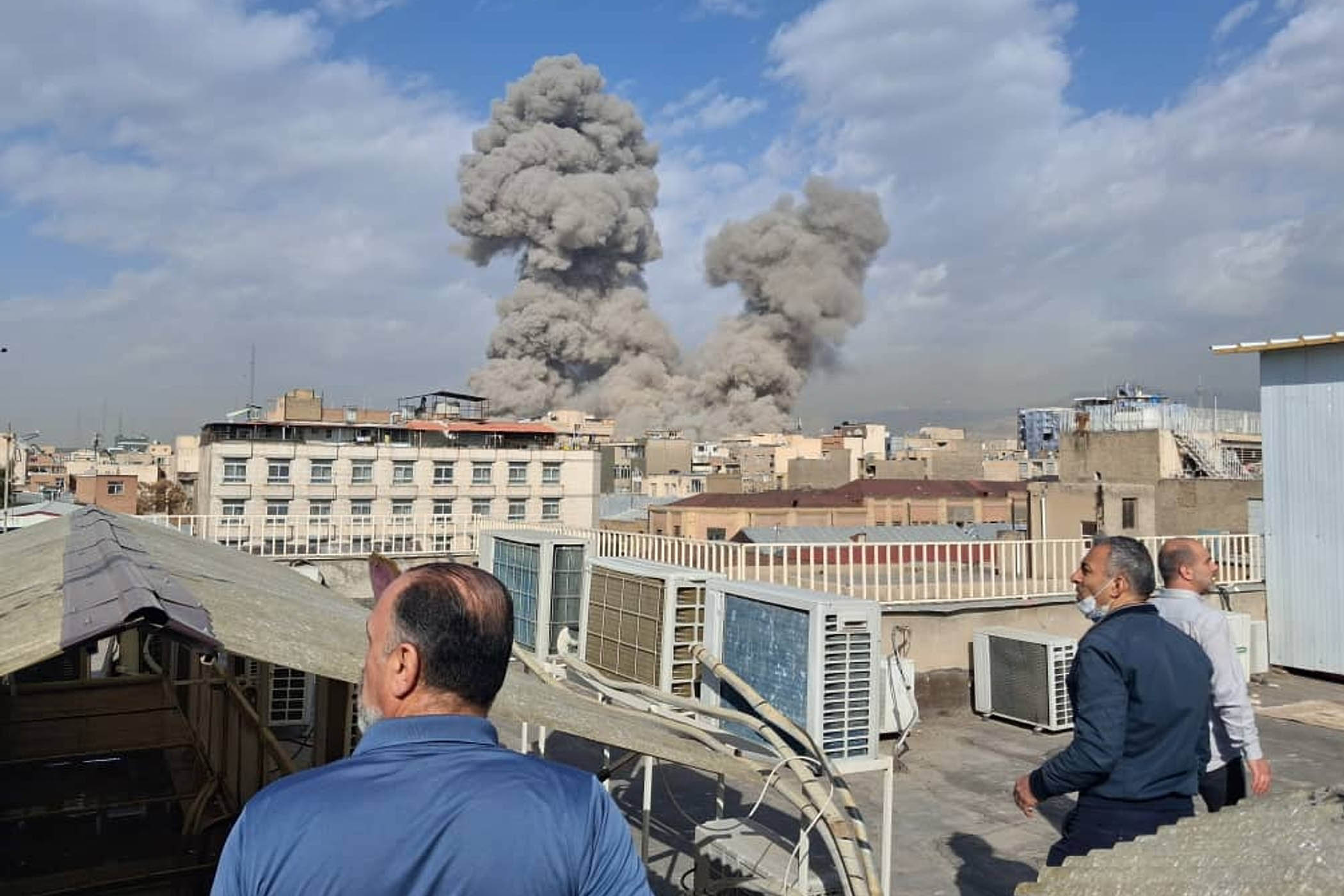
Marjan heard the first fighter jets that roared over Tehran’s skyline, puncturing the quiet of a Saturday morning. Suddenly, her street in the western part of the capital was filled with the sound of schoolchildren running back home. She feared that, as panic spread, people across Iran’s capital would be stuck in gridlock traffic as Israeli and American bombs fell around them. “There was no warning,” she said. “People are just running everywhere.”
Video showed the dark form of a fighter jet soaring over Tehran and smoke billowing from government buildings in the Iranian capital. Strikes pummelled central Tehran as huge explosions sounded in the seminary city of Qom, as well as Isfahan, Karaj and Kermanshah. An initial strike in Tehran hit close to the office of Iran’s supreme leader, Ali Khamenei. Last night, the Israeli prime minister Benjamin Netanyahu said: “All indications show that this tyrant is no longer with us.” A senior Israeli official told Reuters that Khamenei’s body had been found.
Israeli media also reported targeting leading figures among the Iranian regime, including the president, Masoud Pezeshkian, and Ali Shamkhani, the head of Iran’s defence council. The country’s foreign minister, Abbas Araghchi, told NBC News that Khamenei was still alive “as far as I know”, and that “almost all officials are safe and sound and alive. We may have lost one or two commanders, but that is not a big problem.”
Iran’s 47-year-old theocracy crushed an internal uprising early in January, gunning down thousands of protesters who took to the streets to demand an end to life under the regime. The US president, Donald Trump, and Israel’s prime minister, Benjamin Netanyahu, declared that their attacks on Iran were intended to obliterate Tehran’s military capabilities and missile programmes, prompting the regime to crumble with the leadership under attack.
Trump issued a video statement telling the Iranian people that the wave of bombardments would weaken Iran’s theocratic regime and eventually allow them to seize control of their government in the aftermath. “The hour of your freedom is at hand,” he said. “Bombs will be dropping everywhere. When we are finished, take over your government. It will be yours to take. This will probably be your only chance for generations.”
Yet in Tehran, Marjan said, there were few signs of regime collapse. “The streets are really scary here. Regime forces have appeared on the streets in high numbers – on motorcycles, showing their guns to create fear,” she said by phone.
Iranians across the country sheltered in their homes, and those with the means to do so stockpiled canned food and cash. Meisam, who took to the streets in his home city of Rasht during the recent mass demonstrations, said he had no money to buy up food, amid the deep economic crisis that had prompted the first protests in December, and which quickly grew into calls for the regime to go.
Instead, he turned on satellite news channels, with phone lines disrupted and internet outages spreading across the country. He found he was soon unable to text his sister in Tehran over WhatsApp as the internet sputtered. For Meisam, an attack on the regime was welcome, with many Iranians desperate for any change, even if strikes brought deeply unpredictable outcomes. “I hope this can lead to the collapse of this regime with the minimum of harm to my people,” he said.
In Tehran, 24-year-old Hamid weighed the US president’s grand promises that he had finally come to help Iranians through “overwhelming strength and devastating force”, after the attacks on crowds of protesters in January. Hamid, a student in the Iranian capital, was among those who braved small protests on university campuses earlier last week when students defied a crackdown to commemorate their fallen friends.
“Many people welcome any military attack and foreign intervention because after the massacre, the path to any peaceful protest has been essentially blocked. Some want the Islamic Republic to go, but they fear the consequences of a long-term war for society and a defenceless people,” he said, placing himself in the second group.
Newsletters
Choose the newsletters you want to receive
View more
For information about how The Observer protects your data, read our Privacy Policy
Trump was putting American interests first, he feared, not those of the Iranian public. “No one in the world came to our aid,” he said pointedly, when protesters were shot and the regime implemented an internet blackout, cutting the country off from the outside world. “We are in a region where the world’s great powers play and dominate without regard for people’s lives.” Despite Trump’s promises of providing an opening for opposition elements to seize power should Iran’s regime emerge weakened, Washington’s long-term aims in Iran remained unclear.
Bryan Clark, a former longtime US naval officer and military operations expert who now heads the Center for Defense Concepts and Technology at the Hudson Institute in Washington, said: “Normally, when you mount an attack to demonstrate weakness in a regime, people need something to defect to. The problem is that there is no other power centre in Iran willing to take up the mantle of leadership and replace the current regime.”
The Iranian regime risked “dissolving into something less cohesive and more chaotic amid a power vacuum”, he added. “The question is: who steps in to try and bring the country back together? The missing element that the US leadership has not given the people involved is: what’s the alternative governance structure in Iran?”
Iran’s crown prince, Reza Pahlavi, who is the son of the shah deposed in Iran 1979’s revolution, and who has increasingly positioned himself as ready to assume power, met Trump’s Middle East envoy, Steve Witkoff, a week before the attacks. Many notable figures from Iran’s fiercely divided opposition remain either exiled or jailed, leaving the crown prince to claim that only he offers a path forward that reflects the desires of Iranians; a view that remains controversial amid few signs of defections from the regime during the recent protests – even if some Iranians who took to the streets chanted his name.
“The regime is collapsing,” said Pahlavi in a statement to The Observer. “The military operation – targeting the Islamic Republic’s political leadership, repressive apparatus, its missile infrastructure, and its nuclear program – will save lives,” he claimed. “The final victory will be forged by the hands of the Iranian people. I have a plan for a stable transition to democracy. I have the support of the people and am the one national figure the armed forces can defect and rally around. We are making our final preparations to form the transitional government and lead the country to stability and peace.”
Others are less convinced. “We are facing a long, unpredictable war with global repercussions,” said Prof Maziyar Ghiabi, who heads the Persian and Iranian studies centre at Exeter University. “It’s an all-out confrontation, with US and Israeli war objectives set very high.”
Photograph by AP