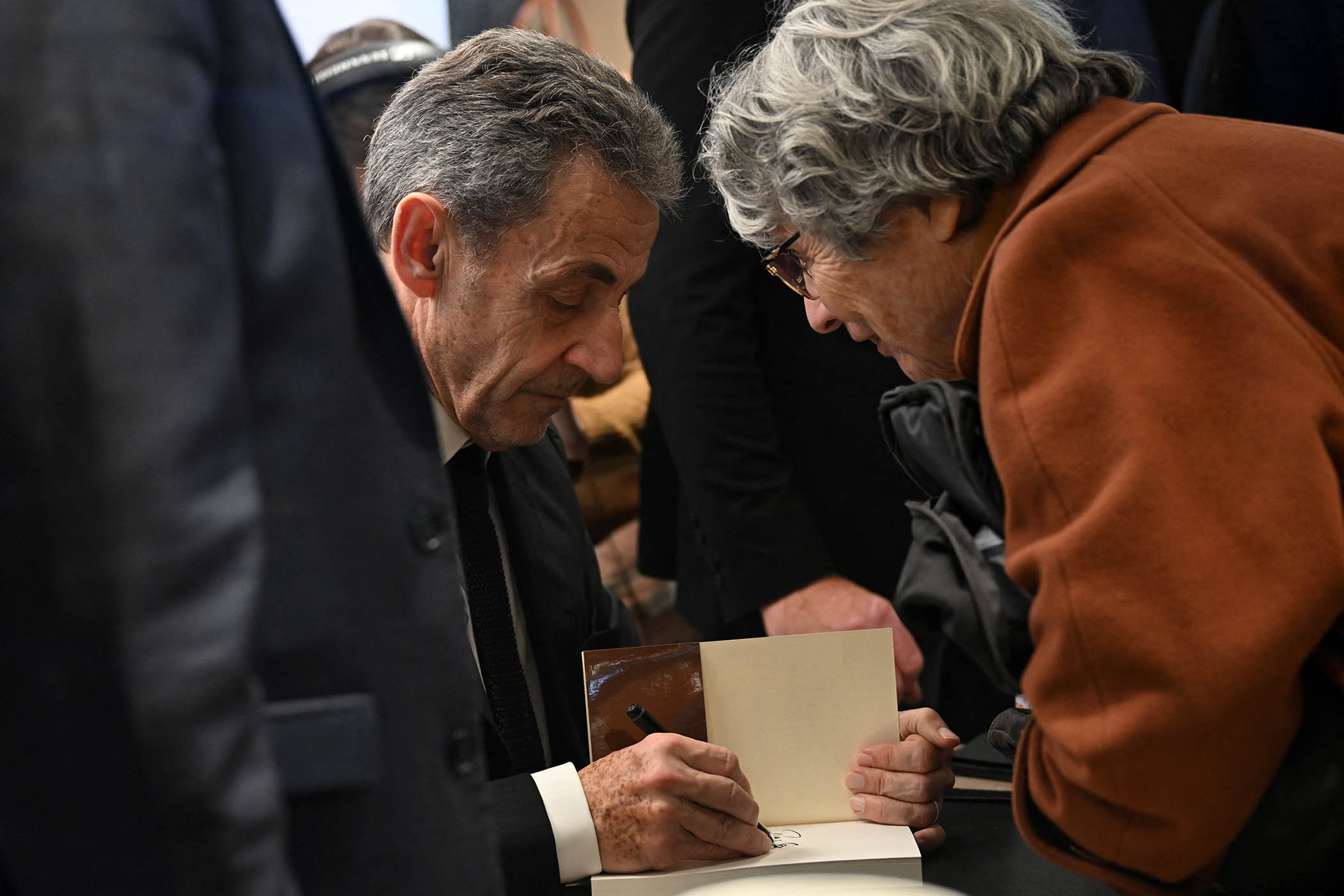

In his new book, The Journal of a Prisoner, it takes Nicolas Sarkozy 42 pages to get to 4pm on his first day in jail. The memoir opens with him waking up on that fateful day – 21 October 2025 – then proceeds to crawl through the morning.
There is an agonisingly long description of his “last breakfast of freedom” with relatives, and an unintentionally funny passage where he remarks that La Santé Prison in Paris could pass for a “cheap hotel”.
There are many unintentionally funny passages. The former French president has written an entire book about a stint behind bars that lasted exactly 20 days. Long Walk to Freedom it is not. Still, across those 213 pages, Sarkozy assumes the role of an indignant fighter; a man living through anyone’s worst nightmare.
Though it is true he didn’t know for how long he would be imprisoned when he went in, the end result is the same. If you thought you were having a heart attack then were found merely to have awful acid reflux, people would struggle to take you seriously if you talked about your brush with death.
Similarly, it’s tough not to laugh when Sarkozy writes about being on his knees beside his bed on that first night inside, praying “to have the strength to carry the cross of this injustice”. Most women have menstrual cycles longer than his prison stretch.
Happily, this doesn’t stop him from laying it on thick. Had the allusion above been too subtle for you, rest assured that he has hammered it home elsewhere: among the books he took with him was a biography of Jesus Christ. Another pick was The Count of Monte Cristo, a novel about a man who is unfairly imprisoned then wreaks revenge on those who wronged him.
You shouldn’t get the wrong end of the stick, though: Sarkozy isn’t a man trying to settle any scores – quite the contrary.
“I never hold grudges against anyone,” he explains early on. “My friends have often told me off for forgiving too quickly.”
About 50 pages later, he mentions 13 right-wing political figures and goes through how supportive each one of them was, publicly or privately. Towards the end, he thanks Christine Lagarde, president of the European Central Bank and his former finance minister, for the letter she sent to him, and takes time to note that not everyone felt the need to get in touch.
This isn’t even Sarkozy at his least self-aware. Over the space of two pages, he writes that he isn’t someone who “likes to complain” and he has “learned to be humble”, but that “by trampling on my innocence, they have brought France down”.
Newsletters
Choose the newsletters you want to receive
View more
For information about how The Observer protects your data, read our Privacy Policy
Who “they” are is complicated – but then in his defence, so is the case that got him behind bars. He was convicted of criminal conspiracy over a scheme to obtain election campaign funds for his 2007 presidential campaign from people close to Muammar Gaddafi, the late Libyan dictator.
Much of The Journal of a Prisoner is dedicated to pleading his innocence, and insisting that the entire trial was politically motivated. “My crime seems to be that I’m not left-wing?” he offers as a hypothesis at one point. Not a word is uttered about his several other criminal convictions.
Instead, Sarkozy offers a handful of telling anecdotes. In one, for example, his successor in the Elysée Palace offers to move him to a plusher prison, demonstrating that Emmanuel Macron’s political nous has all but evaporated.
Sarkozy also mentions the phone call he had with Marine Le Pen in which he told her he was against the idea of a “republican front”, where the mainstream right would fight to keep the far right out of power.
These insights are few and far between, however. Mostly, his journal goes long on the dozens, hundreds, thousands, millions of people who supported him. Some of them are in tears as he goes into the prison; others are practically dancing in the street when he gets released. At one point an entire restaurant, including the staff, stand up and applaud him. Polling has found that six out of 10 voters felt his prison sentence was “fair”, but what would polls know?
In what feels like a parody of French social customs, Sarkozy also reveals that nearly 30 people sent him a copy of the latest winner of the Prix Goncourt – the country’s equivalent of the Booker prize. A man can be put behind bars, but keeping him out of the literary loop is a step too far.
Naturally, he doesn’t see any of this as especially amusing. He also writes, with a straight face, that he visited children on a hospital cancer ward before heading to La Santé, partially to offer them support.
“I must admit that I did it for myself too,” he says, “because seeing so much suffering and such dignity made me put what was going to happen to me into perspective.”
One can only hope that the parents of those poor kids won’t be picking up the book anytime soon.
In fact, everyone else can probably give it a wide berth too. The great irony of The Journal of a Prisoner is that, by using so many words to talk about so little, Nicolas Sarkozy manages to make this slim volume feel as long as Marcel Proust’s 4,215-page In Search of Lost Time.
Photograph by Bertrand Guay/AFP via Getty Images