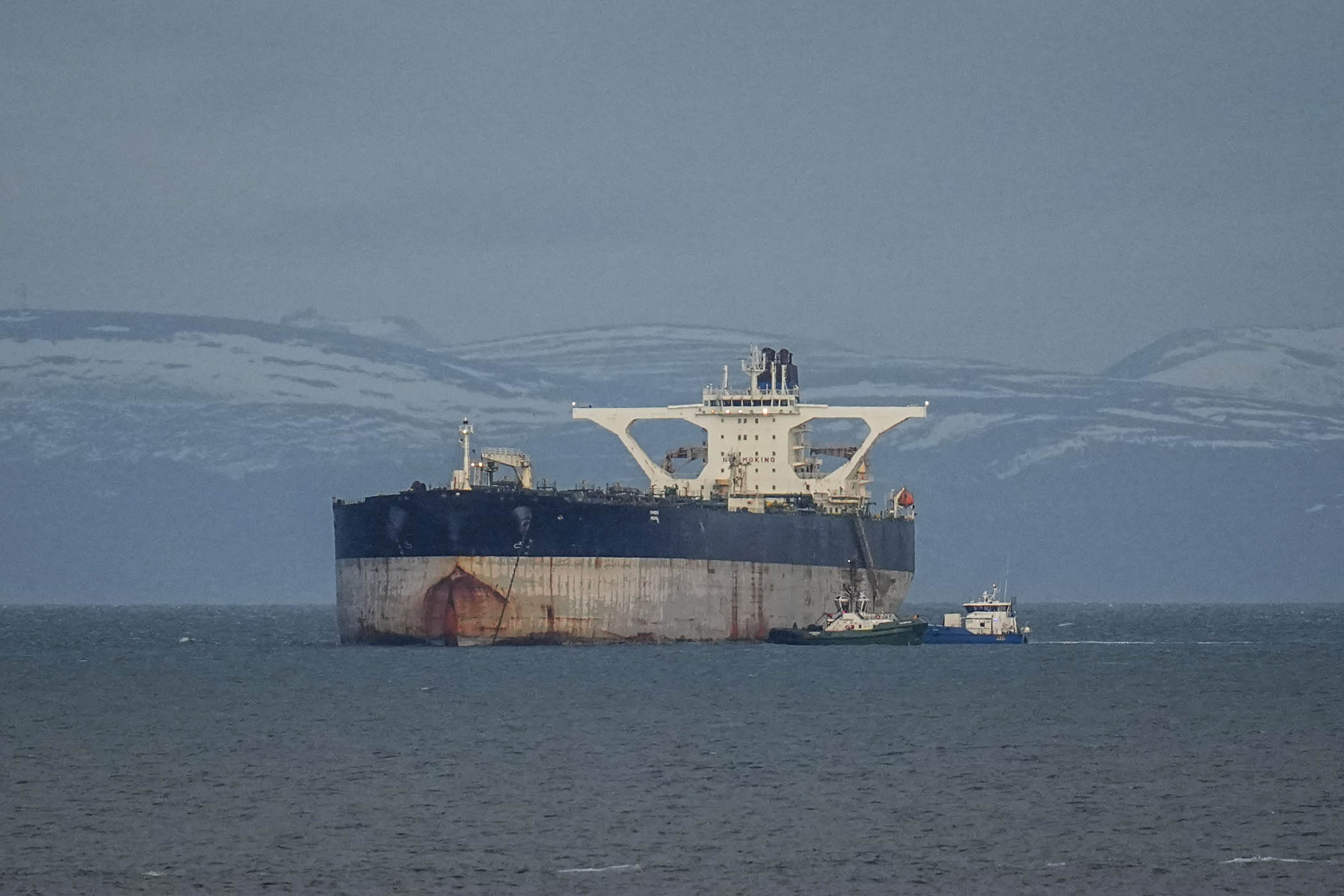




At least 18 “shadow” tankers from the Kremlin’s ghost fleet have passed through the Channel since the defence secretary said the UK would step up action to stop them selling Russian oil abroad.
The figure – from analysis by The Observer of marine traffic data on known sanctioned vessels – suggests illegal oil shipments are continuing despite the US seizure last week of the hastily renamed Marinera tanker.
British bases and at least one refuelling vessel assisted US forces in that operation, and John Healey, the defence secretary, explained the UK’s participation as part of a global crackdown on the ghost fleet that is helping to fund Russia’s war on Ukraine.
Among the vessels to have passed through the Channel since the Marinera operation on 7 January was the Onega, which has travelled as a stateless vessel since last March, when it was sanctioned and struck off Panama’s shipping register. It adopted its current name and the Russian flag in August and transited the Channel on 13 January. A day earlier, the Pate – which has flown Sierra Leone’s flag since August, having previously operated under Palau and Gabon – made the same journey unimpeded.
Following the operation against the Marinera, formerly the Bella 1 – its name was changed while being pursued by the US and its flag changed to Russian – the Ministry of Defence said “deterring and disrupting the Russian shadow fleet is a priority for the UK”. This may mean further military action against sanctioned vessels. Government sources confirmed to The Observer that the navy’s Special Boat Service will lead more missions to board sanctioned vessels as they pass through British waters, but would not say when special forces operations might begin.
Further analysis of 312 tankers that have been sanctioned since September shows that those vessels have made 160 journeys through the Channel since August.
Andriy Klymenko, head of the Institute for Strategic Black Sea Studies in Ukraine, says the Kremlin has spent much of the past four years building a global infrastructure for circumventing sanctions, and “as long as Russian oil exports continue, Russia will keep fighting”.
The seizure of individual tankers will have negligible impact on Russia’s economy, he says. The only way to undermine its capacity to wage war is through the physical reduction of its oil exports, and the only place to do that is the Baltic Sea, which it uses for 60% of crude oil exports by sea.
About 100 tankers, each carrying 100,000-150,000 tonnes of oil, transport 10-11m tonnes of crude oil per month, Klymenko says. Of those tankers, 10% have no flag, and should therefore be detained under the UN Convention on the Law of the Sea.
Newsletters
Choose the newsletters you want to receive
View more
For information about how The Observer protects your data, read our Privacy Policy
In practice, enforcement is minimal to nonexistent. When shadow tankers sail through UK waters, authorities typically make contact to request details such as registration and insurance documentation – information they should be unable to provide under sanctions. About a quarter of these ships fail to respond and proceed without consequence.
Klymenko says Russia is increasingly placing armed guards on ghost tankers – usually from private military companies such as the Wagner Group. These guards, acting on behalf of the ship owner, instruct captains not to comply with orders from Baltic countries to stop and allow inspection teams to board. The reality is that small, unarmed patrol boats are powerless against tankers that can be hundreds of metres long.
To avoid being confronted in the Channel, growing numbers of tankers are travelling around the UK’s west coast, according to Gonzalo Saiz Erausquin of the Royal United Services Institute, suggesting that the UK’s current rules of engagement act as a meaningful deterrent. These ships still reach their destinations, but longer routes add time and cost. The Ministry of Defence says Russian oil revenues have reached their lowest level since the start of the war in Ukraine.
Some countries have responded more forcefully. In May, Estonia attempted to board the oil tanker Jaguar, intending to escort it to port. The operation was aborted after Russia sent a fighter jet into Nato airspace in what was interpreted as a warning.
For sanctions to work, Klymenko says, “the model must be changed to prohibit sanctioned tankers from using not only ports and services, but also territorial waters”. For example, the Joint Expeditionary Force, which is led by the UK and includes most Baltic Sea countries, as well as Norway, could announce that sanctioned and flagless vessels will be refused access to the Baltic Sea via the Danish straits, backed up with naval enforcement. Similar enforcement measures could be introduced in the Dover straits.
The lesson of the seizure of the Marinera – last seen taking on supplies off Scotland’s east coast under British supervision – is that anything is possible given sufficient political will.
Photograph by Peter Summers/Getty Images