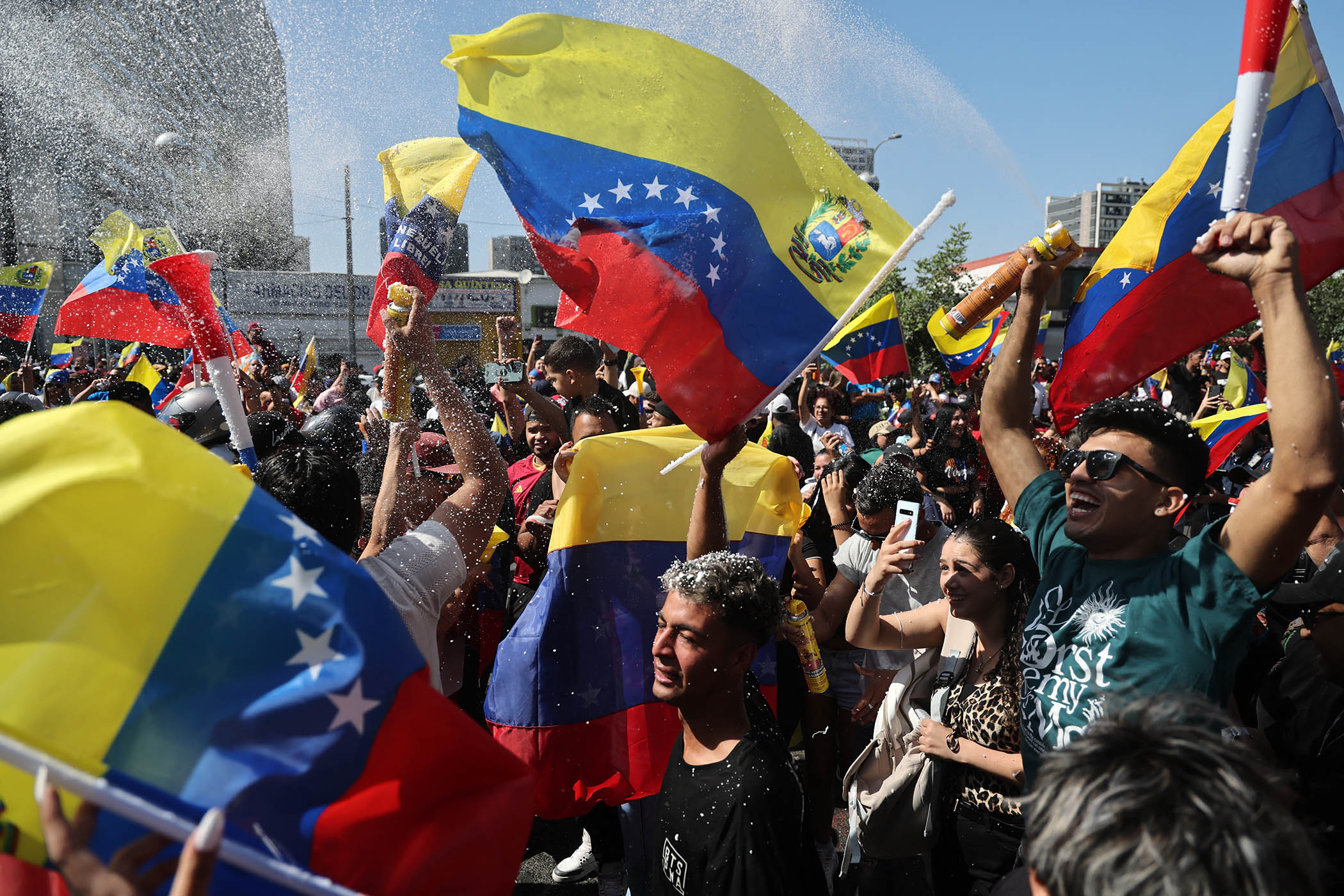
As Latin America awoke to the news that the US military had attacked Venezuela and extracted its leader, Nicolás Maduro, the immediate reaction from leaders across the region ranged from celebration to condemnation.
The Trump administration began amassing military assets in the southern Caribbean in mid-August, nominally to stop the trafficking of drugs to the US. But when it alleged that Maduro himself was the leader of a drug-trafficking cartel, many concluded that the true objective might be regime change in Venezuela.
The extraction of Maduro is a brutally clear demonstration of the “Donroe doctrine”: Donald Trump’s revival of the 1823 Monroe doctrine, in which the US marked the Americas as its patch – and was willing to impose its will through force.
While the region has long been wary of US interventions, Maduro, who presided over an economic collapse of his country that saw almost 8 million Venezuelans emigrate had become an unpopular, isolated leader.
Still, the strongest condemnation of the US intervention came from Brazil, whose president Luiz Inácio Lula da Silva said that the US had crossed “an unacceptable line”.
“These acts represent a grave affront to Venezuela’s sovereignty and yet another extremely dangerous precedent for the entire international community,” Lula wrote on X.
‘These acts represent a grave affront to Venezuela’s sovereignty’
‘These acts represent a grave affront to Venezuela’s sovereignty’
Brazilian president Luiz Inácio Lula da Silva
Mexico and Colombia – two other countries that the Trump administration has singled out for trafficking of drugs to the US – also condemned the operation, citing international law.
The president of Colombia, Gustavo Petro, who has made a habit of fighting with Trump online, called for an immediate meeting of the United Nations and the Organization of American States, while reposting comments on X describing the operation as illegal and sending troops to the country’s border with Venezuela amid concerns over an influx of refugees.
Meanwhile, Mexican president Claudia Sheinbaum Pardo referred to a statement from the country’s foreign ministry: “Mexico emphatically reiterates that dialogue and negotiation are the only legitimate and effective means of resolving existing differences, and therefore reaffirms its willingness to support any efforts to facilitate dialogue, mediation, or accompaniment that contribute to preserving regional peace and avoiding confrontation.”
The president of Cuba, perhaps Maduro’s only remaining staunch ally in the region, demanded an “urgent” response from the international community against the “criminal attack” by the US. “Our #ZoneOfPeace is being brutally assaulted. State terrorism against the brave Venezuela people and against Our America,” wrote Miguel Díaz-Canel on X.
Newsletters
Choose the newsletters you want to receive
View more
For information about how The Observer protects your data, read our Privacy Policy
‘To the Venezuelan people: it is time to reclaim your country’
‘To the Venezuelan people: it is time to reclaim your country’
Ecuadorean president Daniel Noboa
On the other side, Trump’s ideological allies in the region celebrated the operation, citing the Maduro regime’s repression of the Venezuelan people and the fraudulent victory it claimed in the 2024 election.
“FREEDOM MOVES FORWARD. LONG LIVE FREEDOM DAMMIT,” wrote Javier Milei, the libertarian president of Argentina, on X.
Bolivia, which recently elected a rightwing government for the first time for 20 years – one of a string of elections that has swung the region towards Trump – declared its support for the Venezuelan people and blamed the current crisis on the political movement of Maduro and his ideological godfather, Hugo Chávez, who it said had created a “narcostate”.
The president of Ecuador, Daniel Noboa, called on Venezuela’s exiled opposition leaders to return and take power. “To [María] Corina Machado, Edmundo González, and the Venezuelan people: it is time to reclaim your country,” he wrote on X. “You have an ally in Ecuador.”
In last year’s election, followers of Machado – who was banned from running – managed to collect voting tallies from more than 80% of polling stations showing that González, the stand-in opposition candidate, won more than twice as many votes as Maduro. Nonetheless, Maduro claimed to have won 51% of the vote and cracked down on protests.
Photographs by Javier Torres/AFP via Getty Images