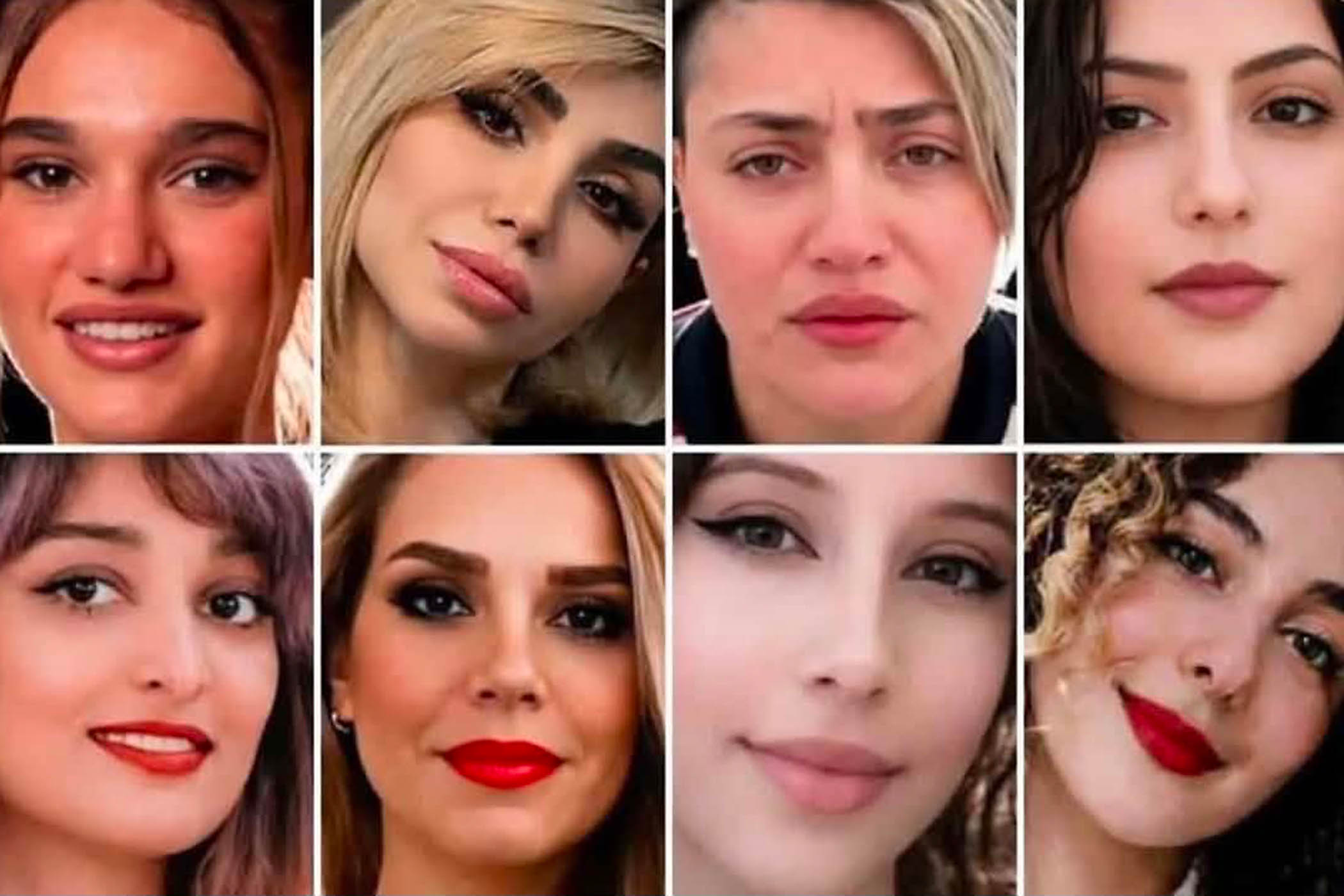
Hours before US and Iranian negotiators were due to meet in Pakistan last week, Donald Trump posted portraits of eight women on Truth Social with a plea to the Islamic Republic.
“I would greatly appreciate the release of these women,” he wrote. “Please do them no harm!”
Iran was preparing to hang them, according to a screenshot reposted by Trump alongside the photographs, which bore the telltale veneer of AI enhancement. Twenty-four hours later, Trump announced the “Very good news!” that Iran had agreed to cancel the executions in response to his request; Four of the women would be released immediately and the rest would be freed after one month in prison.
The images and Trump’s claims were instantly sucked into a vortex of misinformation and propaganda that has filled a void of reliable information, magnified by an ongoing internet blackout in Iran.
The details of their cases as claimed by Trump were quickly disproved, and the AI-enhanced photographs only amplified doubts surrounding them. But the women in the photographs were real; all eight were detained or disappeared during anti-government protests this year, though only one is currently facing the death penalty, according to human rights groups.
As well as generating fake content, AI tools are also being used in ways that make real images look artificial. The effect is similar: to damage the credibility of victims – and the work of human rights defenders who face huge challenges in documenting and verifying abuses in Iran.
“Until we have widespread, accessible and reliable verification systems in place, using AI on human rights documentation risks undermining the global trust around genuine content,” said Shirin Anlen, research technologist and impact manager at Witness, a global human rights organisation working to defend reality in the age of AI and contested truth.
Bombarded with a mixture of real and synthetic content, most people are likely to reject it outright than try to locate the seam between fact and fiction. Online AI detection tools also don’t distinguish between content that is enhanced rather than generated by AI.
For perpetrators, the confusion makes it easier to dismiss evidence of human rights abuses.
A news agency linked to Iran’s judiciary claimed none of the eight women Trump posted about were at risk of execution. Some had been released, while others faced imprisonment if found guilty of the charges against them, it claimed.
The Iranian Embassy in South Africa, which has been at the forefront of the propaganda war against Israel and the US, responded with its own montage of eight AI-generated women: “Eight other Iranian girls are going to be executed in Iran tomorrow. Ask Trump to help,” it read. Below “Thanks to chatgpt,” followed by a wink emoji.
Drowned out in the maelstrom was the plight of the eight women in Trump’s post. Bita Hemmati, has been sentenced to death alongside her husband and two neighbours for their involvement in protests, according to human rights organisations. Two others face charges that could result in the death penalty, while two more are detained with no further information. Two were released on bail and one has disappeared.
“The victims get lost in the entire story because they are only there to serve a political narrative or to justify violence,” said human rights lawyer Sherizaan Minwalla.
Among human rights defenders, there is a debate about whether AI can be harnessed for good. Some say it may create an opportunity for victims to come forward and share their testimony in a way that resonates and raises awareness, without violating their privacy.
“I remember everything,” says the Iranian woman, taking a seat in a softly lit room with books lining one wall and a Persian rug on the floor.
In the video, Maral, 34, described her harrowing ordeal interspersed with footage of the protests earlier this year. After being detained by Iranian security forces, she was stuffed into the back of a van and taken to a place with other women. Wiping a tear from her eye, she described how they were taken to another room – seven or eight at a time. “They raped us in groups,” she said.
In the top right hand corner of the video it says: identity protection, AI avatar.
The underlying testimony is real, according to the company that made the video. Generative AI for Good seeks “to amplify diverse silenced voices, deepen empathy and global awareness, and drive action on life-saving social challenges”, it says on the company website.
Human rights defenders say it risks backfiring.
“Survivors are so often disbelieved – look at the Epstein survivors, all the people coming forward in the Me Too Movement – people are still sceptical, so now when you start adding AI it just muddies the water so much more,” said Minwalla, who has worked with survivors of sexual violence in conflict.
“I don’t doubt by any means – I know what is going on in Iran is horrific – but then when you put an avatar on it and create a video, it looks so fake,” she said. “How is anyone supposed to believe that?”
Photograph by Donald J Trump/Truth Social
Newsletters
Choose the newsletters you want to receive
View more
For information about how The Observer protects your data, read our Privacy Policy