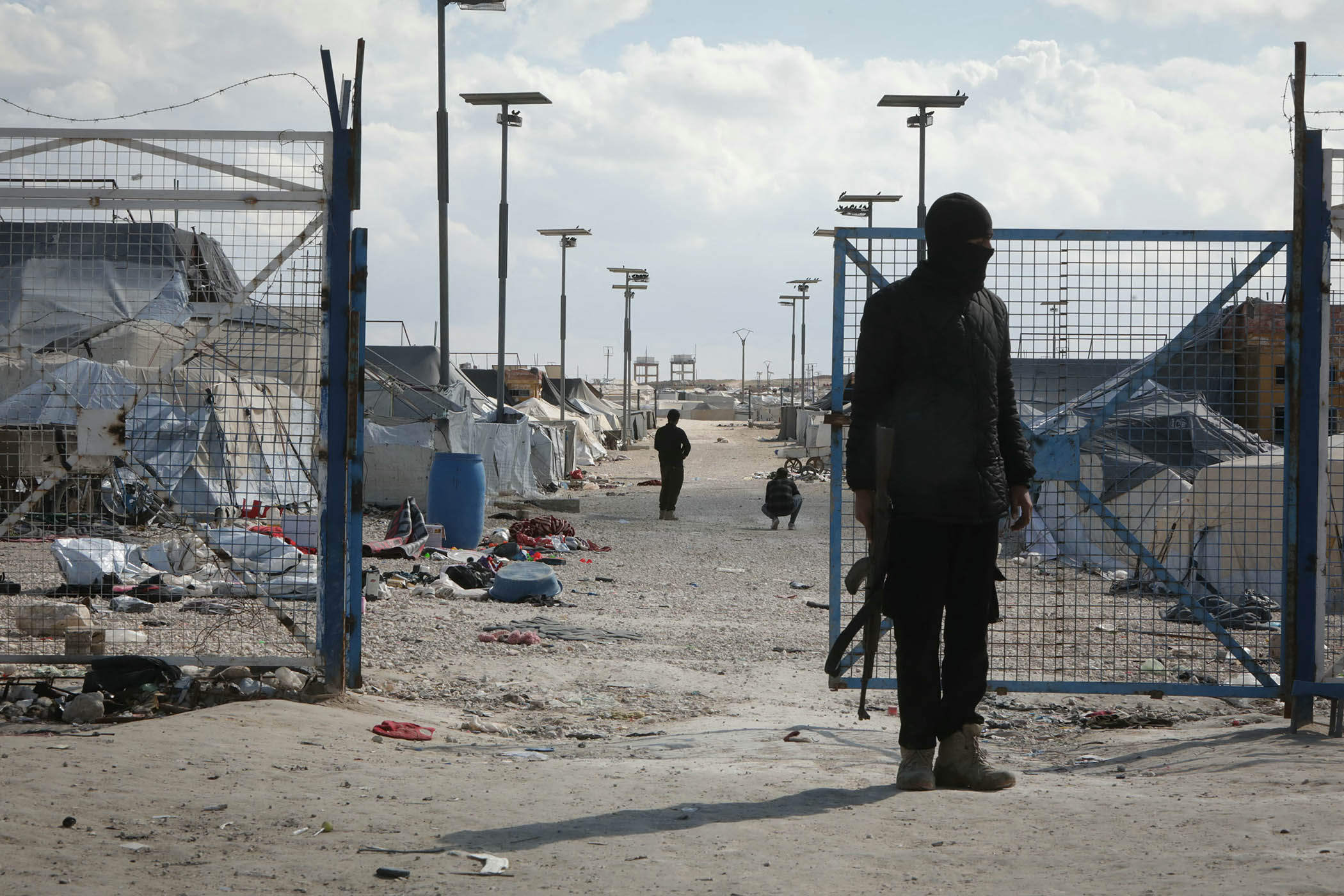
The cars came at night, parking a short distance from the open-air prison in eastern Syria. Women and children left through a hole in the chain link fence, walking about 15 minutes to reach the waiting vehicles. At last – after years held in a squalid camp in the desert – they were out.
It was a chaotic end to a festering problem that many had warned was untenable. Tens of thousands of people accused of links with Islamic State had been held without charge in al-Hol camp since the group’s defeat in 2019, including citizens of more than 60 countries. Their governments ignored repeated calls to repatriate them, citing concerns about security. But in the space of a few days this month, security at the camp unravelled, and its residents scattered across Syria – and beyond.
After leaving the camps, “we all came to Idlib, and after a week, some left for another city, some for Turkey,” read a text message from a European detainee, in an exchange with a humanitarian who asked to remain anonymous.
The collapse of al-Hol is part of a broader reordering of power in Syria following the overthrow of Bashar al-Assad. After seizing power in Damascus, Syria’s new rebel rulers moved to assert control over the whole of the country, which had fractured during more than a decade of civil war. In the northeast, a Kurdish-led group that allied with the West in the war against Islamic State controlled a swath of territory where a network of prisons and camps are located. As Syrian government forces pushed into their zone last month, the Kurdish-led group withdrew from al-Hol.
What happened next is unclear, but the camp, which held some 24,000 people – mainly women and children from Syria and Iraq – is now empty. Among those who got out are hardened acolytes of Islamic State who have raised their children to further the cause. But many others became disillusioned with the group, or were swept up by the conflict and pose no threat.
The mass escapes from al-Hol raise questions about the status of some 45 British women and children detained in another camp that is still under the control of the Kurdish-led group. Syria’s new rulers are expected to take over Roj camp, where 2,700 foreign nationals are being held, including about 15 British women and 30 children – the majority under the age of 12. Among them is Shamima Begum, who travelled from her home in east London to Syria more than a decade ago, when she was just 15. A local official said there were plans to close the camp, once again urging foreign governments to repatriate their citizens. Otherwise, it is unclear what will happen to them. Women in the camp are concerned they could be moved to another detention facility, according to a humanitarian worker who is in contact with several residents.
“We’ve seen what happened with al-Hol: these camps can collapse, there can be fighting, and people can disappear,” said Maya Foa, executive director of Reprieve, an international organisation that advocates for British citizens detained in Syria. “The do-nothing approach that the government is taking isn’t just harmful for the lives of the British kids and mothers: it’s also bad from a security perspective”.
About ten British men are also believed to be among 5,700 detainees rendered from prisons in northeast Syria to Iraq where Human Rights Watch said they face unfair trials and torture. The US transferred them out of Syria in recent weeks over concerns that detention facilities there were no longer secure. Iraqi officials have said they will put the men on trial, while urging their countries of origin to take them back.
A handful of British citizens have been repatriated to the UK from Syria in recent years, including unaccompanied children and two sisters who were underage when they travelled to Syria. But nearly all of those remaining in Syria have had their citizenship revoked by the British government “for the public good”.
Lawyers for Begum are appealing the decision at the European Court of Human Rights arguing she was trafficked by Islamic State for sexual exploitation. The British government revoked her citizenship in 2019 on the basis that she could theoretically obtain Bangladeshi nationality, though she was born in the UK.
Newsletters
Choose the newsletters you want to receive
View more
For information about how The Observer protects your data, read our Privacy Policy
“It is now crucial that states finally come through and take responsibility for their citizens,” said Beatrice Eriksson, spokesperson of the rights group Repatriate the Children Sweden. “This is the only way to prevent further radicalisation and to protect children and mothers from exploitation by violent extremist groups.”
In an open letter this month, a group of NGOs called on Prime Minister Keir Starmer to abolish a practice they criticised as “cruel, racist and ineffective”. Only Nicaragua and Bahrain deprived more people of citizenship than the UK between 2010 and 2024, it said. During that period, the British government stripped 223 people of their citizenship “for the public good”, with nearly half of those cases in 2017, when Islamic State was at the height of its power. No other member of the G20 has resorted to stripping citizens of their citizenship en masse.
The vast majority of those deprived of citizenship are Muslims with South Asian, Middle Eastern or North African heritage. A study by Reprieve and the Runnymede Trust found that people of colour were 12 times more likely to have their citizenship stripped than their white counterparts. As many as 9 million people are vulnerable to having their citizenship stripped – around 13% of the population.
“I’ve always grown up feeling like I am British. This is who I am, and this is where I’m from. So how can somebody say to you, you’re not?,” said Faisal, whose sister had her citizenship taken away, in comments shared with The Observer. “I think many people don’t know how dangerous this is to them.”
After years of demurring, bringing British citizens home from Syria is not only in the best of interests of security. It would also prove that citizenship is equal for all citizens of the UK.
More from The Observer
Photograph by Bakr Alkasem / Getty Images