


When Donald Trump announced the start of the war on Iran, he invoked the “imminent threat” posed by the regime to the US and its allies.
“If we didn’t hit within two weeks, they would’ve had a nuclear weapon,” Trump said several days later. “When crazy people have nuclear weapons, bad things happen.” In Trump’s rationale, there were echoes of a venture the US had vowed never to repeat. It took months for the Bush administration to make the case that Iraq had weapons of mass destruction, culminating in a PowerPoint presentation at the UN security council a month before the US invaded.
The Trump administration made no attempt to establish the “imminent threat” of a nuclear Iran. According to intelligence sources and official statements, it is untrue. Nine months ago, Trump declared Iran’s nuclear facilities had been “obliterated” after the US dropped 14 of its most powerful bunker-buster bombs on Natanz and Fordow, leaving craters so large they can be seen from space.
Since then, Iran made “no efforts” to rebuild its enrichment capability, according to US intelligence assessments. Asked whether Iran had been days or weeks away from building a nuclear bomb, the head of the UN’s nuclear watchdog agency, Rafael Grossi, simply said: no.
Israeli officials saw signs the Islamic Republic was determined to revive its nuclear programme. “They wanted to build another site that would be much deeper under a mountain and make sure that it was immune even to the B-2 bombs,” said Tzachi Hanegbi, who was head of Israel’s national security council until last October. “It’s not as imminent as it was in June, but if you don’t catch this now, they will get immunity from future attacks”.
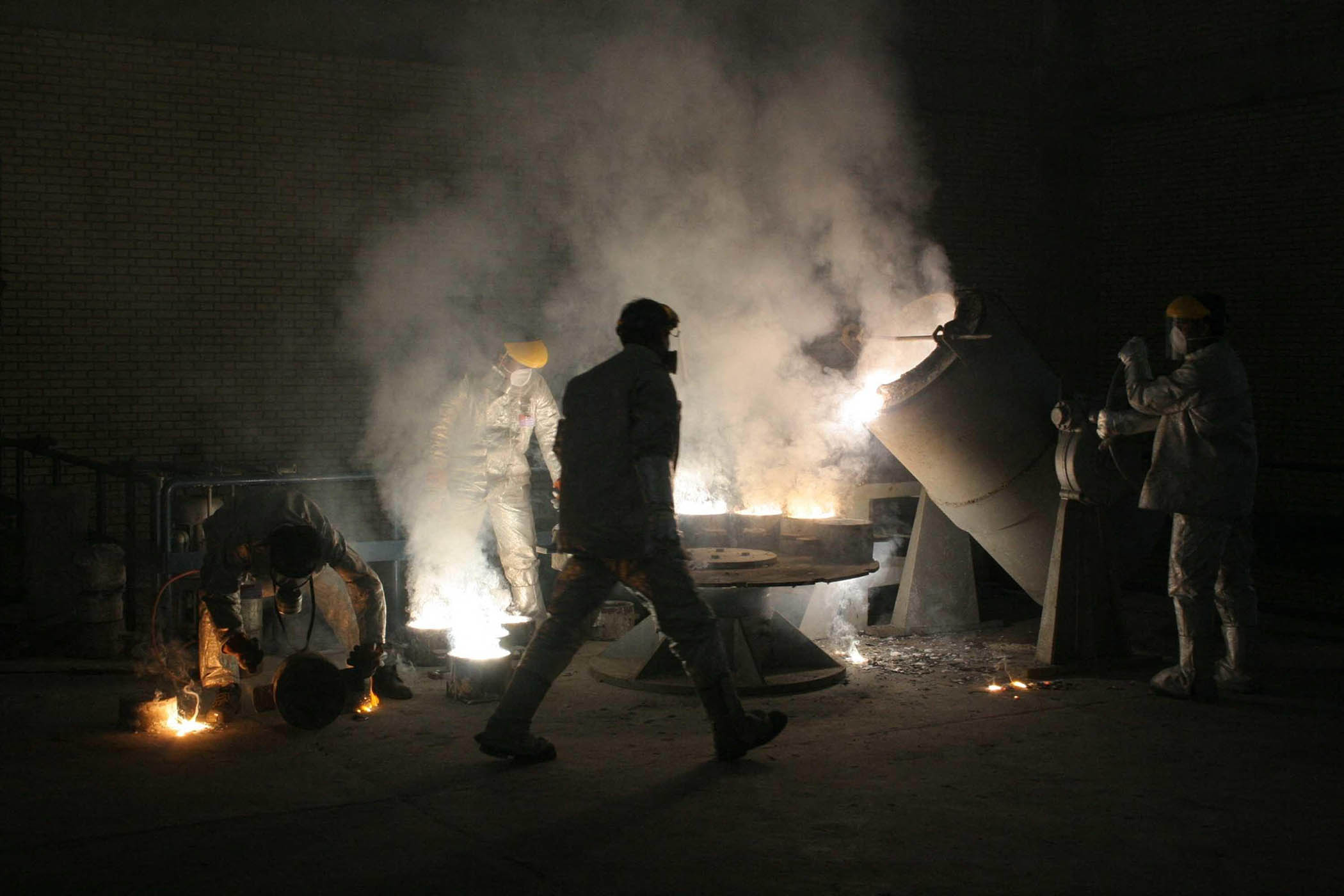
Had it decided to make a nuclear bomb, Iran would have faced huge challenges. First, it would have had to retrieve its 440kg (970lb) stockpile of highly enriched uranium from under the rubble of its nuclear sites. Further enriching it to weapons grade would require centrifuges that were destroyed in last year’s strikes. It would also have had to reconstitute the ability to convert enriched uranium from gas to metal, since the US and Israel destroyed Iran’s metallurgy facilities in Isfahan. Only once that was achieved could Iran have begun to develop and assemble a working nuclear explosive device. A crude device would have been months away, and a practical nuclear device a year – or longer. Still, Iran retained a stockpile of highly enriched uranium, a degree of knowhow – and intent.
Three weeks into the war concerns are growing about the stash of uranium. The regime shows no sign of cracking, and Iran’s late supreme leader, Ayatollah Ali Khamenei, has been replaced by his son Mojtaba, whose position on nuclear weapons – unlike his father’s – is unknown.
With uncharacteristic discretion, Trump has declined to comment on the possibility of a high-stakes ground mission to seize the cylinders containing the highly enriched uranium. The only way to manage the risks is diplomacy, said the head of the UN’s nuclear watchdog, Rafael Grossi. In talks before the war, Iran had proposed “downblending” its highly enriched uranium to lower levels and pausing enrichment for several years. It went further than the landmark 2015 nuclear deal, but not far enough for an administration that expected full capitulation and had little understanding or patience for a technical deal.
It will be difficult to convince Iran to return to the negotiation table with an administration that has twice broken off talks to go to war. If anything, Iran’s leadership is likely to conclude that nuclear weapons are indispensable. For years, the country had developed the infrastructure, expertise and technology to make a bomb, without crossing the threshold to weaponisation.
The doctrine known as “nuclear latency” was designed to deter Iran’s rivals, while avoiding the risk of overt weaponisation so clearly manifested in neighbouring Iraq. The attacks by the US and Israel have proved that strategy a failure.
Newsletters
Choose the newsletters you want to receive
View more
For information about how The Observer protects your data, read our Privacy Policy
“In the future, Iran will never again pursue a hyper-latency approach to weaponisation,” said Ali Vaez, a senior adviser to the head of the International Crisis Group. “Now that it has been convinced that nuclear weapons are actually essential for deterrence... it has more intense and higher motivation than ever before.”
Photography by UPI Photo/Stringer