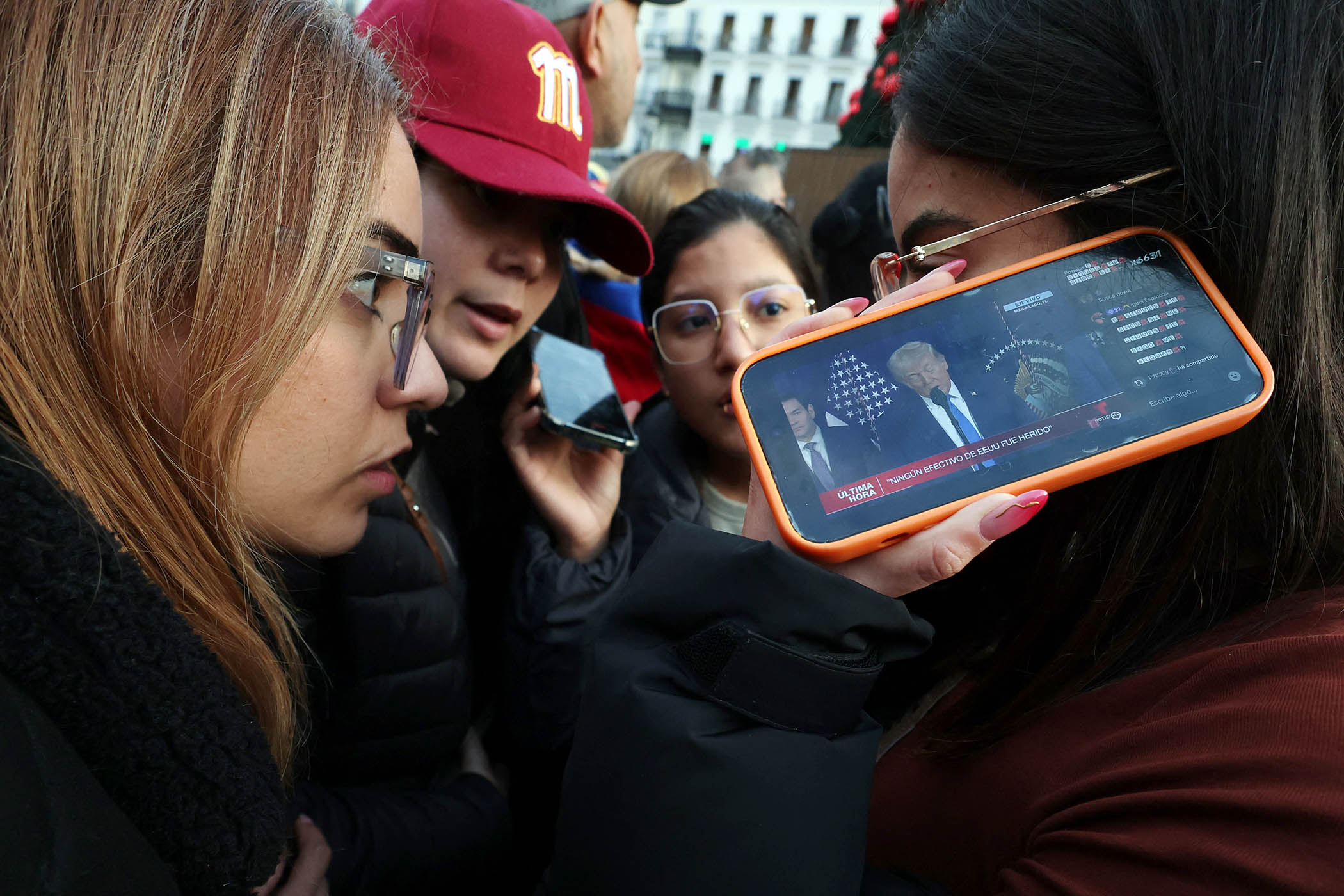

President Trump announced that the US will “run” Venezuela after president Nicolás Maduro was snatched by US forces in a pre-dawn raid after a months-long standoff with the oil-rich South American nation.
“We’re going to run the country,” Trump declared after Maduro and his wife Cilia Flores were dragged from their beds by US soldiers with the elite Delta Force. US troops swept into Caracas under cover of darkness after a barrage of airstrikes on targets across the Venezuelan capital. Within hours, the couple were onboard a warship bound for the US to face drug-trafficking charges.
Elected on a promise to end America’s involvement in foreign wars, Trump announced that the US would now occupy Venezuela, take control of its vast oil industry and oversee a change of power in Caracas.
“We can’t take a chance that somebody else takes over… We’re not going to let that happen,” he said at a press conference at his Mar-a-Lago estate on Saturday . He also issued a warning to other hostile governments in the region that “what happened to Maduro can happen to them”.
“We are reasserting American power… in our home region,” Trump declared, adding: “We’re going to make the people of Venezuela rich, independent and safe.”
‘We can’t take a chance that somebody else takes over… We’re not going to let that happen’
‘We can’t take a chance that somebody else takes over… We’re not going to let that happen’
Donald Trump
Trump hailed the raid , which followed months of brinkmanship with the Maduro regime, as “one of the most stunning attacks… and powerful displays of American military might… in American history.”
The president said he was “ready to stage a much larger attack” if the US-backed regime change faced resistance. “We’re not afraid of boots on the ground,” he said. “We’re ready to go again if we have to.”
In another echo of the Iraq war, Trump triumphantly posted a photo of Maduro in handcuffs, his eyes masked and wearing headphones, dressed in a grey tracksuit. The president said US troops had been ready to kill the Venezuelan despot if they faced armed resistance.
Trump said the White House had spoken to Venezuelan vice-president Delcy Rodríguez and was “designating various people” to run the country and “make Venezuela great again”.
He dismissed questions about America’s mixed record of sponsoring coups and regime change in Latin America. “Not with me,” Trump said. “We have a perfect record of winning.”
Newsletters
Choose the newsletters you want to receive
View more
For information about how The Observer protects your data, read our Privacy Policy
But Trump made clear the operation’s goal was to secure access to Venezuela’s oil industry.

Fuerte Tiuna, Venezuela's largest military complex, burns yesterday after explosions in Caracas
“They stole our oil,” he said, claiming US companies had built the energy infrastructure before they were expelled by successive socialist governments.
Speaking to Fox News before the press conference, Trump brushed off the outrage from members of Congress, which retains the constitutional right to declare war, insisting the operation was “really genius”.
“All they do is complain,” he said of his opponents.
“They should say, ‘Great job.’ They shouldn’t say, ‘Oh Gee, maybe it’s not constitutional.’ You know, the same old stuff that we’ve been hearing for years and years and years,” he said.
The operation began at around 2am local time, with a series of US airstrikes on military bases around Caracas, including the Cuartel de la Montaña which houses the mausoleum of Maduro’s predecessor, Hugo Chávez.
US military helicopters then swept low into the city, snatching Maduro and his wife from their secure compound on a military base. US officials said the operation took less than 30 minutes. Trump confirmed that US troops were wounded and one helicopter “hit up pretty bad” in the raid but confirmed that all personnel and aircraft returned safely.
‘This war is illegal... we went from the world cop to the world bully’
‘This war is illegal... we went from the world cop to the world bully’
Ruben Gallego, US senator
US attorney general Pam Bondi said the couple had been indicted in Manhattan, with Maduro facing narco-terrorism, drug trafficking and weapons charges. On social media, Bondi said the couple “will soon face the full wrath of American justice on American soil in American courts”.
The raid was the most direct US intervention in Latin America since the 1989 invasion of Panama to depose Manuel Noriega and brought condemnation from around the region.
The mounting pressure on Maduro to step aside was backed by a huge military buildup off the coast of Venezuela. The Gerald Ford aircraft carrier strike group was deployed to the region in November, backed by F-35 stealth jets, a nuclear submarine and about 15,000 troops. The US Coast Guard has seized oil tankers that the White House claimed were violating sanctions on Caracas.
Trump and Maduro spoke in late November as the standoff grew. The US president rejected Maduro’s offer to step aside and leave Venezuela if he could keep his multi-million-dollar fortune and secure amnesty for a coterie of allies.
In an interview broadcast on national TV last week, Maduro claimed he was still willing to cooperate with Trump’s demands.
“The US government knows, we’ve told many of their spokespeople, that if they want to discuss a way to combat drug smuggling, we’re ready,” he said. “They should know our message is very clear: ‘Not war. Yes peace.’”
Secretary of state Marco Rubio said Maduro was “under indictment for pushing drugs in the US”, but the Trump administration’s justification for ousting Maduro has shifted in recent days. Trump has demanded US access to Venezuela’s vast oil reserves and said the US would be “very much involved” in the country’s oil industry with Maduro gone.
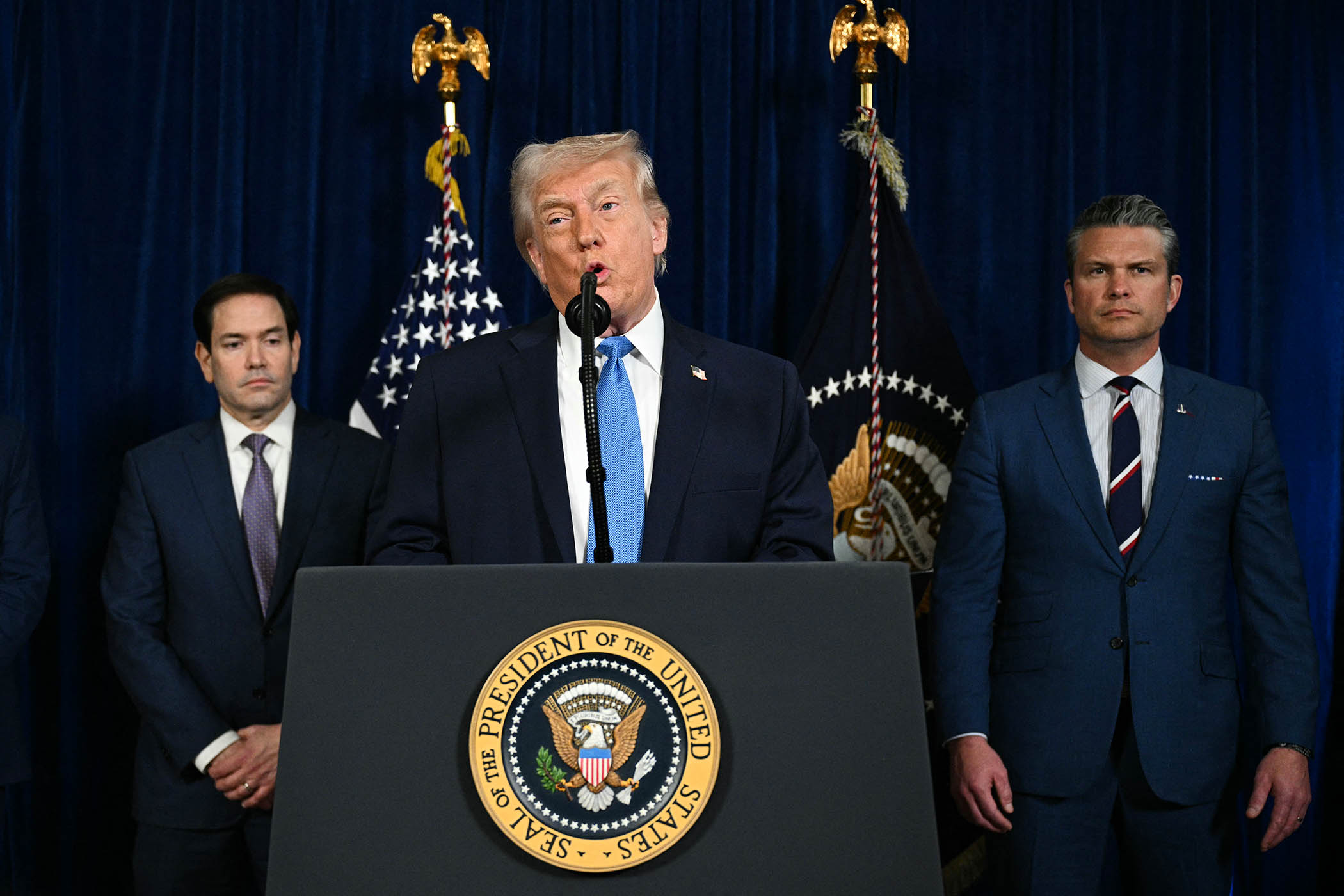
Trump holds a press conference at Mar-a-Lago alongside Secretary of State Marco Rubio and US Secretary of Defence Pete Hegseth
“We have the greatest oil companies in the world … the biggest, the greatest, and we’re going to be very much involved in it (the oil industry),” he told Fox News.
The Trump administration had previously denied that regime change was its goal in Venezuela and Democrats in Congress condemned the military operation as unconstitutional.
“This war is illegal, it’s embarrassing that we went from the world cop to the world bully in less than one year,” said Arizona Democrat senator Ruben Gallego. “There is no reason for us to be at war with Venezuela.”
‘If I lived in Havana and I was in the government I’d be concerned, at least a little bit’
‘If I lived in Havana and I was in the government I’d be concerned, at least a little bit’
US secretary of state Marco Rubio
Senior Trump aides, led by Rubio, have pushed to remove Maduro, arguing that his fall could trigger a domino effect that topples left-wing governments across the region.
Trump hinted that he could make similar intervention in Cuba. “I think Cuba is going to be something we’ll end up talking about, because Cuba is a failing nation right now, very badly failing, and we want to help the people,” he said.
The son of Cuban immigrants, Rubio issued a warning to Havana, declaring that “Cuba is a disaster… run by incompetent, senile men.”
“When the president speaks you should take him seriously,” he said. “So, if I lived in Havana and I was in the government I’d be concerned, at least a little bit.”
Trump also took aim at his Colombian counterpart Gustavo Petro, warning that he should “watch his ass” after the mission to seize Maduro. “He’s making cocaine and they’re sending it into the US, so he does have to watch his ass,” he said.
Some Republicans said the US action in Venezuela would embolden US adversaries.
“My main concern now is that Russia will use this to justify their illegal and barbaric military actions against Ukraine, or China to justify an invasion of Taiwan,” said Nebraska congressman Don Bacon. “Dictators will try to exploit this to rationalise their selfish objectives.”
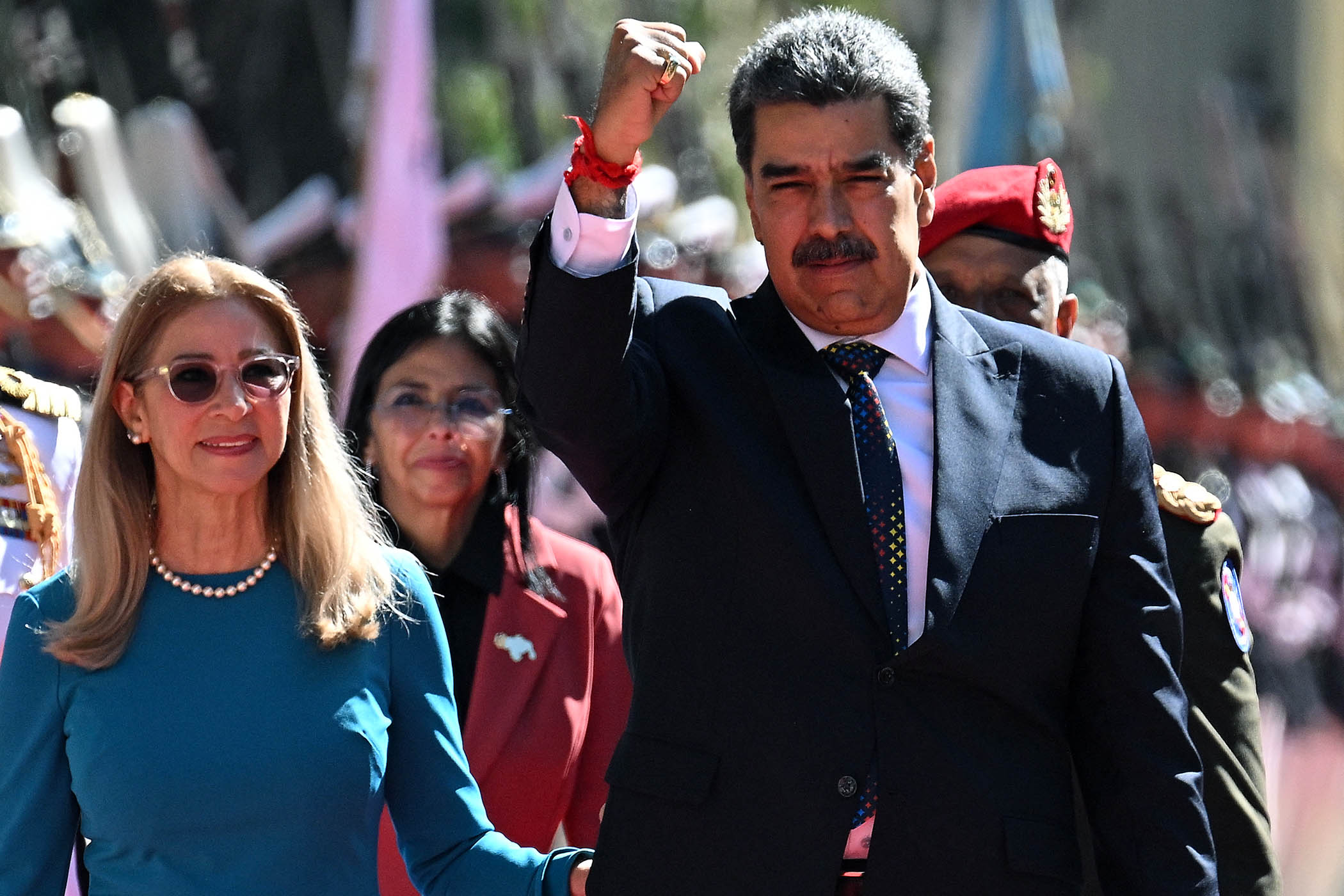
Venezuelan president Nicolás Maduro and first lady Cilia Flores were abducted by American special forces to stand trial in the US
Trump’s move also risks a backlash from his own political base, which backs an “America First” foreign policy. On the campaign trail in 2024, Trump vowed to end America’s involvement in foreign conflicts and the president has already faced dissent from some Maga supporters after he launched airstrikes on Iran’s nuclear sites last summer.
Venezuela’s government issued a call to action: “People to the streets!” Carmen Meléndez, the mayor of Caracas, joined a protest to demand the return of Maduro. A crowd chanted: “Maduro, hold on, the people are rising up!” and “We are here Nicolás Maduro. If you can hear us, we are here!”
But much of the city was quiet and the streets deserted in the hours after the attack. Many said they were stunned and fearful. A university teacher, who asked to remain anonymous due to fear of government repression, said she awoke to the sound of explosions at the Carlota airbase.
“I feel a lot of anxiety about what will happen next,” she said. “I’m afraid there will be more attacks and of what the chavismo [regime]will do.”
Now, she said the capital was remarkably quiet. “It is too calm, too much silence, I’m worried,” she said. She added that no one was in the streets of Caracas, and only a few cars had passed by in since the attack.
‘They have attacked us but they will not vanquish us… we will form an indestructible wall of resistance’
‘They have attacked us but they will not vanquish us… we will form an indestructible wall of resistance’
Venezuelan minister of defence Vladimir Padrino López
Another Venezuelan saw the helicopters from his apartment in Caracas before there was a power cut. Then he heard an explosion close by.
“Now there is a deep silence. People are careful and try to protect themselves [from government repression],” he said. “The next 48-72 hours will be the most important difficult ones,” as the Venezuelan government gauges its response to the attack.
“For now, there are only very small groups in the streets,” he added. “People seem very afraid and do not want to go out.”
Attention will now turn to the response from Venezuela’s military. The defence chief, Vladimir Padrino López, called on civilians and soldiers to unite against the US “invasion”.
“They have attacked us but they will not vanquish us… we will form an indestructible wall of resistance,” he said.
Venezuela’s opposition leader in exile, the Nobel peace prize winner Maria Corina Machado, declared that the “time for freedom has arrived” and said her colleague Edmundo González should assume the presidency with the support of the military.
“Venezuelans, these are decisive hours. Know that we are ready for the great operation of the reconstruction of our nation,” Machado said in a statement, calling for the release of political prisoners. “We have fought for years, we have given everything, and it has been worth it.”
Photographs by Pierre-Philippe Marcou/AFP via Getty Images, AFP via Getty Images, Jim Watson/AFP via Getty Images, and Photo by Federico Parra/AFP via Getty Images