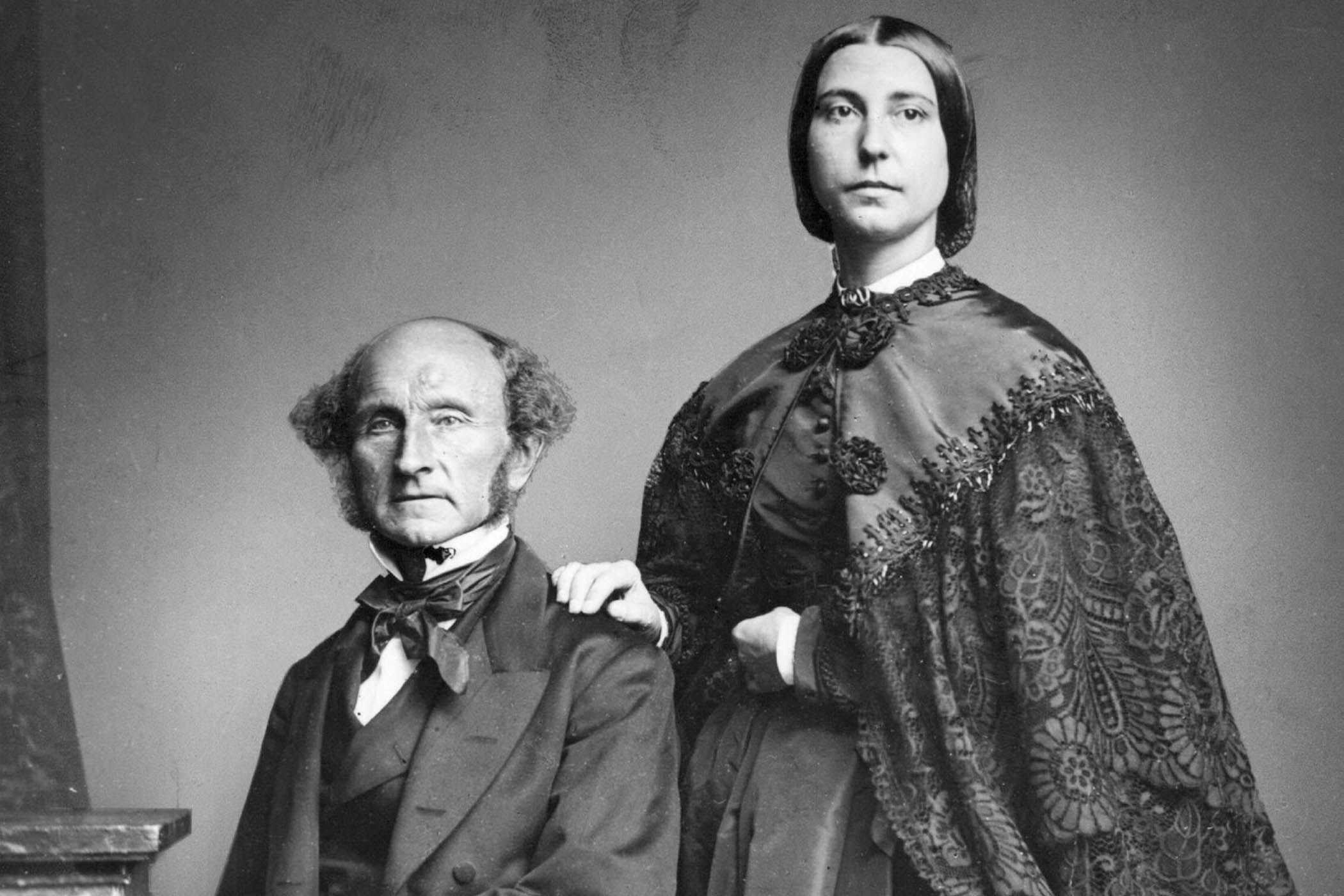

The name of England’s most influential 19th-century political writer, John Stuart Mill, has shifted along the spine of his seminal work, On Liberty, to make room for a co-author. The latest edition, out this month, gives credit to his wife, Harriet Taylor Mill, for the first time.
This step follows a fresh analysis of the book’s prose style which has revealed evidence to “say with some degree of confidence that JSM did not write On Liberty all by himself and that HTM played a part in putting parts of the text into words”, according to three of the six joint-editors of the Hackett Classics edition.
Lilly Osburg, Michael Schefczyk and Christoph Schmidt-Petri had first explained how the new textual clues stacked up in a 2022 essay.
The fact it has taken more than 150 years for Harriet’s name to appear on the cover is a neat literary irony, given that her husband is also famous for his radical work, The Subjection of Women. This volume contains the bold claim that “what is now called the nature of women is an eminently artificial thing – the result of forced repression”. After its publication in 1869, Mill was cast as a figure of fun and often depicted wearing a dress in newspaper caricatures.
Beyond the new “stylometry”, the strongest case for the joint-authorship of On Liberty comes from Mill’s own repeated acknowledgements of his wife’s contribution. Almost as if atoning for a sin, Mill namechecked Taylor Mill in the dedication, explaining she “was the inspirer, and in part the author, of all that is best in my writings […]. Like all that I have written for many years, it [On Liberty] belongs as much to her as to me.”
In his autobiography, he makes the point again, writing “...it is difficult to identify any particular part or element as being more hers than all the rest. The whole mode of thinking of which the book was the expression, was emphatically hers. But I also was so thoroughly imbued with it that the same thoughts naturally occurred to us both.”
The editors’ essay, printed in Utilitas, did concede that Mill would have had to push against all the norms of the day to credit his wife’s work, due to “bigoted and sexist Victorian times”.
Newsletters
Choose the newsletters you want to receive
View more
For information about how The Observer protects your data, read our Privacy Policy