Listen, I hate writing about this stuff. The minute I start talking about antisemitism my shoulders seize up and something heavy settles on my thorax. I sit here now, 48 hours after two Jewish men were stabbed in Golders Green in an intimate act of terrorism, and I am talking over myself, constantly muttering two thoughts at once. Is my fear valid, or is it politicised paranoia? Was the attacker a cold-blooded terrorist or mentally ill man, high on ambient racism? Or – in quiet moments – are these still my people? Is this still my home?
This was the third attack in five weeks in the same part of Golders Green. Last October, two people were killed in an attack on a synagogue in Manchester on Yom Kippur. In March, Jewish volunteer ambulances were firebombed around the corner from where, this week, the same ambulance crews would tend the knife attack victims. In April there were three more arson attempts in north London, first at Finchley Reform Synagogue, then Kenton United Synagogue, then a memorial wall, metres away from the stabbings, where today an empty chair sits guard and a parakeet screams.
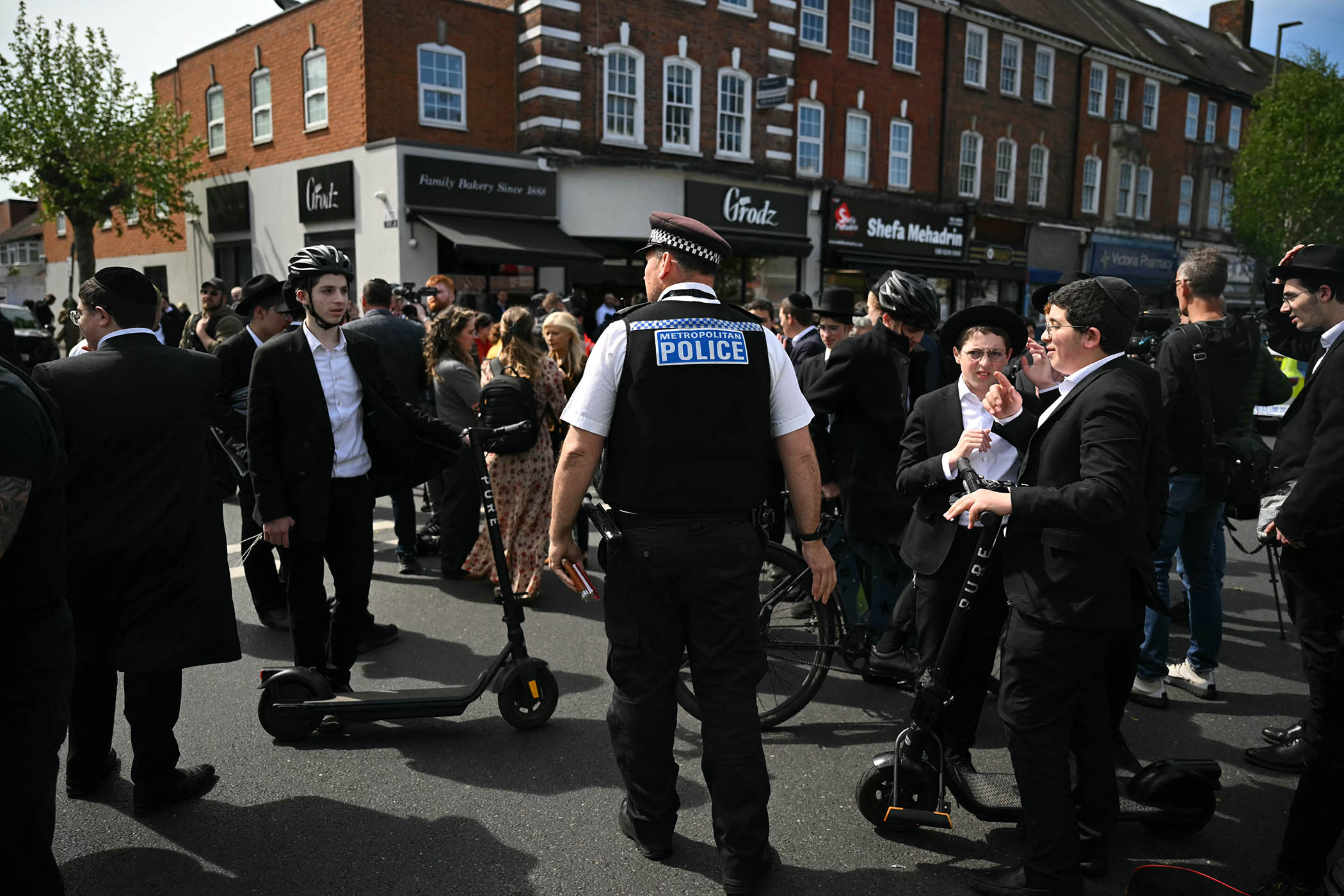
Golders Green, a north London suburb along the western edge of Hampstead Heath, has been predominantly Jewish since the first world war, and on a warm Friday morning as I walk down the high street, tight queues of people wait outside bakeries to buy challah for Shabbat and rugelach pastries for the children. By the underground exit, uniformed police tell me that though there’s an “increased police presence” following an additional £25m of government funding to boost patrols and protection in Jewish areas, I might not notice it on the high street, where they’ve sent “officers in plains”. They’re right, I don’t – the street, a man in the kosher shop tells me, feels “completely normal”, a fact that contains its own sadness. None of these attacks were shocking to a community that has learned to live, quite calmly, under constant threat.
As I approach Kosher Kingdom I see four different reporters hunched over notebooks doing voxpops with weary locals – like the attacker, they are approaching anyone who is “visibly Jewish”. Here I pass for another journalist, rather than a Jew. After the stabbings the crime scene outside Torah Treasures, a Judaica bookshop, became a press pit. Stocky men with earpieces appeared ahead of politicians and police officers. First there was Chris Philp, the shadow home secretary, then Kemi Badenoch, leader of the opposition, followed by Met police commissioner Sir Mark Rowley. Calls for Rowley to resign drowned out his prepared statement, while one heckler repeatedly shouted “bitch” when local MP Sarah Sackman spoke. That night, a rally at the tube station organised by a pro-Israel group called Stop the Hate carried banners saying “Keir Starmer, Jew Harmer.” At Torah Treasures, the owner Shani despairs of politicians, too. She says she doesn’t feel safe here any more, and like many of her friends is thinking of moving to Israel. “I feel very scared to be a Jew here. I have four kids, my son’s going to school every day by train. I say ‘take off your kippah’. He’s scared too.” Rabbi Charley Baginsky, co-lead of Progressive Judaism, gives her son similar advice, telling him not to wear the top from his Jewish camp out of the house. Just in case.
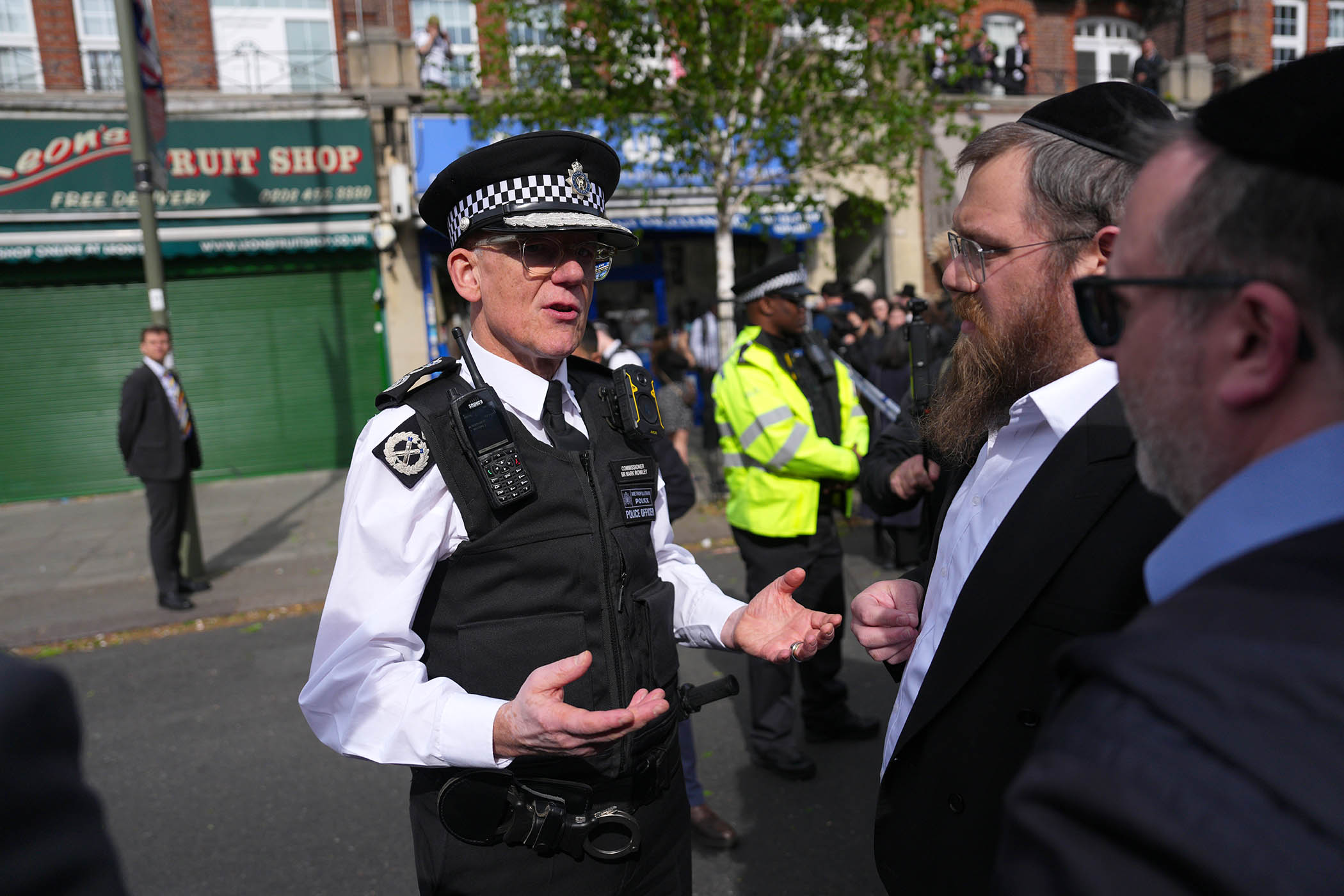
Met police commissioner Sir Mark Rowley speaking to members of the community.
Baginsky and I chat as I walk back up Golders Green Road. In the past she’s been noisily critical of the Israeli government, saying it poses an “existential threat” to Judaism, and I ask her what role Israel plays with regard to antisemitism. “Antisemitism is the oldest hatred,” she says. “The incidents that happen in the Middle East do not justify rising antisemitism,” instead they're used as an excuse. Is that right? Antisemitism can be slippery, and even at its most simple is rarely straightforward. Increasingly the language seems to eat itself.
On Radio 4, Britain’s Chief Rabbi Ephraim Mirvis called for a ban on what he calls “hate marches”, conflating Israel and Jewishness in a way that seems to perpetuate the very thing terrorists believe, and suggests Palestinian freedom is incompatible with Jewish safety. Here is some of the stuff that leads to this feeling on my chest, this tightness. Those who say all critics of Israel are antisemitic mirror those who say all Jews are racist. Rightwing politicians who make accusations of antisemitism have agendas that sit far beyond the safety of Jews, and (as in the case of Tommy Robinson or the Trump administration) are often friends with antisemitic extremists. The more that accusations of antisemitism are misused, the less power a real claim has. The midday sun is full, and under the awning of a bakery with a locked security door, I lean unsteadily into the shade.
The Jews that Rabbi Baginsky is talking to are feeling fearful, she says, insecure. “Had the stabbing been a one-off incident, we could talk about the individual's mental health, but it sits within this wider context that’s been building in the UK since 7 October.” Now she sleeps fitfully, “waking up in the morning and being glad that there’s not been another attack in the night”.
As lunchtime approaches I see girls from the local school, the school I went to, bunking off by the bus stop, their skirts rolled up and faces turned to the sun. The dread I feel today is an old dread, papery and flammable. Growing up, a certain amount of fear was baked into my diasporic Jewish identity, some light paranoia, the vivid sense that the world did not like people like us. In adulthood I started to unpick that feeling in order to work out what was real and what was (as Zack Polanski recently said, to online fury) “a perception of unsafety”. (He later said his remarks had been unfairly edited.) I left the feeling half-picked.
Polanski met more anger when he shared a social media post saying the police officers arresting the Golders Green attacker “were repeatedly and violently kicking a mentally ill man in the head when he was already incapacitated by Taser”. A similar argument had broken out in my sister’s street WhatsApp group. She lives down the road from Finchley Reform Synagogue (FRS), where the attempted firebomb had recently been thwarted. The security in Jewish buildings means each one is in essence a compound – bulletproof with high fences, guards posted outside. The nursery school at FRS, where I went as a toddler, now has a panic room and regular terror drills. In her WhatsApp group somebody posted a video of the arrest, expressing shock at the officers’ violence, and met immediate outrage from neighbours. Order eventually settled when somebody pointed out their conversation was a snapshot of “what it is to be Jewish. Two Jews, three opinions”. Though the Jewish population in the UK is tiny, there is no single “Jewish community”, instead about 280,000 people form many communities, each with their own politics, anxieties, variations in faith, and views that change, as people do. The next day, Polanski (the only Jewish leader of a major political party) apologised for his remarks about the police.
My son’s secular primary school was planning to visit FRS, but this week parents began expressing concern for the children’s safety. On Thursday they sent us a letter. “Now, more than ever, we believe it is important for children of different backgrounds to meet and understand Jewish people,” it read. This – educating children in the diversity of Judaism and potential of community – seems a more lasting way to tackle racism than concentrating solely on policing and party politics. I felt a shiver then, of what I later recognised as optimism. The visit is going ahead.
Newsletters
Choose the newsletters you want to receive
View more
For information about how The Observer protects your data, read our Privacy Policy
I call the synagogue’s Cantor Zöe Jacobs as I leave Golders Green. How does it feel going to work at the moment? How much of being Jewish involves fear? “Attacks are happening,” says Jacobs, carefully, “and they are intended to create terror and they are creating terror. And at the same time, I am inundated with people reaching out and saying, ‘this isn't the UK that we know’. That’s important because otherwise it can feel like all that there is is the fear.” It’s harder for young people, she adds, who find themselves swimming against a tide of antisemitism on social media, and when they “report it for hate speech, the response from the algorithm is, ‘we haven't found anything wrong with this comment.’”
A month or so ago I had a similar experience, after I opened Instagram to a voice message from a stranger saying I was “from the synagogue of Satan”. His was the first of hundreds of antisemitic messages that week – one said they were coming to find me, another simply “Gas Jews”. Half were from far-right accounts, the kinds of people I’d learned early to avoid, but the other half were from the left, which, though less murderous, felt infinitely worse. Another evening saw me awake quite late drafting a message to an old friend who, among his activist posts, had frequently started sharing memes about Jews. I fretted over my wording, wrote, rewrote, eventually deleted. I sleep fitfully too.
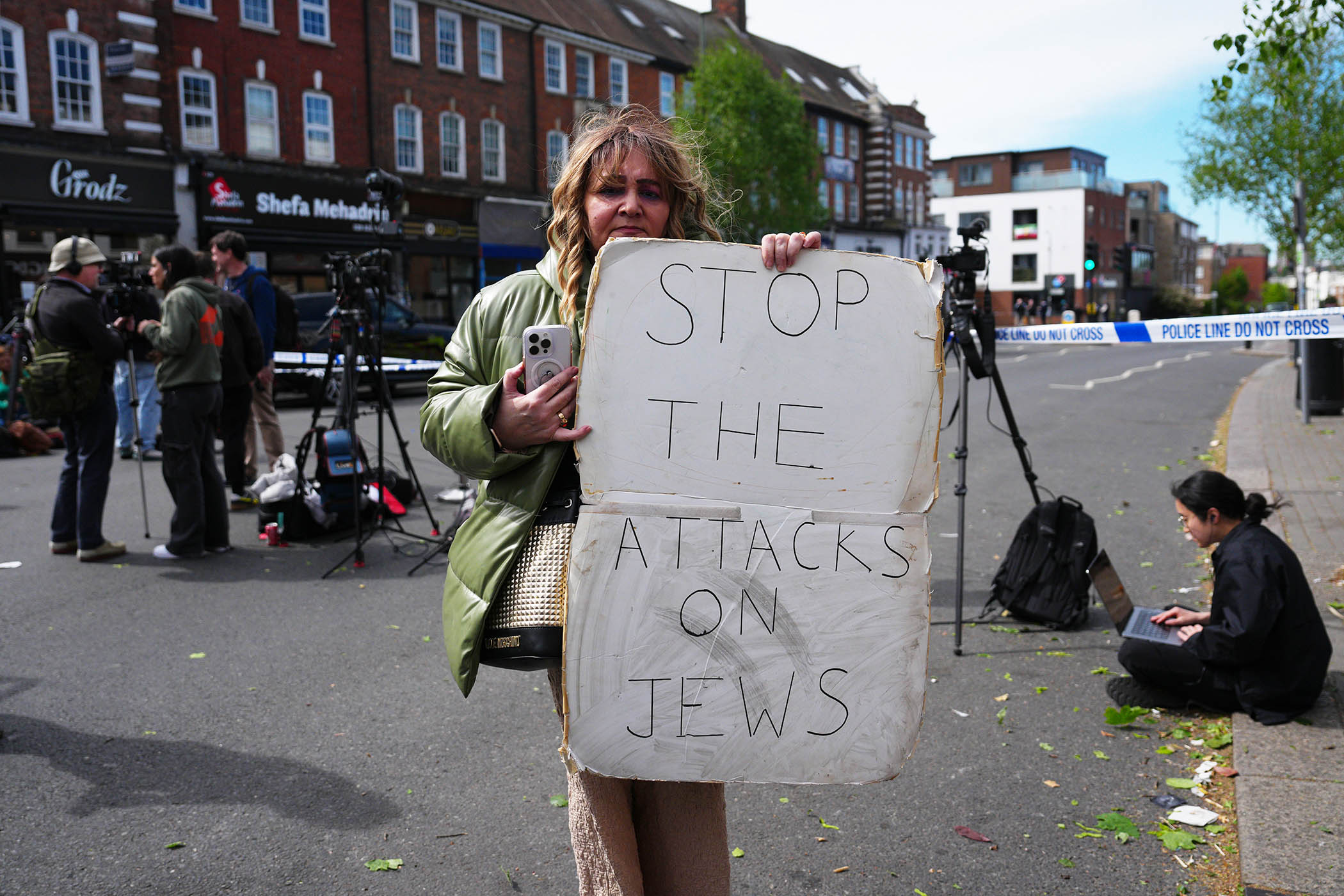
“There is no question that our history tells us that it’s not just that we’re paranoid, this is real,” says Baginsky. Then she tells me the parable of the “two pockets”. This is a Hasidic story that advises carrying two notes, one reading “I am but dust and ashes”, and another that says “For my sake was the world created”. She sees it now as a metaphor for antisemitism in the UK. “We’ve got to be realistic – we need security and to be safe. But in the other pocket, in many ways, there’s never been a better time to be a Jew.” If we don’t take that tension seriously we will silo ourselves from the world. For Jacobs, the parable is about knowing when to reach into which pocket, “and constantly balancing”.
The Friday night service following the attempted firebombing of FRS, the synagogue was full. As well as the congregation there were politicians, police officers, other faith leaders, and a huge number of people from the local Somali Bravanese community. When their centre was destroyed in an arson attack 13 years ago, FRS invited them to use the synagogue for the duration of Ramadan. The arrangement lasted for five years, the friendship continues today. As well as bringing terror, says Jacobs, the attacks “are also succeeding in bringing out the best in people”.
As I pass the heath there’s the smell of burning, an illegal barbecue somewhere, the first real hot day of the year opening out gloriously on to a bank holiday weekend, and my sister asks how it was, this journey to Golders Green, this trip through the weeds. I tell her I’ve started writing to try to find clarity, and that with all the fretting and questions I’ve never felt more Jewish in my life. I say a rabbi told me this story, about how we have two pockets so we can carry different thoughts at once, and it’s taken a small weight off my thorax, and she said, great, but did you put some rugelach in those pockets too, because it’s Friday night, Eva, and we need to eat.
Additional reporting by John Simpson
Photographs by Justin Tallis/ AFP, Carl Court / Getty Images