
Keir Starmer visited northern Scotland on Thursday to draw attention to Russian submarine activity in the North Atlantic and a joint British-Norwegian effort to confront it.
Starmer went to RAF Lossiemouth as leader of a nuclear power, and a prominent member of Nato, with one of the largest defence budgets in Europe. Successive British governments have played up the UK’s military strengths, but there’s a problem: those who know them best say there are far too many weaknesses.
Interviews with almost every defence secretary since the end of the cold war reveal what was really going on behind the scenes as the armed forces were weakened over decades, with money shifted into peacetime priorities such as health and welfare.
Compounding the crisis has been a failure by senior military officers and civil servants to spend what remains a significant defence budget well, with billions of pounds sunk on equipment programmes that have been delivered late, over budget and with faults.
The result, according to a former defence secretary, is that Britain has been left to rely on “a mirage” of fighting power as the threat from Russia re-emerges.
The comments were made in the latest instalments of The Wargame podcast by Sky News and Tortoise, which were released on Wednesday.
“As long as trooping the colour was happening and the Red Arrows flew and prime ministers could pose at Nato, everything was fine. But it wasn’t fine. And the people who knew it wasn’t fine were actually the Americans, but also the Russians,” says Ben Wallace, who was at the helm at the Ministry of Defence from 2019 until 2023.
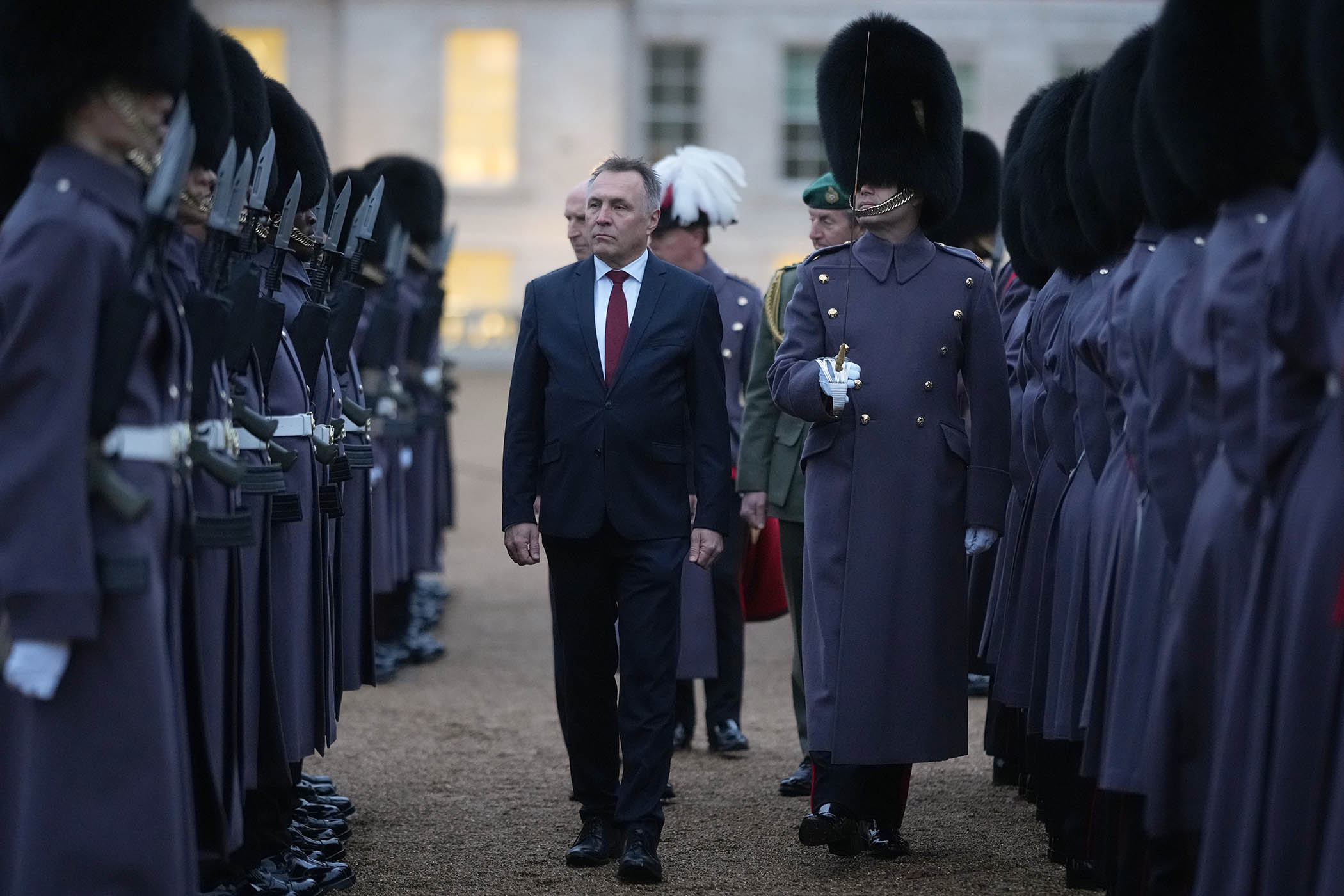
Norway's minister of defence Tore Sandvik inspects a guard of honour at Horse Guards Parade, London on 4 December
George Robertson, a Labour defence secretary between 1997 and 1999 and lead author of a major defence review this year, says when he most recently looked at the state of the army, Royal Navy and Royal Air Force he found “we were really unprepared”.
He adds: “We don’t have enough ammunition, we don’t have enough logistics, we don’t have enough trained soldiers, the training is not right and we don’t have enough medics to take the casualties that would be involved in a full-scale war.”
Gavin Williamson, a former Conservative defence secretary, says he too had been “quite shocked as to how thin things were” when he was in charge from 2017 until 2019.
Newsletters
Choose the newsletters you want to receive
View more
For information about how The Observer protects your data, read our Privacy Policy
“There was this sort of sense of: the MoD is always good for a billion [pounds] from Treasury – you can always take a billion out of the MoD and nothing will really change.
“And maybe that had been the case in the past, but the cupboards were really bare. You were just taking the cupboards.”
However, Philip Hammond, a Conservative defence secretary between 2011 and 2014 and chancellor from 2016 until 2019, was less sympathetic to cries for increased cash. “Gavin Williamson came in [to the MoD], the military polished up their bleeding stumps as best they could and convinced him that the UK’s defence capability was about to collapse,” he says.
“He came scuttling across the road to Downing Street to say, I need billions of pounds more money… To be honest, I didn’t think that he had sufficiently interrogated the military begging bowls that had been presented to him.”
The Wargame simulates a Russian attack on the UK and imagines what might happen, with former politicians and military chiefs back in the hot seat. It reveals how vulnerable the country has become to an attack on the home front – in two new episodes, it seeks to find out why.
‘We don’t have enough ammunition, we don’t have enough logistics, we don’t have enough trained soldiers, we don’t have enough medics’
‘We don’t have enough ammunition, we don’t have enough logistics, we don’t have enough trained soldiers, we don’t have enough medics’
George Robertson, Labour defence secretary 1997-99
The story of the UK’s hollowed out defences starts in a different era when an iron curtain divided Europe, Ronald Reagan was US president and an Iron Lady was in power in Britain.
Malcolm Rifkind, who went on to serve as defence secretary between 1992 and 1995 under John Major, remembers his time as a foreign minister in 1984. In December of that year, the prime minister, Margaret Thatcher, agreed to host a relatively unknown member of the Communist party politburo called Mikhail Gorbachev, who subsequently became the last leader of the Soviet Union.
Rifkind recalls how Thatcher emerged from the meeting and said, “I think Mr Gorbachev is a man with whom we can do business.” He adds, “I’m oversimplifying it, but that led to the cold war ending without a shot being fired.”
In the years that followed, the UK and much of the rest of Europe reaped a so-called peace dividend, cutting defence budgets, shrinking militaries and reducing wider readiness for war.
Into this new era stepped Tony Blair, Labour’s first post-cold war prime minister. Robertson, his defence secretary, revealed the threat he and his ministerial team secretly made to protect their budget from the chancellor, Gordon Brown, amid a sweeping review of defence, which was meant to be shaped by foreign policy, not a financial envelope.
“I don’t think I’ve ever said this in public before, but John Reid, who was the minister for the armed forces, and John Speller, who was one of the junior ministers in the department – the three of us went to see Tony Blair late at night. He was wearing a tracksuit, we always remember. And we said that if the money was taken out of our budget, the budget that was based on the foreign policy baseline, then we would have to resign,” Robertson says.
“We obviously didn’t resign – but we kept the money.”
The podcast hears from three other Labour defence secretaries – Geoff Hoon, John Hutton and the incumbent, John Healey – and from former Conservative defence secretaries Liam Fox, Michael Fallon, Penny Mordaunt and Grant Shapps.
Shapps is asked whether he regrets the decisions the Conservative government took when in power. He says: “Yes, I think it did cut defence too far. I mean, I’ll just be completely black and white about it.”
Robertson says Labour also shares some of the responsibility: “Everyone took the peace dividend right through.” Asked if the defence situation was worse than he had imagined, he said: “Much worse.”
Photographs by Leon Neal; WPA pool via Getty