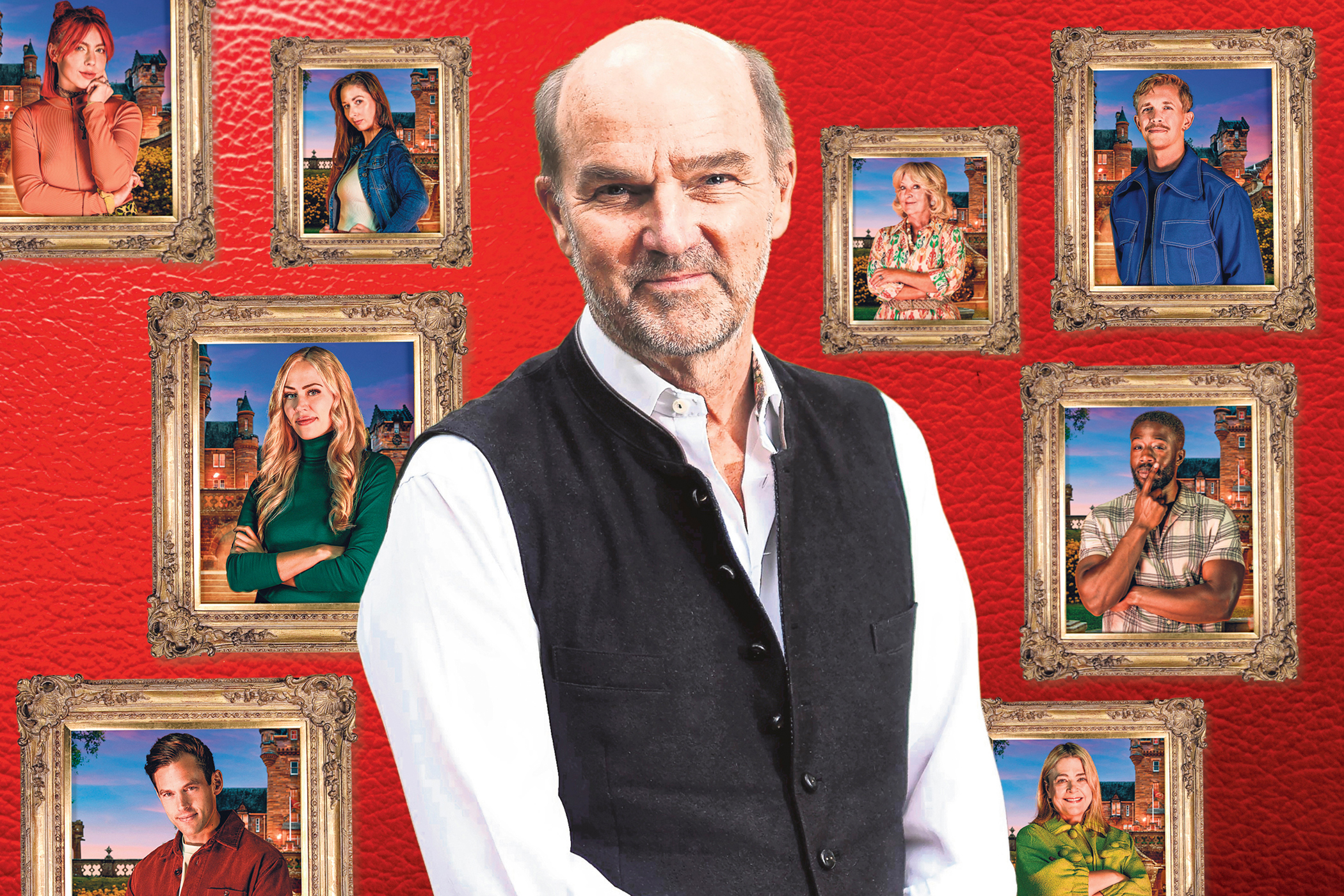
Watching The Traitors right now is like turning on a crime drama you’re familiar with and suddenly seeing the cast attack each other with pickaxes. In the past two weeks, traitors have turned on each other in public, faithfuls have asked to be banished to prove a point, and players have sneakily pocketed protective shields to keep themselves safe. One faithful has even offered himself to traitors to recruit, like a vampire familiar asking for fangs in the neck.
“The players this year have taken things to a new level – they’ve surprised even us,” says Lewis Thurlow, the show's executive producer. “We’ve seen a highly strategic game by so many players and they’re more invested in the game than in any series we’ve ever seen.”
The result is defying expectations and TV trends. Episodes on Thursday and Friday pulled in overnight audiences of at least 8 million – roughly the same as the tenth most-watched show of 2025 or the fifth most-watched in 2024. And that’s before catch-up figures are added. Given that catch-up can double an episode's ratings after 28 days, The Traitors is a phenomenon all by itself in a TV world where 4 or 5 million is considered a popular show.
But the real story of this series has been the players’ off-the-wall strategies – which are difficult to recount without spoilers. This, says Thurlow, was completely unexpected.
The only things producers decide on is the daily missions and the casting process – and it’s rigorous. Casting for the next series has started and filming won’t start until summer, giving producers around six months to pick the cast. The number of applications is climbing – about 20,000 applied for series one, 130,000 for series two and 300,000 for series three. Series four applications were a little higher, although Studio Lambert, the production company, is not revealing the final number.
Applicants have to submit a detailed form answering questions such as: what's your biggest fear? What's your biggest lie? Did you get away with it? As well as whether they would rather be a traitor or a faithful, plus their reasoning why. They also send a video explaining how they interact with people. After that, there’s an elaborate interview process and fitness and medical checks. According to this series’s banished contestant Amanda Collier, a CT scan diagnosed her with a “quite serious heart disease” before she took part in the show. The cast also undergo psychological checks which series three contestant Yin Lu described as “having an MRI scan, but full-body, full-heart, full-brain, even full-soul MRI scan” and the production company has a welfare team, including psychologists, checking in daily. The team stays in touch with the cast afterwards to let them know which scenes will make the edit and ensure they are managing the transition to post-Traitors life, helping adjust to public attention.
The key, says Thurlow, is casting players “who are going to play a good game, a hard strategic game. And then you might want people who are going to try to create alliances”. Each cast is built “from the ground up,” he says. “We definitely don't look at the last series. So this year Harriet and Fiona have gone down well. They were really strategic. But it’s a mistake to think, everyone loves this sort of character. You don't want a carbon copy cast.”
Working on a white board in the production office, the team starts with one or two cast members and builds from there, choosing people they think might complement each other. Things are “a moving feast until the very last minute” – hence the wipe-clean board.
Thurlow stresses that he and his team have no control over what happens once the players are in the castle
Thurlow stresses that he and his team have no control over what happens once the players are in the castle
The show has not been without controversy, particularly the accusation that players show “unconscious bias” in voting out ethnic minority contestants early on. In an article for Grazia, Otegha Uwagba wrote that the show is “a brutal reminder of how, in social situations where ‘in groups’ are liable to form, – a group of contestants on a TV show, say, or a workplace – people of colour are often deemed less trustworthy and ‘clubbable’, finding themselves on the outs.”
Newsletters
Choose the newsletters you want to receive
View more
For information about how The Observer protects your data, read our Privacy Policy
Thurlow stresses that he and his team have no control over what happens once the players are in the castle. Apart from wanting “likeable people you’d want a drink with”, he says he’s trying to produce what he describes as “the ideal version of a jury, a diverse representation of the British population. We want to represent British society as widely as possible and have a proper cross-section of society in every way so people watch thinking, ‘Oh, that’s how I would play it, or oh, that’s like my next door neighbour, or oh, I can imagine my dad doing that.’”
The only hard and fast rules are: no one who wants to take part to be famous or to get their faces on the telly. After that, he explains, “we talk to them about how they think about playing the game, and it is nice to have a variety of strategies”.
He highlights the difference between Matt and Harriet this series. Both were given “the same opportunity to speak to the traitors in a confessional booth, find information or play the game how they want to play it,” he says. “Harriet wanted to take control of her own game while Matt did the total opposite. He asked to be a traitor. From day one he’s wanted to be a traitor. It’s the contrast that works.”
Given the devious nature of the game, an ability to lie is a bonus. The traitors have to hide their identities and in this season many of the faithful have had secrets they’ve kept hidden. Ross and Ellie, both now banished, kept the fact they were a couple quiet, Judy and Roxy hid their mother/daughter relationship at the start, Amanda concealed her past life as a police detective and Harriet only revealed she was a criminal barrister as she was banished – following a spectacular implosion at the roundtable.
This mendaciousness is a useful skill for would-be players. Previous contestants have offered extensive online advice to would-be applicants on lying tactics to impress interviewers – including season two’s Brian, who showed up for his Zoom interview sporting a fake black eye.
“As soon as I got on the call I was like, ‘I’m so sorry, I feel so embarrassed I just like gave myself a black eye messing around with my friends,” he explains in his tutorial. “And then we got to the end of the call and I went, ‘stop’, I took control of the Zoom call and they were like, ‘whoa’, I totally blindsided them. I was like I’ve been lying to you this whole time.”
But whatever anyone does or says in the casting process, says Thurlow, has almost no effect on how they play the game. He says: “Everything changes as soon as they get into the castle,” he says. “Fiona was a lovely, sweet lady all through the application but once she was inside, my goodness she played that game hard.”
Photograph by Studio Lambert/PA Images/Alamy