
Those who worry about the future of the NHS can point to one grim worst-case dystopia: British dentistry.
Among the posh, dentistry is thriving – Tatler runs a list of the most fashionable private practitioners – but elsewhere the treatment of teeth has degenerated into an almost Victorian state. Sky News reported this month that a Beyond Borders-type charity set up to run clinics in poor countries is now spending much of its time in West Yorkshire, where its workers find people trying to extract their own teeth with ring pulls from fizzy drink cans. After eight years without a dentist, one man said he had “no real chewing teeth left”.
Tooth infections can turn dangerous; emergency admissions are through the roof. In 2024-25, 21,162 children aged 5 to 9 were admitted to hospital for tooth decay. Shockingly, tooth decay is the leading cause of hospitalisation among young people.
“We’ve got kids having to go to A&E and get antibiotics for toothache,” says Shiv Pabary, who works in urgent care in Cumbria and the north-east of England. Some of the most deprived areas of the UK have been dubbed “dental deserts”. In places such as Middlesbrough, West Northamptonshire and the London boroughs of Barking and Dagenham and Newham, there are fewer than 10 dentists per 100,000 people. But in an editorial, Nature declared that “the whole of Britain is now a dental desert”.
The crisis in dentistry echoes the one in mental healthcare. Policy-makers talk up the importance of these areas, but they are ultimately viewed as secondary to everything else dealt with by the NHS – such as broken bones and cancer – and that view is reflected in the funding. Over the past decade the money given to the health service has fallen by a third in real terms. In the last spending review the NHS got an increase of £29bn a year; dentistry is likely to get nothing. Among European nations, we invest the smallest proportion of our healthcare budget in dentistry. Yet studies acknowledge links between bad oral health and the development of conditions such as Alzheimer’s and diabetes. Good oral health contributes significantly to overall wellbeing.
Dentists are expanding into other aesthetic tweaks: Botox, micro needling and dermal fillers. All are quicker and easier than filling a damaged tooth, and have far higher profit margins
Dentists are expanding into other aesthetic tweaks: Botox, micro needling and dermal fillers. All are quicker and easier than filling a damaged tooth, and have far higher profit margins
Prevention is important (it is, after all, cheaper) but multiple public health innovations and awareness-raising campaigns – the sugar tax, National Smile Month – have not had visible effects. A recent government survey found that 41% of people had obvious signs of tooth decay, similar to the state of our teeth in the 1990s.
Dentistry’s second-tier status is also reflected in the attention we give to sorting out bad policy. Some of this dates to 2006, when a new contract dramatically changed the way people get their teeth seen to: Britons lost the right to register with a dentist in the same way they would with a GP, where practices get paid for every patient on their books. Instead, dentists would get paid for each “unit of activity”.
The fees were irrational and dentists raised concerns almost immediately. “You get paid the same per course of treatment, whether the patient needs one root canal or 10,” says Pabary. The change was made because the nation’s oral health was expected to improve, meaning people would require only small tweaks now and then. But that 2006 prediction was wrong. According to analysis by the British Dental Association (BDA), dentists lose £42.60 every time they fit dentures, and £7.69 when they examine each new patient’s dental health.
At last the contract is being changed. From April there will be a more sensible system for patients who need multiple treatments. A standardised payment package will be introduced for those who need more than one treatment at a time and dentists will be paid more for emergency treatments. Dentists, however, say this is a surface-level tweak, and in any case, much of the damage is done.
Newsletters
Choose the newsletters you want to receive
View more
For information about how The Observer protects your data, read our Privacy Policy
For one thing, dentists in England have subsidised treatment to the tune of about £332m a year – paid for by ramping up the proportion of private work they take on, limiting the slots available to NHS patients. This is unlikely to reverse.
The financial stress has driven many dentists to abandon the NHS altogether. A fifth of NHS positions are vacant – amounting to 2,749 vacancies. In one recent survey, 90% of dentists said they were suffering stress or burnout. More than 60% say they are thinking of leaving the NHS. Dental students increasingly go straight into private practice.
A shift in priorities within clinics may also be hard to change. “NHS dentists now concentrate on low-value treatment, seeing healthy adults too frequently, and providing scaling and polishes, rather than dealing with pain,” says Richard Watt, a professor of epidemiology at University College London. “There is lots of guidance on preventions – applying fluoride, giving patients advice about tobacco and alcohol, checking for oral cancer – but that’s not being incentivised either, so it’s not always implemented.”
That trend is echoed in private practices. These too are drifting away from root canals and fillings and towards veneers, whitening treatment and teeth straightening solutions, such as Invisalign: that’s where the money is. This has been exacerbated by individual practices being “rolled up” by corporations, transforming private dentistry from a cottage industry into a leaner, profit-driven enterprise. “These larger corporations are putting dentists under a lot of pressure to make money,” says Watt.
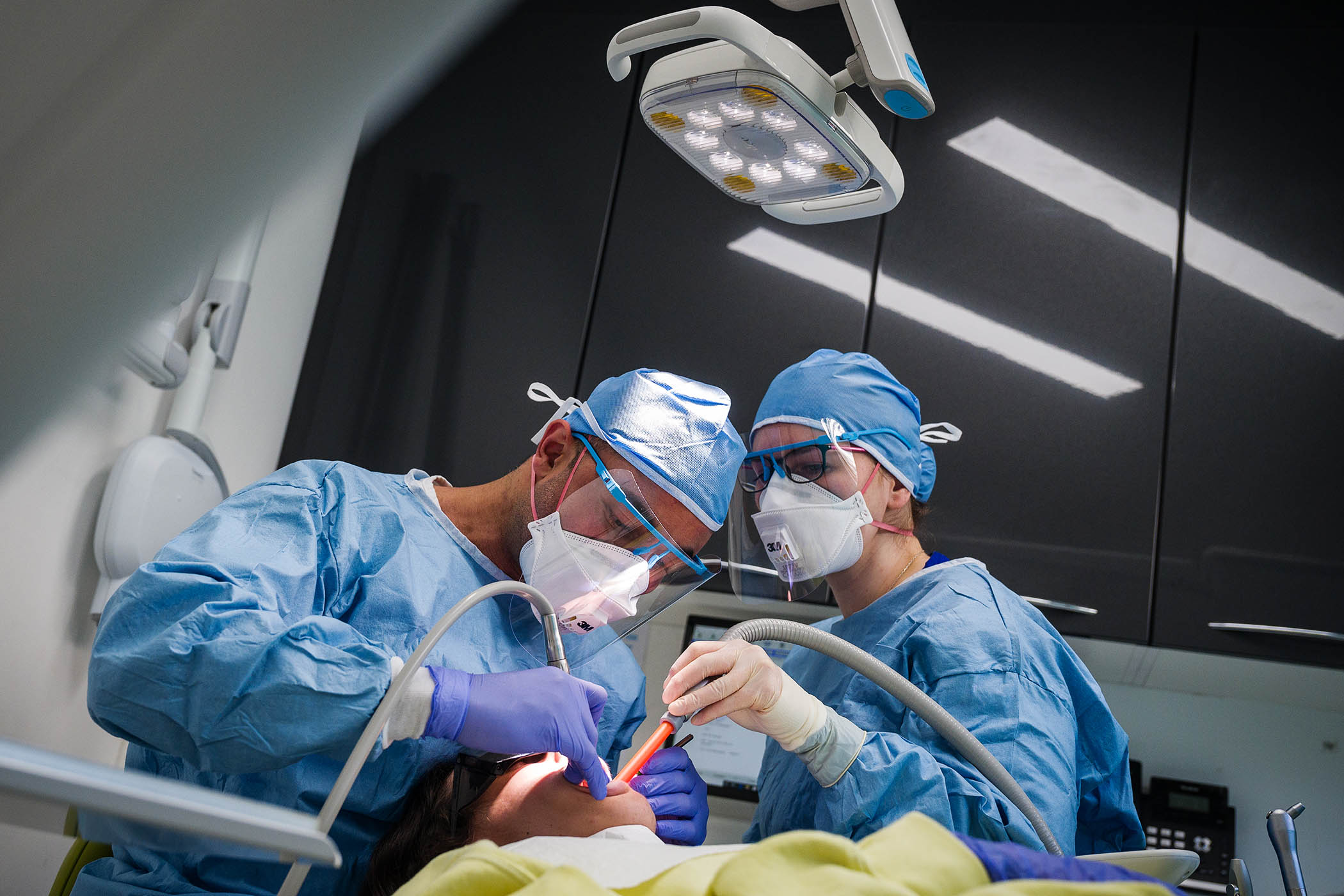
As a result, dentists are expanding into other aesthetic tweaks: Botox, micro needling and dermal fillers. All are quicker and easier than filling a damaged tooth, and have far higher profit margins. Demand for cosmetic treatment is soaring, particularly among the under-35s. But while dental spas proliferate, thousands of Brits are left with no treatment at all.
To rescue NHS care, dentists want a budget increase of £1.5bn, which they say is the amount lost in the past decade of effective cuts. “Otherwise we need to make some choices,” says Eddie Crouch, chair of the BDA. “One is to have a means-tested NHS service for the poorest, and send everyone else private. Another is to turn it into the equivalent of A&E, only dealing with emergencies. A third is to focus only on children.”
We also need more dentists, and one solution may be hiding in plain sight. There are about 6,000 foreign-qualified dentists in Britain who can’t work until they pass a General Dental Council exam that has both written and practical elements. The problem is it takes place only in London, can be sat by a maximum of 600 applicants at a time and is held just three or four times a year.
In the meantime, according to a report last year by the Association of Dental Groups, experienced dentists are flipping burgers at McDonald’s until it’s time to scramble to book an exam slot, in a process some liken to obtaining tickets for a Taylor Swift gig. Perhaps this is one piece of bad policy we could change in time.
Photograph by Leon Neal/Getty Images