


My wife is looking straight at me, but she can’t see me. I’m in a crowd of people in the West End but I’m also wearing a bright orange coat (down-filled, SuperDry, £40 on Vinted), so I’m hardly undercover. Still, it takes a wave from me before her face floods with recognition and a tinge of bafflement.
The problem is that I’ve changed. My silhouette is no longer Hitchcockian, as it had been for a couple of decades. Two and a bit years ago I was 140kg – 22 stone, with a BMI of 43 which is “severely obese” in NHS speak, and wearing size 46 jeans and 4XL tops.
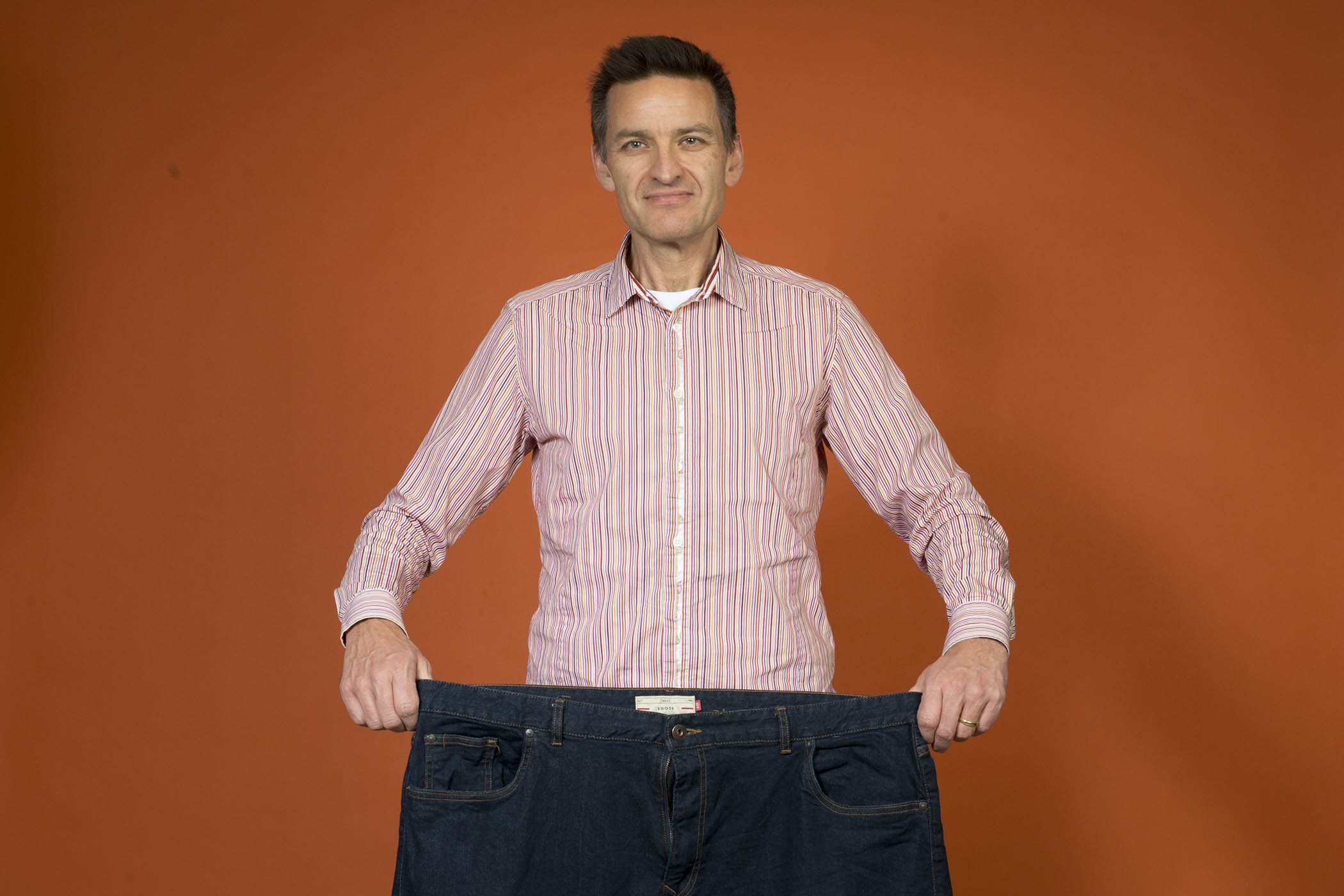
Now I’m 78kg, 12st 3lb, 24 BMI – a healthy weight – in size 30 jeans (Diesel, £5) and size S tops (Paul Smith, £8). Overall, since I started weighing myself every day, I’ve lost nearly 57kg, which is nearly 42% of my body weight. That’s almost 9 stone in British, 125 pounds in American or about one Taylor Swift.
Eli Lilly doesn’t list “may cause unrecognisability” as one of the side-effects of Mounjaro but it’s an unexpected one for me, along with “risk of Vinted addiction” and “can result in fashion crimes”. A former colleague who knows me well, but hadn’t seen me for months, spent most of a conversation mixing me up with a mutual friend, until she styled it out. That was funny; immigration officers at Dubai airport suspecting I was using a fake passport because the 2023 photopage didn’t match the man in front of them in 2025, was not.
Bodies are our identities. Who wants a raven-haired Monroe, a brow-plucked Groucho or a Thinston Churchill?
Losing weight had seemed impossible – unimaginable, in fact. All the evidence pointed the other way. Diets were short-term pain for long-term weight gain. Exercise was hard to sustain and, for someone of my heft, embarrassing to do in public. Why bother trying when failure was inevitable?
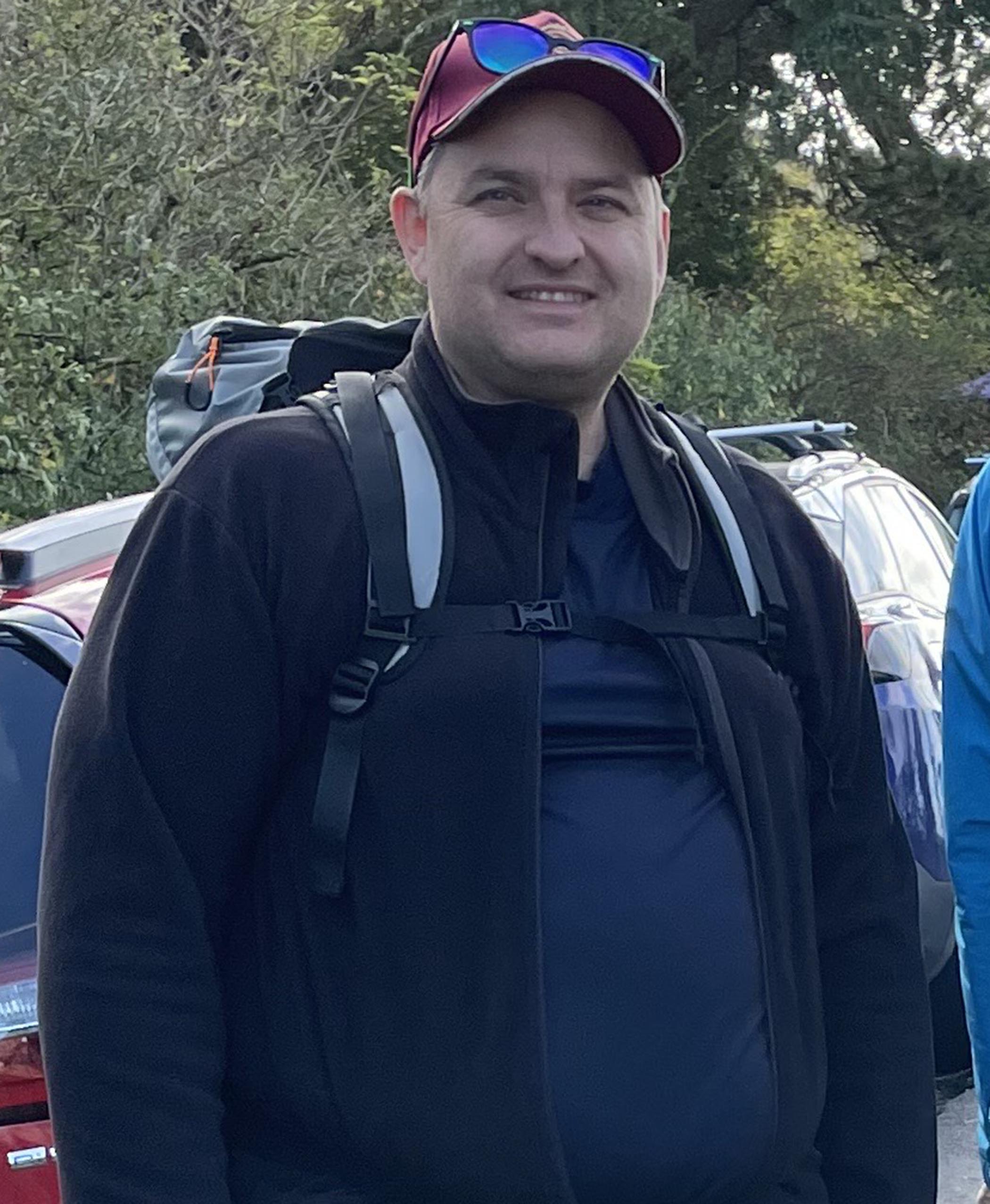
James Tapper in more substantial times
So for me the pin-prick needle of a Mounjaro pen has been a magic wand, dispelling 30 years of despair. Behind the sorcery, though, is a story about science, and science stories are a cattle-prod for the imagination. Usually, reporting on the marvels of new research leads me to flights of fancy. Would I clone my cat? Would brain implants allow me to access my unconscious mind? Could I navigate the Pacific by learning the patterns of waves?
Yet somehow it hadn’t occurred to me when reporting on weight-loss drugs that the numbers of people taking them might include me. Until, that is, I began researching a tip in April 2025 about brides being rushed to A&E after losing too much weight before their wedding.
I’d had a bit of success, over the course of about a year, on what I think of as the Robin McKie plan. The Observer’s former science editor, who retired last April after more than 40 years, had adapted a pandemic metric, the seven-day rolling average of Covid cases, for his own coronavirus-inspired weight-loss journey. If, on a daily weigh-in, the number goes the wrong way, the angel of despair is banished by the McKie mind trick of looking at the trend.
This scientific approach gave me a taste of success – 15kg in 13 months, my spreadsheet shows, the result of doing Couch to 5k again and eating an orchard’s-worth of apples. If I kept that up, in three years I might simply be overweight.
Newsletters
Choose the newsletters you want to receive
View more
For information about how The Observer protects your data, read our Privacy Policy
It was time to dive in. But what about the side-effects? People reported severe nausea, dehydration, constipation, even malnutrition and mental health problems. Serious but rare side-effects include gallstones and pancreatitis. Then there’s the cost – despite my severe obesity, I did not qualify for NHS treatment, and the monthly cost doubled after Donald Trump pressured Eli Lilly to raise prices outside the US.
I’ve been lucky, so far. I could afford it – even after Eli Lilly decided last summer to double the wholesale price of a monthly starter dose from £122 to £247.50 – and I’ve not noticed any side-effects from the drug, although there are some from losing weight. And covering the science beat means I’ve also had the privilege of discussing GLP-1s with some of the UK’s foremost experts along the way.
The science bit often left out of GLP-1 stories is how these drugs work. GLP-1 is used as shorthand – properly, they are incretin mimetics, since they work by mimicking gut hormones called incretins. The two we know of are Glucagon-Like Peptide-1 (GLP-1) and Glucose-dependent Insulinotropic Polypeptide (GIP).
Our guts produce these hormones naturally after we eat. They then tell our pancreas to release insulin, creating the incretin effect of regulating our blood sugar levels, slowing down the passage of food through our bodies and telling our brains we feel full. Semaglutide (Ozempic and Wegovy) mimics GLP-1, while tirzepatide (Mounjaro and Zepbound) mimics both GLP-1 and GIP.
Clinical studies show average weight loss for semaglutide users is 17% of their body weight over 68 weeks, while for tirzepatide it reached 22.5% over 72. My loss on the drug of 42kg, or 35% of my body weight, in 38 weeks makes me an outlier – another piece of luck.
I’m conscious that not everyone is so lucky. Losing weight has made exercising far, far easier – my best 5k time is under 27 minutes and it used to take me 40 – but years of obesity have given me knee problems; other people might not be able to run and cycle as much as I have. I can’t forget, either, that some people can’t cope with the nausea or other side-effects and have had to give up. And is the pursuit of weight-loss actually a good thing? Am I adding to the western hallucination that thin is better? Has losing weight made me happier?
I mean, yes, yes it has. Being fit is fun. The compliments, the ability to astonish old friends, the sense of achievement – these are all ego-boosts. But some of the positives also point to areas of society that are unfair. I can take a seat on an airline or train without worrying I won’t fit. I can go into clothes shops and actually choose things, rather than know nothing will fit me. I no longer avoid meeting contacts face to face, in case my physical self repulses them. There are plenty of studies suggesting that people believe that if you’re obese you’re lazy, lack willpower or moral character, have bad hygiene or are stupid, as the World Obesity Federation puts it. That translates into discrimination by employers, teachers and even doctors and the fear of that discrimination has always been at the back of my mind.
Barking at people to ‘eat less and move more’ obviously doesn’t work otherwise we wouldn’t have an obesity epidemic
Barking at people to ‘eat less and move more’ obviously doesn’t work otherwise we wouldn’t have an obesity epidemic
Barking at people to “eat less and move more” obviously doesn’t work, otherwise we wouldn’t have an obesity epidemic with nearly two thirds of adults overweight. Alongside incretin hormones we have ghrelin, a hormone that stimulates hunger. For every kilo lost, ghrelin levels rise – your body signals that you need to eat, eat, eat to regain that lost weight. It’s why dieters yo-yo. The body goes through a process called “metabolic adaptation”, using less energy (although whether this really contributes to weight regain is a matter of scientific dispute). Maybe I can feel my own adaptation happening: as I’ve lost weight, I’ve become intensely sensitive to the cold. Sitting in an office requires a T-shirt, shirt, two jumpers and a jacket.
There are so many unanswered questions but the biggest one for me is what happens if I stop the jabs? One theory is that we have a “biological set point” – a weight that the body thinks it should be – and it pumps out ghrelin until we hit that weight. That could explain why a meta-analysis in January found that on average people regained weight rapidly after coming off incretin mimetics.
Perhaps by tapering – slowly reducing my Mounjaro dose – I’ll be able to recalibrate my set point, but there’s no scientific evidence for this. There is some evidence that patients who have bariatric surgery see their set point change, but people who lose weight rapidly by dieting, like me, are much more likely to rebound. Yet another hormone, leptin, which tells the body it has stored enough fat, might be the key. Obese people often suffer from leptin resistance – their brains do not respond to the hormone’s signals that they have had enough. Studies in mice show that another drug, rapamycin, may help.
Reading research like this or hearing people talk about using GLP-1s like statins, as a lifelong medication, is quite disheartening. I worry that other people suffering from obesity due to ghrelin levels or leptin resistance might feel it’s still pointless to even try. The flaw behind the body positivity movement has always been that obesity is linked to poor health.
Reading this research also makes me wonder about habits ingrained since childhood – always clearing my plate; taking the last scrapings from the pot – that amount to years of training to ignore my body’s signals. The last 10 months have helped me tune into what my body is saying: listening to it is easier when it doesn’t have to shout above the food noise.
I’ve come far enough to still have hope, though. And too many pairs of size 30 jeans (Paul Smith, £7.50) to give up.
Photographs by Sophia Evans for The Observer