

Photographs by Tom Pilston for The Observer
Will Barnard, a farmer with a mischievous face and easy wit, points out an excavator on a field.
“A digger that size disappeared into the peat last summer,” he says. “Somewhere out there is a steam train. It came off the tracks and disappeared. The ground was too sloppy to get any lifting gear in.”
Centuries of mystery lie beneath the peat of the Somerset Levels. King Alfred hid from the Vikings at Athelney when the village was an island in the Avalon marshes, like Glastonbury Tor a few miles westward. Alongside diggers and locomotives in the bogs are prehistoric chariots, neolithic axeheads and Roman coins.
For centuries people have tried to tame the Levels by draining the marshland, to plant apples or brassicas or graze cattle. This 250 sq mile-landscape is crisscrossed with rhynes, a network of drainage ditches worked on by Dutch engineers. The water that seeps into the rhynes is pumped up into larger channels whose banks rise above the farmers’ fields.
It costs about £2m a year to run, but global heating makes this sum barely a finger in the dyke. Warming seas deliver more rainfall and construction of the £249m Bridgwater Tidal Barrier Scheme is under way to protect nearly 13,000 homes and businesses from Bristol Channel surges.
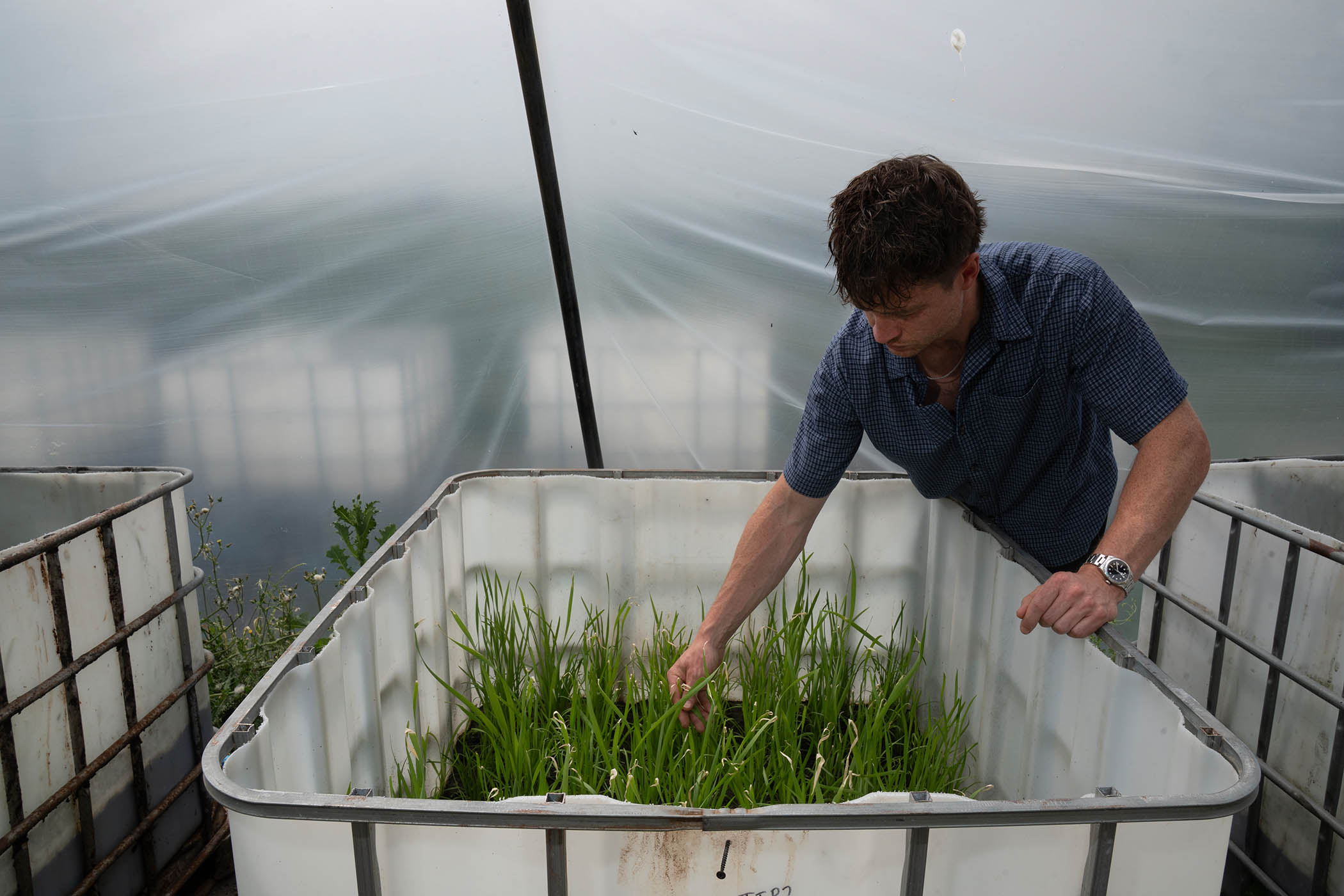
Austin Shepherd checks on bulrush seedling in a polly tunnel.
Barnard is convinced there must be an easier way. Instead of fighting nature, why not let the fields flood? The f-word is a touchy subject though. “People tense up,” he says, at the mention of storing water in the landscape – a red flag for flood-hit communities. “They’re not wrong in that you do want to be rid of the stuff you can’t handle, but it’s about balancing things.”
The balance began to tilt in 2021, when Chris Evans, a professor of biogeochemistry, demonstrated that global peatlands store more carbon than all the trees and plants in the world. But when peat dries out, it begins emitting carbon. The UK’s dried out peatlands account for about 4% of its emissions. The Department for the Environment, Food and Rural Affairs is supporting moves to rewet dry wetlands, and the Biodiversity Net Gain scheme means farmers can get grants to rewild their land.
Barnard kicks the dirt. No farmer likes the idea of being paid for idle land their families have cultivated for decades. “I have the advantage of being a second-generation farmer,” he says. “I can follow the money and the opportunities. I don’t have five generations tutting over my shoulder that I’ve ruined it all.”
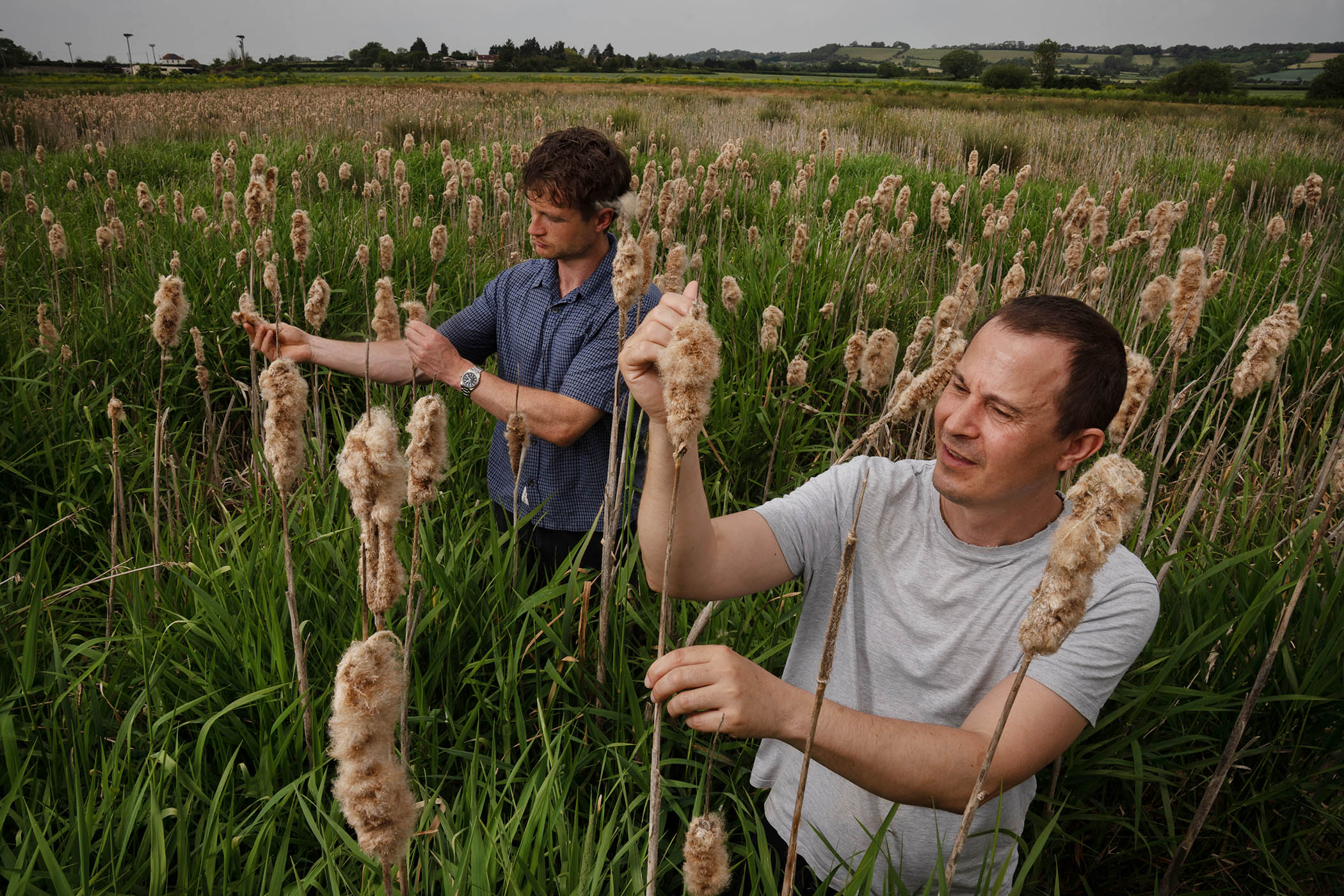
The field we are standing in is soggier than the neighbouring ones planted with winter barley. It’s also a lot wilder, more like in King Alfred’s time, with bulrushes above us, their wispy, cotton-ball heads swaying in the breeze. Barnard picks one apart to show why this land is not just being used, but used profitably. The wispy seed heads trap air, an excellent natural insulator.
Newsletters
Choose the newsletters you want to receive
View more
For information about how The Observer protects your data, read our Privacy Policy
Barnard harvests the bulrushes – typha latifolia, a native English plant – and sells them to Ponda, which cleans the seeds and turns it into BioPuff wadding for puffer jackets, handbags and other garments. Twenty seeds is enough for one jacket.
So far Ponda has done fashion collaborations with Berghaus and Stella McCartney, for her Falabella bag line, and its fledgling supply chain is working with sustainable fashion brands including Sheep Inc on luxury knitwear and Melina Bucher’s vegan handbags and accessories. In the autumn it will launch a Ponda x Imperial College London collaboration – the founders were students there – with their own line of gilets and jackets.
Austin Shepherd, Ponda’s man responsible for finding more farms, says that wet fields can yield as little as £1,000 per hectare for traditional crops. “We’ve been paying farmers up to £4,000 a hectare for purchase of the material,” he says “The argument is that the lowest-performing wet fields that farmers are struggling with can be hands-off and more profitable.”
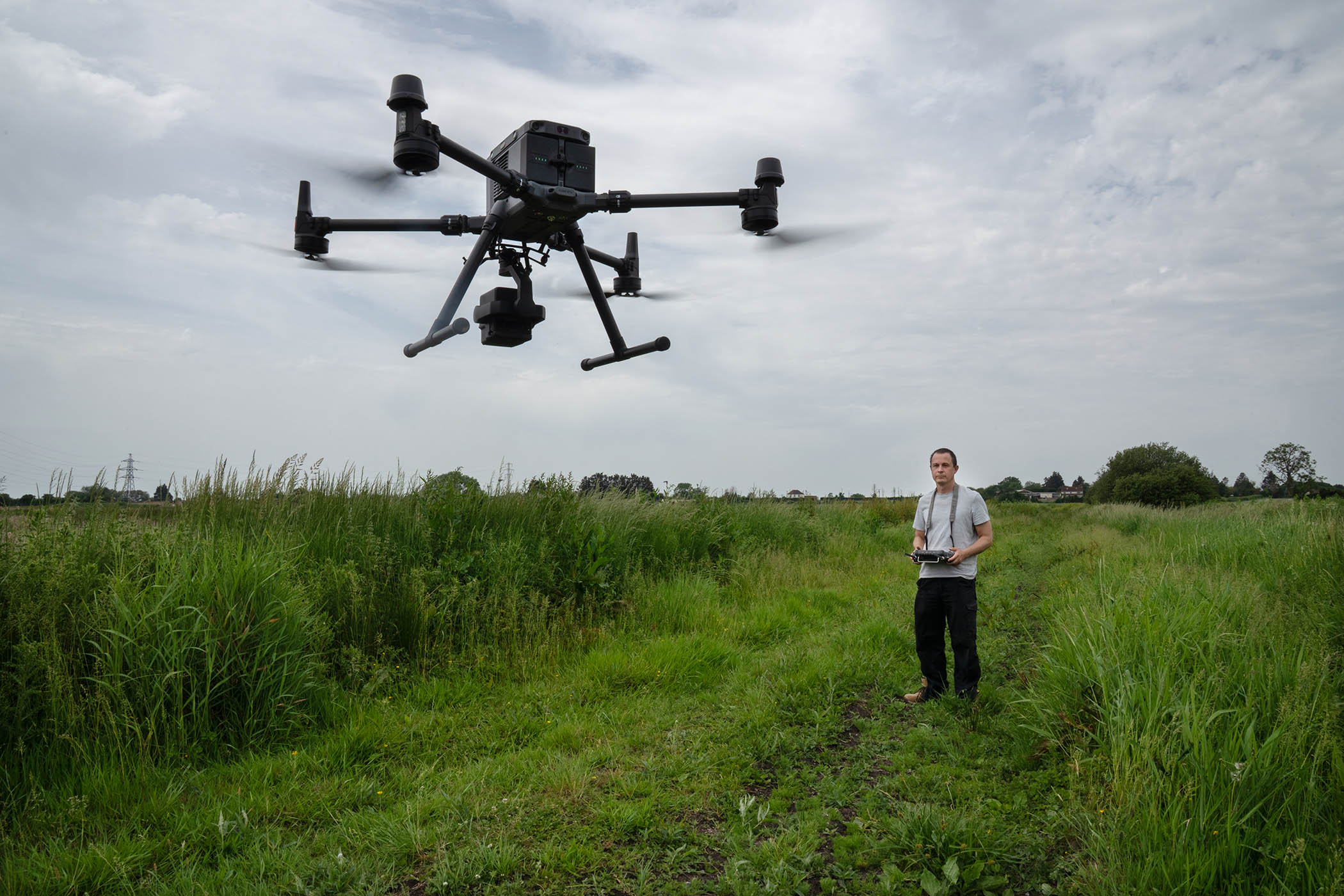
Will Barnard flies one of the drones used to seed the marshland.
The real prize of sustainable fashion is to replace polluting materials in mainstream brands. A sheet of BioPuff costs £12 per metre – the same as the cost of plastic wadding. The problem is that not enough people are growing it.
Julian Ellis-Brown, Ponda’s chief executive, lays out the economic argument. “Each hectare of regenerated wetland produces around a tonne of bulrush, equivalent to roughly 2,000 metres of BioPuff wadding,” he says. “The UK alone has around 400,000 hectares of drained lowland peat, representing a potential 800m metres of wadding.
“Globally, there are hundreds of millions of hectares of drained wetlands available. We would need only a small fraction to make a serious impact on the synthetics market.” Production of all types of synthetic fibre was about 90m tonnes in 2024, according to Textile Exchange. About 2.2m tonnes of that was plastic wadding, equivalent to about 15bn metres of wadding rolls.
Ponda’s initial target is 500 hectares. “But even that produces enough material for around 100,000 jackets a year,” Ellis-Brown says.
An obvious problem comes to mind as Barnard squelches through the field, feet sinking slightly into the peat. How can he sow the crops and then harvest them?
“Drones.” An XAG drone, with a 50kg payload, flies over the land delivering seed pellets.
Harvesting required another innovation: a special harvester that runs on caterpillar tracks that apply less pressure to the wet peat than a human foot does. It was made by another west country firm, Loglogic, which creates specialist harvesting gear.
“I can’t imagine there’s anywhere else on the planet that I could have rolled up at and said, ‘I need to make a bulrush harvester,’ and didn’t get laughed at,” Barnard said.
But bulrush farming is unlike other kinds of agriculture, he says. Once the seeds are planted, the bulrushes grow year after year and never need to be replanted. Traditional arable farming creates a blank slate every year, the land pummelled into submission.
“This is more like nudging an ecosystem to deliver what you want,” Barnard says. “I need to encourage it to grow and look after them. They’re more like livestock – I have to look after them year in, year out, to make it work. It’s a pretty radical shift in thinking.”