Photograph by Andy Hall for The Observer
On a Saturday morning in October 2004, 13 people gathered in Bushy Park, south-west London. They were there to run a timed 5km round the park. There was no marked course, just an instruction to keep the trees to their left. Paul Sinton-Hewitt stood at the finish line with a stopwatch.
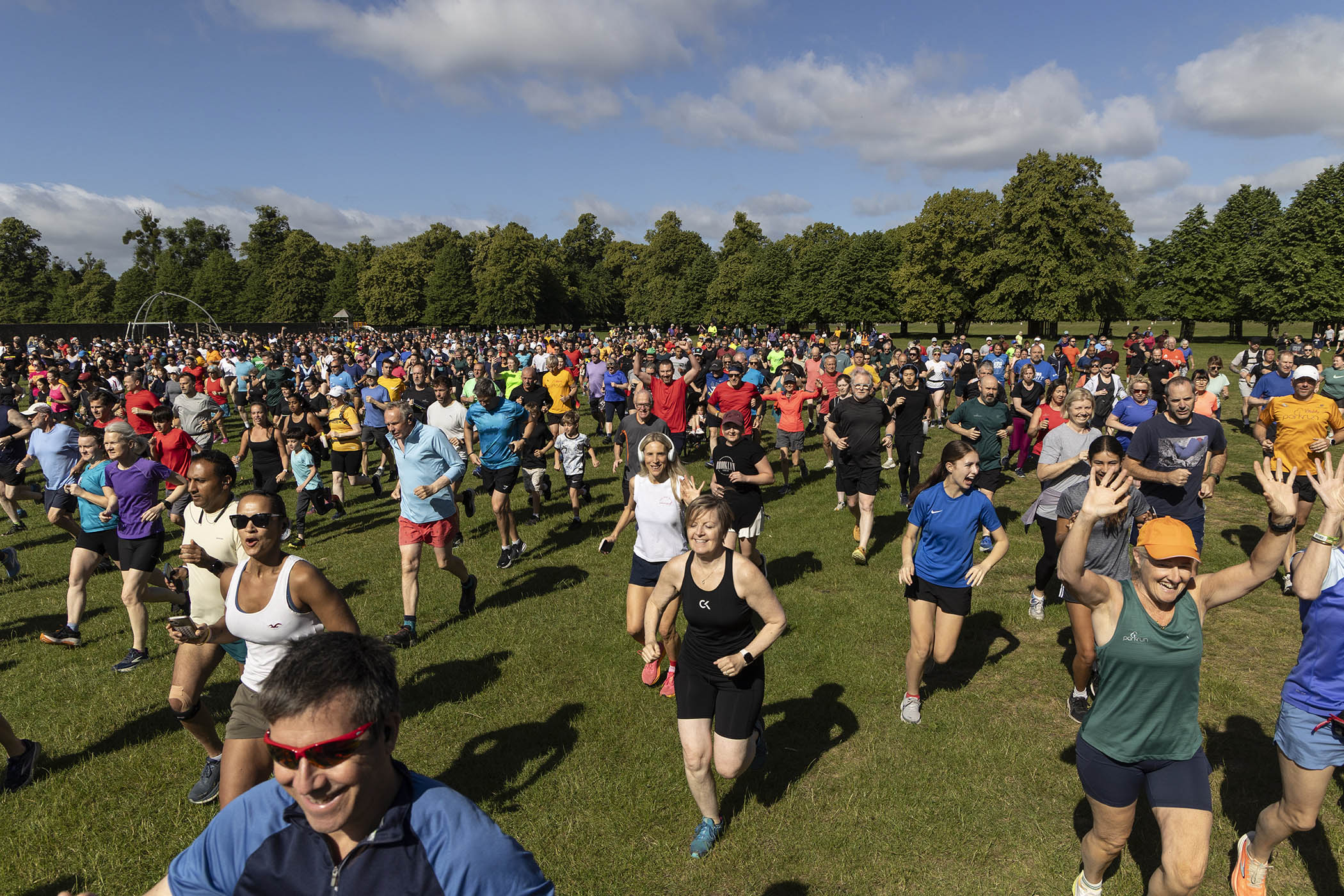
Twenty-two years and 1,093 5km runs later, 1,667 people gathered with the deer and early morning cyclists on a sunny June Saturday. In the intervening years, the event, which costs nothing to join, has been named Parkrun. It has also become a global phenomenon, with 400,000 runners. There are close to 1,500 events in the UK alone. Yesterday, Parkrun celebrated its millionth event.
The founder, Sinton-Hewitt, could hardly have imagined his original idea would extend this far. Initially he was even unsure about starting a second Parkrun in nearby Wimbledon, two years after the Bushy Park one had begun. Eventually he adopted the mantra: “Let there be a Parkrun wherever someone wants one.”
“Part of our magic is that we enable a local community to start a Parkrun, and then we empower them,” he said, sitting near the starting line at Bushy Park yesterday.
“You have to have guardrails. You have to have governance. You have to manage that group, but if you manage too hard, you get kicked back. The whole purpose is to allow individuals to make their Parkrun the best it can possibly be, without overdoing it.
“There’s not a week when somebody doesn’t come to me and tell me a story about how their life has changed because of Parkrun. Those for me are the most incredible moments.”
Parkrun is powered by volunteers who run the events – timekeeping, scanning barcodes or supporting runners on the course.
“Volunteering gives as much to the individual in terms of health benefits as participating from a running or walking perspective,” said Parkrun CEO Elizabeth Duggan.
The variety of ways to participate is what has helped Parkrun reach so many people. “There is a global running boom but we’ve seen really strong growth at the young end of the spectrum, in late teens or early 20s, and at the other end,” said Duggan. “We’ve seen 22% growth in our over-70s in participation. That gives you an idea that Parkrun is for everyone.
Newsletters
Choose the newsletters you want to receive
View more
For information about how The Observer protects your data, read our Privacy Policy
“You can run with a buggy. You can run with your dog. You can be visually impaired and run with a guide runner. When you go around the course, you will see a whole spectrum of people.
“There’s room for everyone and everybody’s motivated differently. Some people are motivated by improving their personal best times and some people are motivated by the coffee and cake. Both are OK. It’s whatever gets people out and active.”
Nothing sums up the diversity of participation than regular Parkrun participant Kelly Holmes. The double Olympic champion first came across Parkrun as she was coming to the end of her professional running career, but began going regularly in the past three years.
“You get the bug!” she says, before taking part at Bushy Park. “I don’t think anyone’s finished thinking I hated it.
“I started walking [Parkrun] after having an injury and I was very humbled by the conversations I had. People doing it because they’ve come back from a heart attack or saying that Parkrun saved their life or that this is the only time they get to speak to people.
“I don’t think I’ve ever known anything in the world that’s encapsulated an ongoing wellbeing movement. There’s big individual events, but this is something very special.”
The first finisher at Bushy Park completed the course in 15:47 and the final finisher in 1:11:12. Holmes ran a pacy 19:45 and this writer did it in 27:28. At courses across the country, thousands of people ran their own times.
They will do the same next week, and the week after.
Thank you for reading. Tell us what you think by writing to letters@observer.co.uk