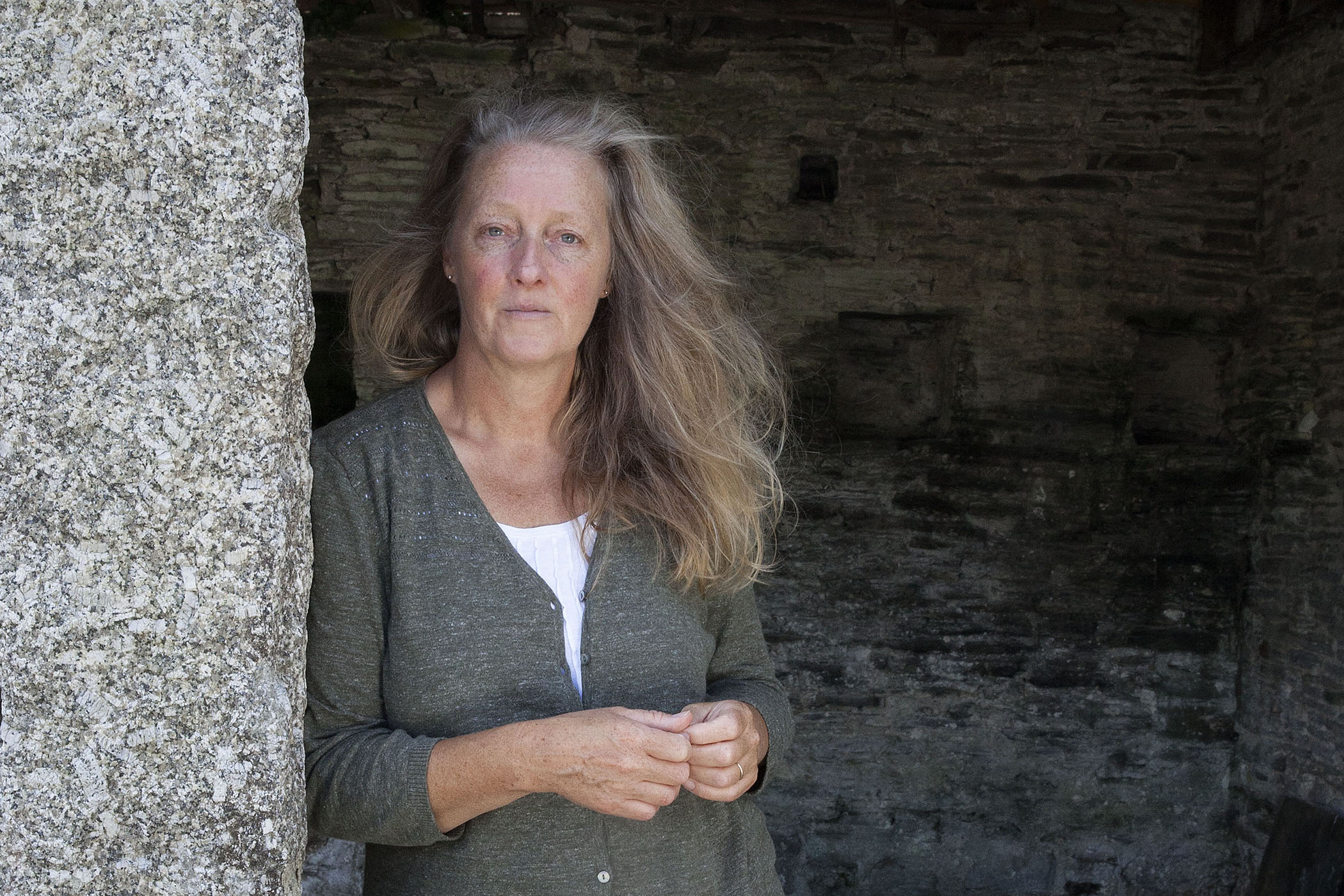



On a sunny morning at a motorway service station in the west of England, a blond woman in her 40s nervously pulls out a clear plastic folder and slides it towards me. “I think this will explain everything better than I can,” she says.
Inside is what appears to be a typed confession letter, written more than a decade ago by the bestselling author Raynor Winn. “Please don’t look any further for the money,” it reads. “I’ve taken it. All of it.”
The letter, addressed to Winn’s sister, continues: “I have to ask you not to take things any further with the bank, but tell them it was just a mistake… I have a police record and should this go any further I will go to prison this time.”
Winn is now a publishing superstar, the bestselling author of the memoir The Salt Path, along with two successful sequels. The story of her life has been translated into more than 25 languages and was this year turned into a feature film.
The book describes how Winn’s husband, Moth, was diagnosed with a terminal neurological disorder days after they were conned out of their home by someone they trusted. Destitute and with limited time left together, they walked the entire 630-mile South West Coast Path through Somerset, Devon, Cornwall and Dorset, and in doing so managed to reverse Moth’s symptoms.
This summer, The Observer published a series of articles revealing the memoir, marketed as “unflinchingly honest”, was in fact underpinned by deceit. The investigation has now been made into a Sky Documentaries film by Candour Productions, The Salt Path Scandal, released tomorrow.
Legal documents and witness testimonies revealed the couple – whose real names are Tim and Sally Walker – actually lost their home after Winn took out a private mortgage to pay back tens of thousands of pounds she was accused of stealing from her employer. Neurologists have since expressed surprise at Moth’s apparent ability to survive 18 years with the rare neurological condition corticobasal degeneration (CBD), as well as the couple’s claims that he reversed its symptoms by taking long hikes.
The moral heartbeat of The Salt Path rests on a sense that Winn and Moth are victims: their home is taken from them, they encounter snobbishness and cold bureaucracy, and they are faced with the painful reality of a terminal illness. But the reality appears very different.
Find all of our original Salt Path reporting here, and listen to our seven-part audio investigation, The Walkers: The real Salt Path, on The Observer app
Newsletters
Choose the newsletters you want to receive
View more
For information about how The Observer protects your data, read our Privacy Policy
Since The Observer published the investigation, new information about the circumstances of Winn’s early life has emerged. She is now alleged to have stolen tens of thousands of pounds, not only from her employer but also, her family believe, from her husband’s elderly parents and her own mother.
Which is how I found myself sitting in a service station opposite a relative of Winn, Anne, who asked that we not use her real name.

From left: Raynor Winn, her mother and Winn’s sister at "Anne’s" wedding
Moth’s family had contacted me in July with an extraordinary claim. A nephew, a niece, Cecille, and another relative, Fiona (not their real names), said that in 2008, around the same time Winn was accused of defrauding her estate agent employer and stealing what we now believe was £67,000, Winn also allegedly stole a large amount of money from Moth’s parents.
At the time of our conversations, there was no documentary evidence to support what they were saying: the elderly couple had since died, and there was no paperwork.
But months later, the woman in the service station, Winn’s niece, handed me a series of handwritten letters addressed to Winn’s mother, and what appeared to be a typed confession letter, allegedly sent to Winn’s sister.
The letters appear to provide corroborating evidence, in Winn’s own words, for the recollections that both her family and Moth’s have of that time, that Winn allegedly stole more than £100,000 from her employers, from her husband’s parents and from her own mother. They and the events they recount have been corroborated by a total of eight family members – four of Winn’s family and four of Moth’s.
Winn declined to comment for this article but The Observer understands she denies writing the letter or taking any money from Moth’s parents or her mother. The Observer also understands her position is that the families have a complex history and some individuals may have an axe to grind.
The letters
Anne explains that the letters she had shown me were handed to her by her mother, Winn’s sister, on her deathbed last year. “I was told to keep them because one day I might need them,” Anne recalls. Winn’s sister died of cancer in November 2024.
The first, written by Winn in an attempt to persuade her sister not to go to the authorities, details how Winn first used forged cheques to steal from her employer, a property surveyor and estate agent in Wales. “It became almost an addiction, something I was doing almost unconsciously. When I was arrested on 8th October 2008 for the theft of £67,000, I was stunned,” she writes.
The employer Winn is referring to is Martin Hemmings, whose widow has previously spoken to The Observer about the alleged theft.
Several years later, when Winn and Moth were facing eviction from their home in Wales, the letter goes on, Winn stole from her in-laws. “During this time, in a mad panic when the mortgage was threatening to foreclose, I transferred £25,000 from Tim’s mum and dad’s account to Tim’s,” she writes. His family has told The Observer they believe Moth never transferred the money back.
The letter adds that the elderly couple had almost no money left as a result: “I left them with very little to pay their rent, hence they are spending the winter in the barn” – a reference to a barn conversion on Winn’s Welsh property.
Her letter continues: “Somehow, somewhere amongst this living nightmare, I started taking money from Mum. Any statements she has had over the last 18 months are fake. I forged them.”
In the apparent “confession letter”, Winn apologises and says she never meant to hurt her family: “This is like something outside of me.” She goes on to promise she will pay the money back. The letter ends: “It’s of no consolation to you but this morning, writing this, I feel better than I have for years because I know it’s over.”
Members of both Winn’s and Moth’s families say that after the thefts were discovered, both sets of parents chose not to press charges. The families say that as far as they are aware no money has ever been paid back.
Winn is believed to have made millions of pounds from her book sales, live events and from the film adaptation of her life, which she produced.
In October, The Observer was invited to a gathering of both families in London. It was their first meeting in several decades and a chance to exchange stories. They spoke of a shared frustration at Winn’s portrayal of herself as a victim and of the emotional harm the thefts had caused them.
Another of Winn’s relatives, who asked not to be named, recalls Winn’s mother saying that someone had taken all her money. “Never in a million years did she think that her daughter had it,” they said.
When Winn’s sister investigated, she found Winn had gained access to their mother’s account. “The money was gone and nobody could get hold of Aunt Sally,” Anne says.
Winn’s mother was left without any savings, unable to pay for food and heating. “My grandmother was in pieces,” Anne says. She believes that on learning her daughter had stolen from her, Winn’s mother was “broken” and never fully recovered.
Debts and housing
In a separate email to her sister, dated June 2013, Winn states the sale of her house will not make enough money to pay off the private mortgage she used to reimburse her employer so that they did not press criminal charges. This directly contradicts what Winn has published on her website, where she claimed she believed the debt had been paid. The creditors say that, prior to The Observer’s initial investigation, they had been unable to locate the Walkers because they were using the aliases Raynor and Moth Winn, and have since requested and received payment for the loan.
Anne says that after their eviction from their home in Wales, Winn and Moth stayed with three different family members before turning up on her doorstep. Anne put them up for close to 18 months. This covers much of the period the couple claimed to be destitute and camping on the coastal path. These dates have been corroborated by emails seen by The Observer.
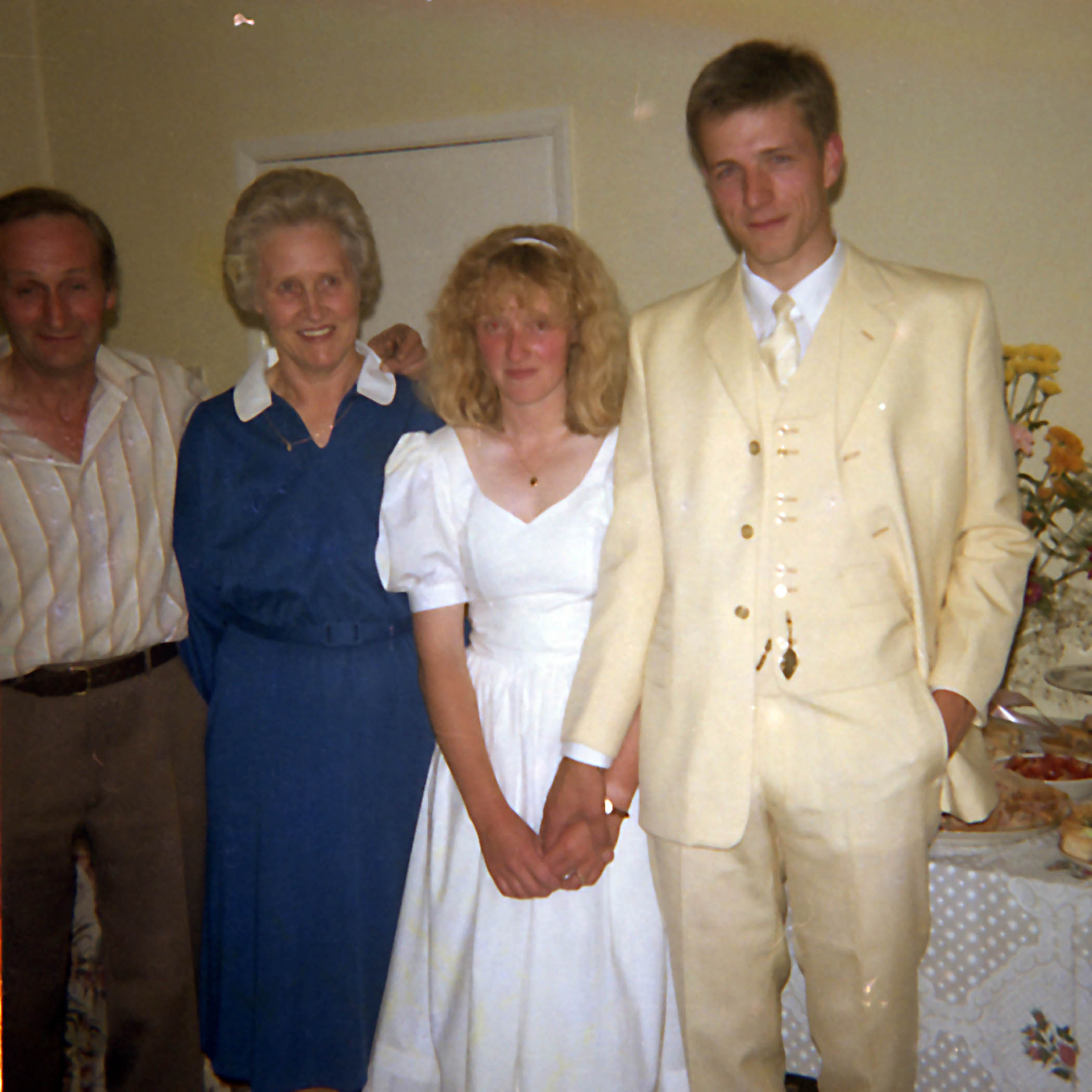
Raynor and Moth Winn at their wedding alongside her mother
Anne recognises herself as the character Polly in The Salt Path, who offers Moth and Winn shelter in a barely habitable “disused meat-packing shed”. But photographs seen by The Observer show the building Anne lent the couple rent-free was a carpeted flat, with hot water, bath, shower, double bedroom and other home comforts.
“There was work around but they chose not to work,” says Anne, who explains that Raynor quit a sheep-shearing job she found for her after only a few days’ work. “It’s what you choose to do, whether you want to keep a roof over your own head or whether you’re quite happy for someone else to do it for you.”
Anne says she does remember the couple taking some hiking trips while they were staying with her.
Another of Winn’s relatives said: “ The inference that they did the walk in one go, because they were homeless and living in tents, is rubbish. They weren’t homeless and they weren’t forced into these things. They did walking holidays like most people do.”
Anne says that she twice tried to get in touch with Winn’s publisher, Penguin, about the inaccuracies in the memoir but wasn’t taken seriously. Penguin has previously said that no one raised any concerns about the book.
On Moth’s side, the alleged theft from his parent’s bank account divided the family. In 2007, Moth and Winn bought a house in France, next to a property owned by Moth’s brother. But after it was discovered Winn had stolen the money, the couple never visited the village again, allowing their house to become an uninhabitable ruin. The brothers have barely exchanged words since.
Walker’s niece, Cecille, says that when her grandmother – Moth’s mother – discovered the money was missing, she immediately suspected her daughter-in-law, with whom she had shared her bank details to help her make online bookings. “My grandmother wanted to know what Sally had done with the money,” recalls Cecille. “But she told me that whenever she tried to confront Sally, she would claim to be mad.” Cecille says her grandmother told her Winn would pretend to be hearing voices or hallucinating, “anything to avoid the question”.
Health claims
The family’s concerns extend beyond the alleged thefts and financial disparities.
A top neurologist who specialises in CBD, Dr James Gratwicke, told The Observer he does not know of anyone in the UK surviving longer than nine years with the condition, and that Moth does not appear to have symptoms he would expect to be visible in its early stages. He also said the damage done to the brain by CBD is not reversible.
Family members say they had not believed Moth’s health claims. “We never worried, let’s put it like that,” says Fiona. “He always made out he was ill.” His parents, however, did believe he was dying, and Cecille believes they would have worried that prosecuting Winn over the alleged thefts would not have been in his best interests.
In her blog, Winn said that questioning of Moth’s health was “utterly vile, unfair and false”.
If what both their families say is true, the entire premise of The Salt Path now appears to be false.
‘The money was just gone and no one could get hold of Aunt Sally. My grandmother was in pieces’
‘The money was just gone and no one could get hold of Aunt Sally. My grandmother was in pieces’
'Anne', niece of Raynor Winn
Throughout the investigative process, The Observer has made repeated offers to Raynor and Moth to meet and discuss the allegations against them, and to give them a chance to correct the story. They have chosen not to speak to us.
Previously Winn sent The Observer a statement through her lawyers: “The Salt Path lays bare the physical and spiritual journey Moth and I shared, an experience that transformed us completely and altered the course of our lives. This is the true story of our journey.”
Another book
As part of the recent investigation, The Observer discovered that in 2012, five years prior to the publication of The Salt Path, Winn wrote another book. How Not to Dal dy Dir (“hold your ground” in Welsh) is a novel – not a memoir – and was written under another of Sally Walker’s pseudonyms: Izzy Wyn-Thomas. It’s the only title released by Gangani Publishing, a business she and Moth set up when they lived in Wales and it’s likely only about 250 copies were printed.
The story the novel tells is familiar. A young couple move to a small whitewashed farmhouse in Wales, which matches the description of Winn’s house. The protagonist gets a job with a property surveyor and estate agents, where she eventually steals tens of thousands of pounds and, after being arrested, flees to London, where she borrows the money to pay back her employer. But in doing so, she ends up having to forfeit the family home in Wales, by which point she has realised her husband is the only real home she needs. The novel presents a justification for the protagonist’s actions, which we are told were undertaken for the sake of her husband. Although it’s not clear how he is helped by her.
A different version of this story appears in the pages of The Salt Path, which is marketed as a non-fiction book and has been read by millions around the world.
For Winn and Moth’s relatives, it’s enough that the record has been set straight. “They are still going to have all the money they’ve made and they’re welcome to it,” Anne says. “At the end of the day, I just wanted to make sure nobody else in this country, or anywhere else, thinks they can walk themselves better.”
Additional reporting by James Urquhart
The Salt Path Scandal is available on Sky Documentaries and streaming service Now
Photographs: Karen Robinson for The Observer; family handouts
More from The Observer's investigation
Find all of our original Salt Path reporting here, and listen to our seven-part audio investigation, The Walkers: The real Salt Path, on The Observer app