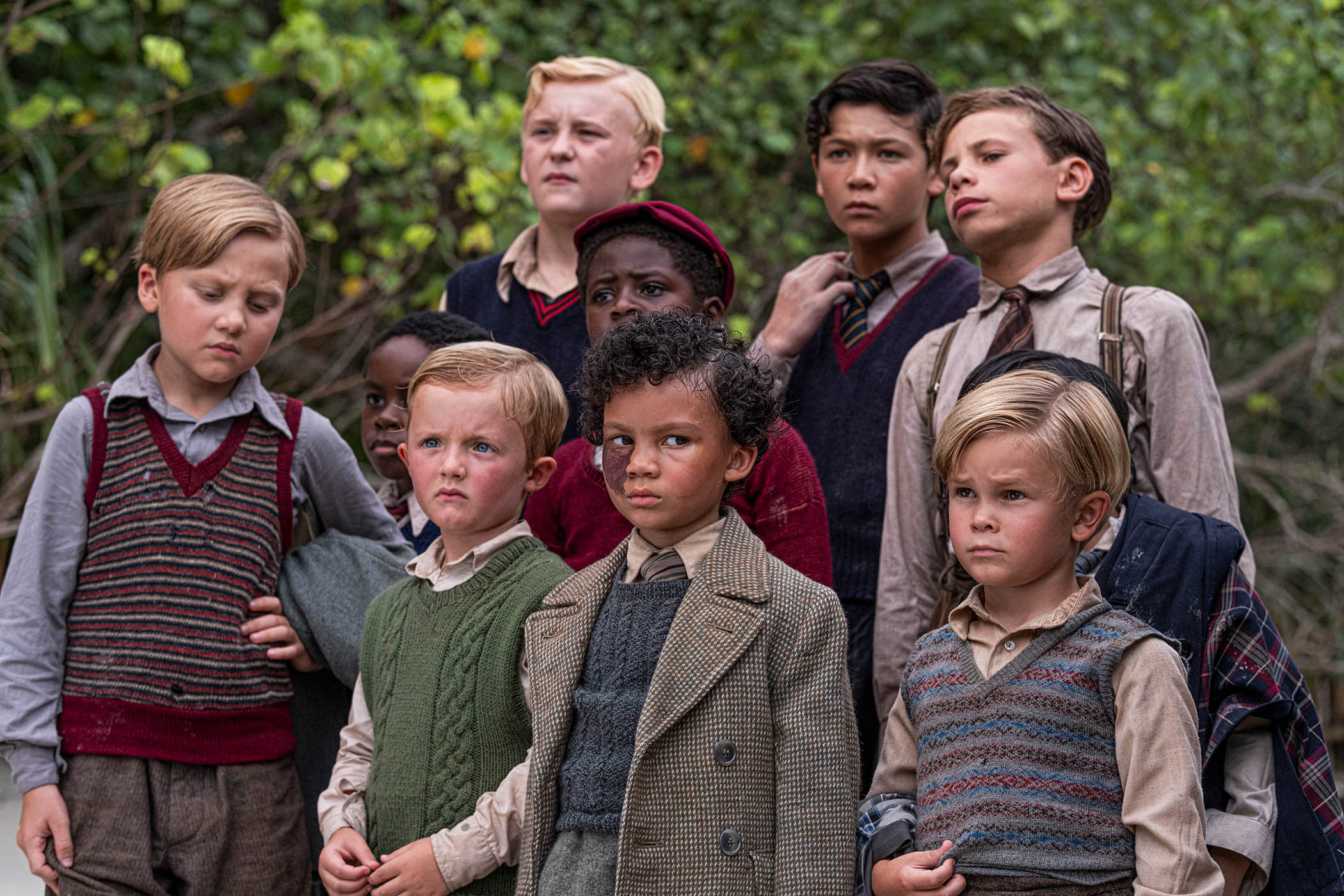



William Golding, author of Lord of the Flies, would have told his dark desert-island fable differently now, adapting it for an era almost as threatening as the one that inspired him in the 1950s, according to his daughter.
Judy Carver, the late Nobel Laureate’s second child, told The Observer that she sympathises with the way the new BBC television series based on her father’s famous novel has chosen to excuse the characters of the schoolboys who are marooned together. Catering to a modern audience, the screenwriter Jack Thorne, best known for Adolescence, has moved the disturbing survival narrative further away from the direct religious allegory of Golding’s vision and brought in references to psychology and childhood trauma.
“When my dad wrote the book, it was the time of ‘stiff upper lips’, and now it is the time of school counsellors,” said Carver, who manages Golding’s estate. “So it does not matter to me that the boys now each have back stories to explain their behaviour.”
For Golding, Carver said, the character of Simon was originally intended to represent not just a Christ-like sacrificial figure but an actual living saint, and so to offer a glimmer of hope in a story that otherwise sheds a stark light on human failings. But in the editing process Golding was persuaded to drop some of the more literal elements of biblical allegory.
“I know my dad regretted Simon’s role being cut back before the book was published, taking away the idea of Simon as a kind of mystic,” Carver said. “You can see this in his manuscript and then expressed quite clearly in his journal too. But my feeling is that, although he said this in his later years, it does not mean it wasn't the best thing to do at the time.”
The important thing, Carver feels, is that the story does not become entirely negative. “My father did have faith in the positive human spirituality he showed in Simon’s character, despite the impact on him of the second world war and the use of the atomic bomb.”
Tim Kendall, professor of English at Exeter University, is the editor of Golding’s archive of letters and has noted the way Simon’s role altered as the book was edited by Faber’s Charles Monteith and then again in later screen versions.
“In the original manuscript Simon is an out-and-out mystic,” Kendall said. “In one scene he even meets up with a supernatural being, and Golding wrote that they dance together ‘courteously’. But in the final book this element is made less clear and becomes explicable in terms of a health condition like epilepsy.”
Kendall sees Golding’s book as an attempt to understand whether the atrocities of the second world war could be blamed on one group of people or on a more basic facet of human behaviour. He believed, Kendall thinks, that British civil structures helped to keep the worst parts of our nature at bay, later telling the writer Jack I Biles in a published conversation: “There has been in this country for about a thousand years a gradually emerging social sense, so that a mob in Britain is not as bad as a mob in some other place.”
Golding also frequently dismissed the popular idea that Piggy is the secret hero of the story, saying he had created the bespectacled character to show the shortcomings of a purely scientific approach to the world. He was, the author once said, a boy “who saw what is impossible, but not what is possible”.
Newsletters
Choose the newsletters you want to receive
View more
For information about how The Observer protects your data, read our Privacy Policy
Carver, in contrast, still has a soft spot for Piggy. “Although in the original my father gave a lot of the spiritual role to Simon, I wonder now if he might have had more faith in Piggy’s rationalism,” she said.
“Every adaptation of the novel is difficult for me, because I’m always worried that I have been wrong to agree. But Jack Thorne’s is a creative approach, and his attempt to understand the boys makes it appropriate for now.”
Image courtesy BBC/Eleven/J Redza