Handprints in the soot on the walls of Grenfell Tower have been destroyed, despite promises to families that they would be preserved for a memorial, a representative for some of the bereaved has told The Observer.
The small prints were on the charred stairwell where at least eight residents of the west London tower block died in the June 2017 fire, becoming a focus of grief for some families of the deceased.
‘[This is a] senseless, cruel act of destruction of significant symbols of the struggle to survive’
‘[This is a] senseless, cruel act of destruction of significant symbols of the struggle to survive’
Shah Aghlani, relative of two victims
Writing for The Observer last month, Kimia Zabihyan, who represents a group whose family members were among the 72 killed in the fire, argued that the government had vowed to preserve the prints on the wall between floors 12 and 14, but their destruction was imminent, as the tower was being brought down floor by floor.
After a news report in this paper drawing attention to the Grenfell Next of Kin campaign group’s proposed legal action, the demolition of the tower was paused. The group believed the handprints had been saved.
Now it has emerged they have already been irreparably damaged – their destruction had possibly occurred prior to the decision to pause the demolition but was not mentioned at the time.
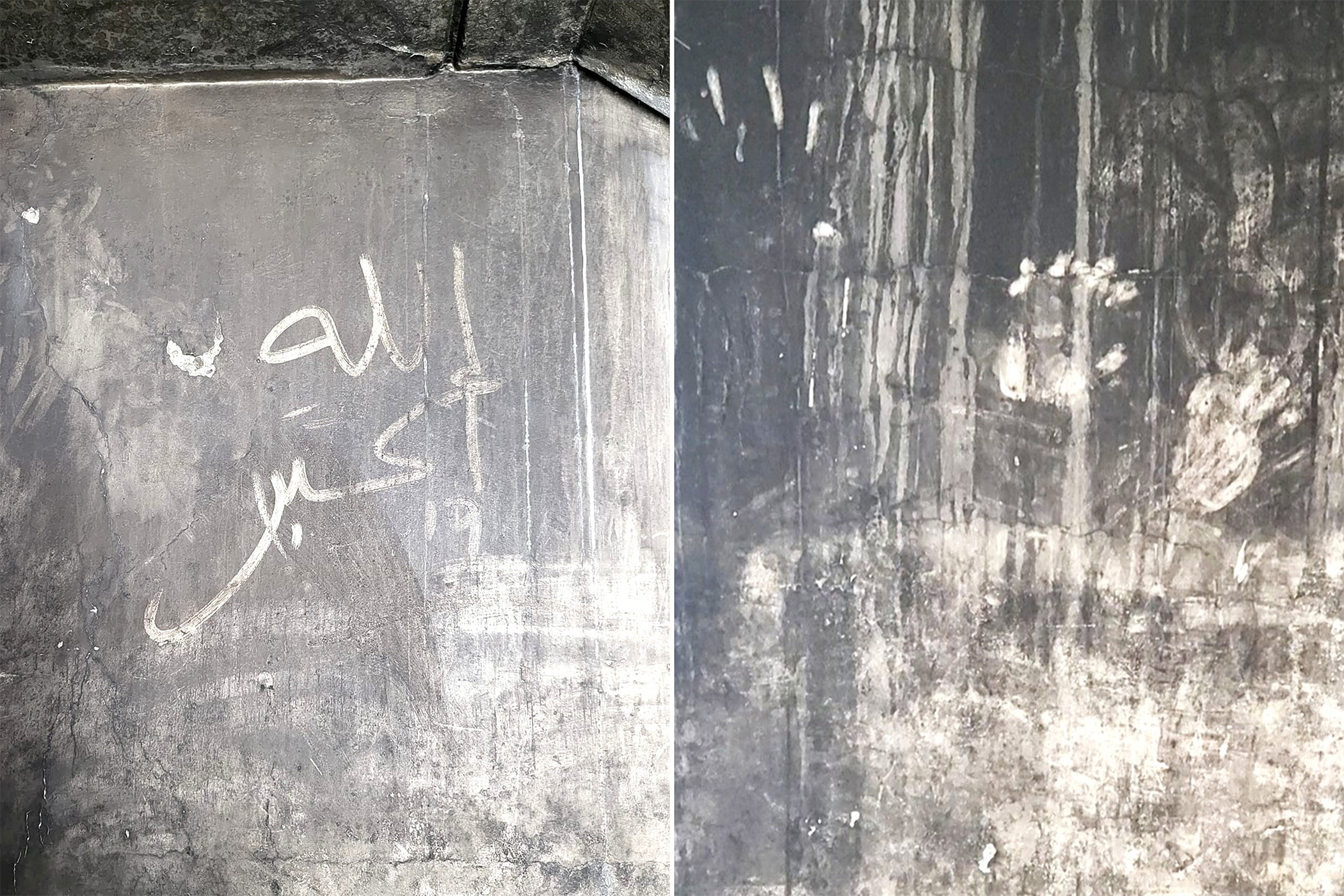
The group had submitted requests as part of a consultation last year, before demolition began, for the preservation of the markings, which included finger marks and smears, along with palm prints on the walls, an Arabic script reading “Allahu Akbar” (God is greatest) and a second, less visible set of hand marks.
Earlier this year, the Arabic script between the 17th and 18th floors was found to have been destroyed. Then, during a virtual site visit conducted by demolition staff via a video link, it became clear on Friday that the most significant set of handprints, found between floors 13 and 14, had also been destroyed, Zabihyan said.
Responding to the news, Shah Aghlani, whose mother and aunt died in the inferno, said: “The senseless, cruel act of destruction of significant symbols of the struggle for survival, and those who died; a plea to God? None of that meant anything to them. Even if they did apologise, it would mean nothing because they abuse you and do it again.
“If the government wants to spend taxpayers’ money on a memorial for our loved ones, but refuses to listen when we say the process is flawed and the memorial commission is not fit for purpose, what are we meant to do?”
“Who is this memorial for? It’s not for us. And the taxpayer is going to pay for it. They’re passing it off as a piece of virtue-signalling in our names but it’s not for us,” Aghlani said, adding: “I cannot keep fighting them. I have to protect my mental health.” Aghlani’s mother, Sakina Afrasehabi, 65, lived in flat No 151 on the 18th floor of the 23-storey building. Her sister, Fatemeh, 59, had been visiting when the fire broke out and died with her in the flat.
Newsletters
Choose the newsletters you want to receive
View more
For information about how The Observer protects your data, read our Privacy Policy
Karim Khalloufi, whose sister, Khadija Khalloufi, died in the fire, said: “What has been destroyed is the real memorial – something authentic that connected us to our loved ones. The handprints represented a deeply human link. The commission failed us over this matter and this was not the first major failure. Ministers and the commission made commitments. They failed to uphold what was important and not only are they not apologising, they are lying and covering up.”
At least eight bodies of people who died in the fire were found in the stairwell or protected lobbies leading to the steps. The families have said that they were given a range of reasons that it would not be appropriate to protect the marks on the walls, including that it would be insensitive to do so because of the proximity to locations where victims perished.
Zabihyan, who has been campaigning on behalf of the families to save the walls, said they had been consulting with the demolition team to see footage of what remained when a senior civil servant admitted the prints had been destroyed.
“I just literally, physically felt sick,” she said. “I walked into the corner of the room. I was facing the wall. I had my head against the wall. I just felt like I was going to throw up.”
She said the families, who threatened a judicial review of the demolition after learning of the destruction of the Allahu Akbar text, would now look at other legal action against the Ministry of Housing, Communities and Local Government.
She said that the civil servant in the room had apologised as the news was delivered, but Zabihyan said: “Do you know how many people have been saying ‘sorry’ since 14 June 2017? Everybody stands up and says ‘sorry’. This was something so obvious, so basic – and they still couldn’t do it.”
The ministry was approached for comment. It is expected to argue that it had turned down requests to preserve sections of the tower above the 9th floor, despite blanket undertakings from ministers.
It is also understood that the ministry has been unable to confirm the extent of the destruction because a safety platform has been installed, and much of the damage has been caused by water penetration, from rain and spraying water on the tower to mitigate dust.
A ministry spokesperson had previously said: “Grenfell Tower has a deep personal significance to the community and we are committed to ensuring what happened at the tower is remembered, with the community's voice at the heart of our work. We remain fully committed to handling elements of the tower with utmost care, sensitivity and respect.”
Photographs by Grenfell Next of Kin/ Leon Neal/Getty Images