

Photograph by Christian Sinibaldi for The Observer
Mick Herron is standing outside an unremarkable row of commercial properties – a parcel shop, a newsagent, a narrow cafe – on Aldersgate Street opposite the Barbican estate on the boundary line of the City of London.
In the row is the door that leads to Slough House, the down-at-heel headquarters for MI5’s failed spies – or “slow horses” – presided over by Jackson Lamb, the magnetically repellent cold war survivor played by Gary Oldman in the television adaptation of Herron’s books. But something is wrong with the picture. Instead of a grey October sky we have a sun-drenched April morning – and there isn’t a bin bag or a faded Chinese takeaway menu in sight.
Turning the corner to look for the building’s back door, though, we find our path blocked by a heavy-set, shaven-headed man in a black leather jacket, unsmiling and smoking. We step around him and I mutter “dog!” – the name for the novels’ brutish MI5 enforcers – to Herron as we enter the alley. Here is a peeling wall, a shabby wooden door (“that looks like it will stick in all weathers,” says Herron, happily), an abandoned shopping trolley, and a sign warning that “any videos of drunk individuals urinating or changing in public will be provided to police – and could be posted on YouTube!” Herron smiles: “That’s it.” We’ve reached a corner of London neglected enough to belong to Slough House.
In the early 2000s, Herron was commuting from his home in Oxford to his job as a subeditor on a trade journal dealing with employment law. The last leg of his journey passed through Aldersgate Street, and something about No 126, with its drab black door, caught his attention. Perhaps, Herron thinks, it subconsciously chimed with a childhood memory.
“Until I was about eight, I grew up on a fairly busy main road in Newcastle,” he says. “My dad was an optician, and we lived in a flat above his shop.” (Herron was the fourth of six children; his mother was a nursery school teacher.) The front door, grimy from traffic, opened on to a flight of stairs leading up to the flat, but they never used it. “We’d always go round the back, via the lane,” says Herron, who passed the habit on to his slow horses.
Peering at the upper floors of what would become Slough House from the top deck of the bus he would glimpse skewed filing cabinets, abandoned Christmas decorations and the detritus of office life. “I just had this feeling that I wanted to write about somewhere that was a really horrible place to work. This fitted the bill.” Indeed, it was deemed an unimprovable location by the Slow Horses production team: instead of finding a more accessible lookalike street, they have, every year since 2020, pitched up on Aldersgate Street, dressed up the cafe as Lamb’s favourite Chinese, and scattered the pavement with rubbish and rain.
Herron’s first novel, Down Cemetery Road, featuring the Oxford private investigator Zoë Boehm, was published in 2003. Three more Boehm books followed, but sales were poor – and when Slow Horses arrived in 2010, it seemed unlikely to buck the trend. His original publisher turned down a sequel, Dead Lions, but when John Murray took it on in 2013 the book won the Crime Writers’ Association Gold Dagger award. Four years later, soon after his 54th birthday, he quit his subediting job to write full time.
The great subject of his novels is failure but Herron himself has left it far behind. His books have now been published in 29 languages and sold almost 5m copies in the UK alone. And the screen adaptation – smart, witty and remarkably faithful to the books – consistently tops Apple TV’s most-watched charts, and sends critics on both sides of the Atlantic into a state of superlative-wielding hysteria.
Clown Town – Herron’s ninth Slough House novel, out in paperback this week – begins, as is customary, with a bravura pen portrait of the exiled spooks’ anonymous office, Dickensian in its channelling of the city’s dark energies and bureaucratic mires. “Should anyone look up,” it reads, “they’d see the legend WW Henderson, solicitor and commissioner for oaths lettered in gilt on a window.” When Herron directs his gaze upwards today and sees the very same, he gives a laugh. “I hadn’t known that was there! I thought it was just [used] for the television show. That’s something I made up… and it’s permanent now, by the looks of it.” He seems delighted at this little win for the forces of fiction over reality.
Newsletters
Choose the newsletters you want to receive
View more
For information about how The Observer protects your data, read our Privacy Policy
As we climb the stairs to the bridge leading to the Barbican, Herron tells me he has often thought about how a big city like London “can swallow you up”. Having attended a Catholic grammar school in Newcastle (which became a comprehensive halfway through his time there), he read English literature at Balliol, Oxford. On graduating in 1984, fearing he would be “lost” in London, he stayed put – and has remained there ever since, now living with his partner, Jo, who has two grownup daughters, and commuting to a nearby apartment each day to write. Our conversation is halted by ludicrously loud drilling, so we concentrate on dodging dirty puddles. This is the broken-down city of Herron’s books, where the traffic is always terrible and you’re just as likely to be killed by a falling paint can as a ruthless assassin.
On the bridge we recall its setting for the tense scene in which River Cartwright, the hot-headed hero of Slough House played by Jack Lowden in the show, is summoned by his former friend, MI5 agent Spider. But, although Herron's books contain plenty of action, it’s invariably not the “running and jumping” aspect of thriller writing that most engages him. “There is so much that happens all the time,” he says, looking at the streets below. “Somebody just crossed the road and almost got hit by a bicycle… That young woman has come out of Tesco and given some money to the man sitting by the postbox. And here are these little children in their hi-vis jackets. I mean, it’s all just life, isn’t it?”
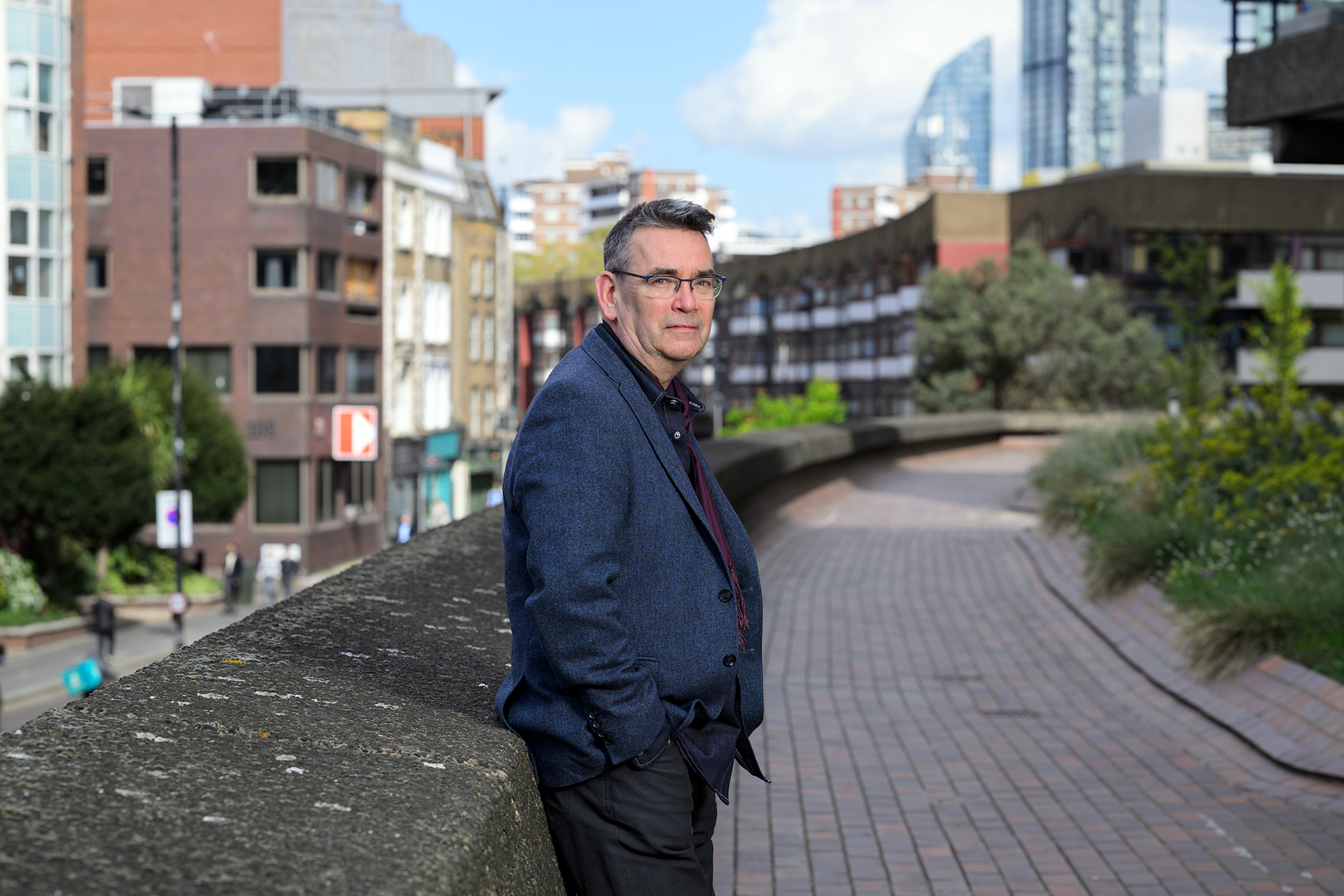
Herron is warm and funny but modest and softly spoken. He does not rush to fill a silence. Dressed in a dark jacket and a purple scarf, with neat greying hair, he poses gamely for Christian, our photographer, in front of the brutalist expanse of the Barbican estate, a regular backdrop for the slow horses’ rendezvous. I mention the utopian vision behind its construction in the 1960s and 1970s but in Herron’s eyes “it becomes Ballardian very quickly. It’s dystopic. There’s something about the way that the concrete weeps with damp which makes it look horrible, and yet all the greenery there… It’s a kind of Planet of the Apes location. When people go, it will still be there.”
In Real Tigers, Herron writes: “There was no straight route through the Barbican, which resembled an Escher drawing assembled in brick by a spook architect, its primary purpose being not so much to keep you from getting where you were going, but to leave you unsure about where you’d been.” And sure enough, it’s not long before we are, he admits, “a little bit lost”. No Google Maps for us: Herron, fearing the claim a smartphone might make on his attention, has never owned one.
Along with thousands of authors, he put his name to Don’t Steal This Book, an empty book distributed at last month’s London Book Fair in protest at the theft of literature to train AI models. Herron knows his own work has been “scraped” because a few years ago on his annual holiday in Yorkshire with his extended family, his younger brother asked ChatGPT to write a recipe for chocolate brownies in the style of Jackson Lamb. “It was crap, but it did it. If you asked AI to describe a tree, then it would look through all of the examples of people looking at trees, but it’s never going to be able to reproduce the actual sensation of looking at a tree for the first time for itself.” He immediately questions himself. “Or is it?”
We consult a map on a Barbican information board. “You are here,” it reassures us. Herron’s spies, like their creator, tend to be quite low-tech, despite the fact that modern-day espionage relies on sophisticated technology. “My scenario is my alibi: the slow horses aren’t allowed access to any of that stuff. So it means that I don’t have to keep up.” The exception is the vainglorious hacker Roddy Ho: later we will pass the spot where, obliviously vibing to his own brilliance, he is almost killed by a van, as well as the pub where the irascible colleague who saves him, Shirley Dander, scores her drugs. Narcissism and addiction are among the dark materials for the tar-black comedy of Slough House.
That London was – probably still is – the money laundering capital of the world is shameful and impossible to ignore once you know about it
That London was – probably still is – the money laundering capital of the world is shameful and impossible to ignore once you know about it
The concrete maze opens up, and below us is the medieval church of St Giles-without-Cripplegate. A study of stubbornness in limestone, it survived the great fire of London and the blitz, and stood its ground while the area around it marched into modernity. Rather like Jackson Lamb. “He’d be happier in the older places,” agrees Herron. “A man out of time.” He is summoned here to meet Ingrid Tearney, director general (“first desk”) of MI5 (Sophie Okonedo on screen). In a show of respect, Lamb refrains from farting and smoking in the church, though he contemplates both. There are waterways on either side of the church, and we stop to observe a moorhen chick, picking and paddling its way through the reeds. “Where are its parents?” Herron asks with concern. We spot its mother, herding siblings, and he is satisfied.
On the scent of old London, we head from St Giles to Bunhill Fields burial ground, where, in the first book, Lamb orders his charges – having thrown away their phones, of course – to assemble by the grave of William Blake. On the way we navigate streets bristling with concrete and glass. “You just have to move a little way that way,” Herron says, gesturing towards the City, “and it’s big fuck-off banks all over the place, and you can really see the money on the streets.” Less visible – though more relevant to Herron’s plots – is the dirty money that courses through the capital, like its subterranean rivers. “The fact that London was – probably still is – the money laundering capital of the world is shameful and impossible to ignore once you know about it.” It’s also one of the least affordable. In Clown Town, four former agents, all but abandoned by the state, eke out a financially precarious existence: “Their joint assets wouldn’t pay a deposit on a flat in central London”.
We pass one of Herron’s former offices. Once the small company was bought out, he began to notice how “dysfunction happens with big organisations”, a “dehumanising process” that has given him one of his major themes. “When I started writing Slow Horses, we had a banking crisis. It was clear that banks were going completely rogue in terms of how they managed themselves and managed the people who were dependent on them for mortgages. Since then, we’ve had the Post Office scandal. We’ve had charities where staff have been sexually exploiting the people they were supposed to be helping. Year on year, there’s always some institutional sector that turns out to be completely off the rails as far as ethics goes.”
The epigraph to Herron’s 2018 novel This Is What Happened is from Blake’s poem London: “I wander thro’ each charter’d street, / Near where the charter’d Thames does flow. / And mark in every face I meet / Marks of weakness, marks of woe.” In Herron’s fiction the capital has a bleak Blakeian flavour: rotten with corruption and self-serving politics, scarred by weakness and woe. But today at Bunhill Fields, the weeds that surround the gravestones are threaded with bluebells. In an almost comically sweet moment, Herron is struck by a memory of lunch breaks spent admiring assistance dogs being trained on the grass next to the cemetery: “Lovely to watch.”
Year on year, there’s always some institutional sector that turns out to be completely off the rails as far as ethics goes
Year on year, there’s always some institutional sector that turns out to be completely off the rails as far as ethics goes
Herron’s next book is not a Slough House novel, which means the television adaptations are catching up with him. Series seven is in production; six is finished and will be broadcast later this year. “Jo and I made a little cameo,” he says. “But that’s all I’m allowed to divulge…” Herron revealed last year that he had worked out how and where Jackson Lamb would die. There will be a 10th Slough House book, he tells me. But after that? He cannot say.
Bunhill Fields is the resting place of not only Blake but Daniel Defoe and John Bunyan: “nonconformists all,” as the narrator points out in Slow Horses. Herron leads me to Blake’s headstone, which bears a mysterious inscription: “Near by lie the remains…” But it turns out that the slow horses aren’t the only ones who’ve been busy with detective work, and around the corner, he is surprised to find a new stone, proclaiming, in strong cursive script: “Here lies WILLIAM BLAKE: Poet, Artist, Prophet.” Flowers are scattered over it. We pause to pay our respects. In Herron’s London, it’s best to know where the bodies are buried.
Clown Town, published by Baskerville, is out now in paperback. Order a copy at The Observer Shopfor £9.89. Delivery charges may apply.