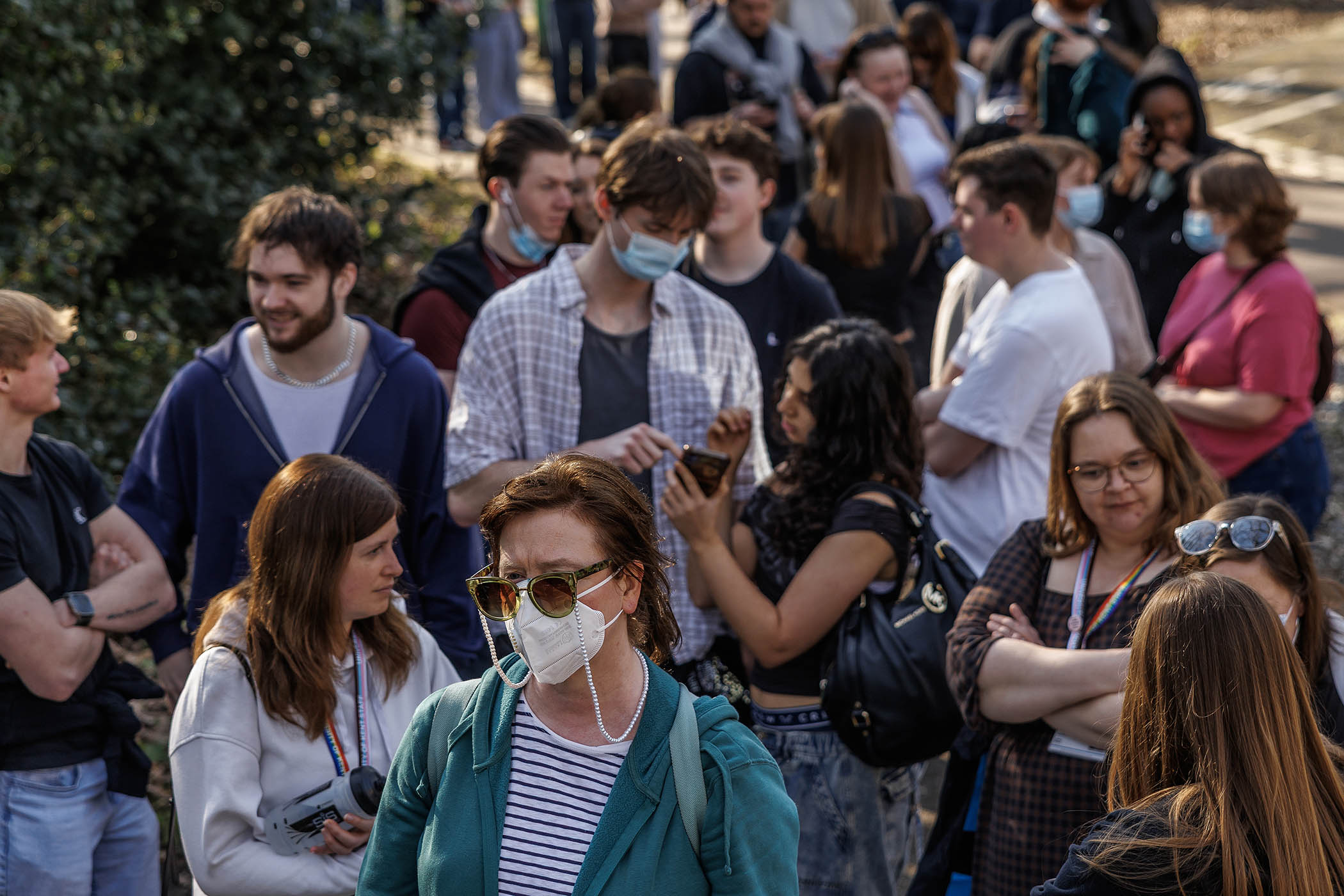


The Canterbury campus of Kent University was unusually quiet last week. Except, that is, for the sports centre, where hundreds of staff and students queued on Thursday and Friday for a meningitis vaccination.
Across the city, which is the centre of this latest outbreak, schools and universities have been battling to reassure anxious parents and academics that they do not need to stay at home.
On social media, parents at five local schools with confirmed cases – as well as those with none – debated whether to follow the official advice and send their children in. One father posted on a Facebook page that he had kept his children off school all week, ignoring school letters warning they would be considered as unauthorised absences. “If Covid taught us anything, I’ll make my own judgment,” he wrote.
At nearby Canterbury Christ Church University (CCCU), which announced one confirmed student case on Wednesday, large numbers of staff were missing from campus by Thursday. Later that day, the University and College Union told its members it would support them if they wanted to work remotely and demanded the university guarantee it would not take disciplinary action.
Prof Rama Thirunamachandran, the university’s vice-chancellor, said the dean of its medical school led an information session for staff on Thursday morning to explain how meningitis spreads and, crucially, how it does not. He said that, unlike Covid, meningitis is a bacterial infection, not a fast-spreading virus, and is passed on through droplets via close contact such as kissing, rather than in the air.
Anxiety is fuelled by the fact that onset of this dangerous disease can be sudden and it can progress fast. Only 75 people turned up in person to the information session, and 750 joined at home. That afternoon, after the session, “many more colleagues came back in”, he said.
‘Covid was unprecedented. Scientists didn’t understand the virus or how to stop it. But meningitis B is a known bacteria, and scientists and medics know how to control it’
‘Covid was unprecedented. Scientists didn’t understand the virus or how to stop it. But meningitis B is a known bacteria, and scientists and medics know how to control it’
“It’s a completely natural instinct, having gone through Covid, to feel anxious about this outbreak. It’s incumbent on leaders like me, as well as politicians and public health officials, to explain why it is different.” He does not believe politicians have done a good job of dealing with the situation so far, and said media attention has fanned fear among his staff and students.
He said he is frustrated that ministers have used words such as “unprecedented” to describe the outbreak. “Covid was unprecedented. Scientists didn’t understand the virus or how to stop it,” he said. “But meningitis B is a known bacteria, and scientists and medics know how to control it.”
What he described as “a very small minority of CCCU students” have been given antibiotics and offered a vaccination as they had been in close contact with the affected student – or they might have been to Club Chemistry, the Canterbury nightspot where it is believed to have spread.
Others have sought medical advice after the university flagged symptoms to watch for, though they have typically been diagnosed with minor coughs and colds. “A few have had Covid,” Thirunamachandran said.
Newsletters
Choose the newsletters you want to receive
View more
For information about how The Observer protects your data, read our Privacy Policy
The university is reassuring parents who contact them that it remains safe for their children to be on campus.
Garry Ratcliffe, chief executive of the Golden Thread Alliance, a trust that runs eight Kent primary schools, said all the headteachers in the area have attended a meeting every day with Kent county council and the UK Health Security Agency (UKHSA).
The information that has been provided has been “swift and accurate and unemotional”, he said. There is “a massive difference from the early days of Covid, when we didn’t have clear information to give scared parents”.
His trust’s primary schools are not on the front lines of this outbreak. Confirmed cases have largely been sixth formers or students, and the infection is spread by close contact, including kissing and vaping. Yet that has not stopped some parents from panicking.
“I have sympathy with parents who may have experienced significant trauma in Covid and are triggered by this local outbreak,” Ratcliffe said.
But he does not think all those keeping their children at home fall into this category. “There are always some who will do anything they can to make a crisis about them and their family,” he said.
It frustrates him, not only because children are missing education, but also because it is his schools who will be held to account, even though every Kent school wrote to parents last week sharing expert medical advice and explaining why attendance is safe.
Some schools in unaffected areas, including parts of London, also wrote to reassure parents last week and make them aware of symptoms, demonstrating how widespread concern about the outbreak has been.
A letter to Kent headteachers from the Department for Education and the UKHSA on Friday stressed that “children and young people are still expected to attend education settings”, with absences marked as unauthorised, even if families are anxious or children are immune-suppressed.
Photograph by Dan Kitwood/Getty Images