

Photograph by Chris Bethell for The Observer
As election day omens go, finding that Labour’s headquarters in Newcastle-under-Lyme is on a road called Dunkirk seemed appropriate. Keir Starmer’s party was about to experience a mass evacuation from the field of local government. How many would be saved to fight another day?
This is one of those post-industrial “red wall” market towns in the West Midlands where economic slump and lost opportunity have bitten hard and the Labour troops seemed weary from the campaign. A small platoon returned to base after a tough morning on the frontline and did not seem overjoyed to find the press waiting.
While the candidate was pleasant enough, she was quickly ushered inside by a youth in a shiny suit, who had the air of someone hoping one day to be given a safe seat, with the promise that she would come out for a chat after a cuppa. Five minutes later, the youngest volunteer was dispatched to send us packing. “She doesn’t want to speak to you,” she said. “She’s got a sore tooth.”
Labour was not the only party to flee from discussing its chances. The local Reform UK chairman had been happy to meet for a chat on Wednesday, but by the evening the diktat had come through from HQ: no speaking to the media. The party was wary of any of its candidates “committing news” on the eve of what would be a good night. At 6.45am the next morning, Newcastle-under-Lyme borough council was the first gained by Reform. One of its new councillors is Jonathan Gullis, a former Tory MP for Stoke-on-Trent North.
Newcastle-under-Lyme has been heavily Labour for a century, since Josiah Wedgwood, great-great-grandson of the potter, defected from the Liberals in 1919. The party held the parliamentary seat until 2019, when it fell to the Tories, but Londoner Adam Jogee won it back for Labour in 2024.
Locally, the seat also tended to be as red as the bricks that were once its industry. Over the past 20 years it oscillated between Labour and no overall control, then fell to the Tories in 2021. Now the red wall is rubble and the Tories are fading from blue to teal. Reform won 27 of the 44 seats, with the Conservatives on 15 and Labour on just two.
This is what Reform are banking on to win votes: despair and the feeling that ‘it can’t get any worse’
This is what Reform are banking on to win votes: despair and the feeling that ‘it can’t get any worse’
The irony for the media-shy Labour candidate was that the first voter I met had supported her, albeit reluctantly. Beside a makeshift polling station in the car park of the Cotton Mill pub, a man called Steve, who has voted Labour at every election since 1982, said he had held his nose and put a cross in the usual box.
“I’ve always been Labour,” he said through gritted teeth, “but I am really disappointed with this government. I had hoped for something more radical.” He considered not voting but said “people fought for us to have this duty”.
The South African clerk running the polling station said voting had been about 50% heavier by this stage of the day than usual for local elections. “Morning,” he bellowed as a family of four arrived to vote. “Afternoon,” they corrected him. “It always feels like morning to me,” he said. This Springbok was one of life’s optimists, despite having arrived at the station at 6am to find that the lights and the plumbing didn’t work. There is not enough optimism in Newcastle-under-Lyme.
Newsletters
Choose the newsletters you want to receive
View more
For information about how The Observer protects your data, read our Privacy Policy
Their democratic duty dispatched, Keith Joyce and Alison Crowe, and their sons Liam and Kyle, admitted they had voted the way they always do, but refused to say for which party, and I wondered whether in the quiet of the polling booth they had opted for change. “I almost didn’t vote,” Crowe said. “He made me do it.” “You can’t complain about them if you don’t,” her husband chided. Possibly shy Labour?
Up the hill towards the town centre, another polling station was being hosted inside St George’s church. A notice on the door of the community centre opposite declared, as if it were a panto, that “voting is behind you”. Vimal Mundakkottil was waiting for his wife before voting. He was concerned about local transport and rising prices but would not disclose his vote.
Ann Elliott was similarly coy. “I don’t think a lot of any of them,” she said. Like the others, she had weighed up not voting but, at 83, wasn’t going to abstain for the first time now. “It’s not Labour or Reform,” she finally conceded when asked who had her cross. A shy Tory then.
At this stage, the Reform surge had not been detected but a couple of locals had said the likeliest ward to go teal was Knutton, a mile to the west of the centre. I walked past the council depot, a squat, unlovely 1970s rectangle surrounded by grounds that were more dandelion than grass and badly peeling railings, to a district that has been left behind. Boards outside the Old Foundry declared that 46 affordable homes will open in summer 2026, but through a crack I saw only a large pile of demolished bricks. A metaphor for the fate of the red wall – and one reason it has collapsed.
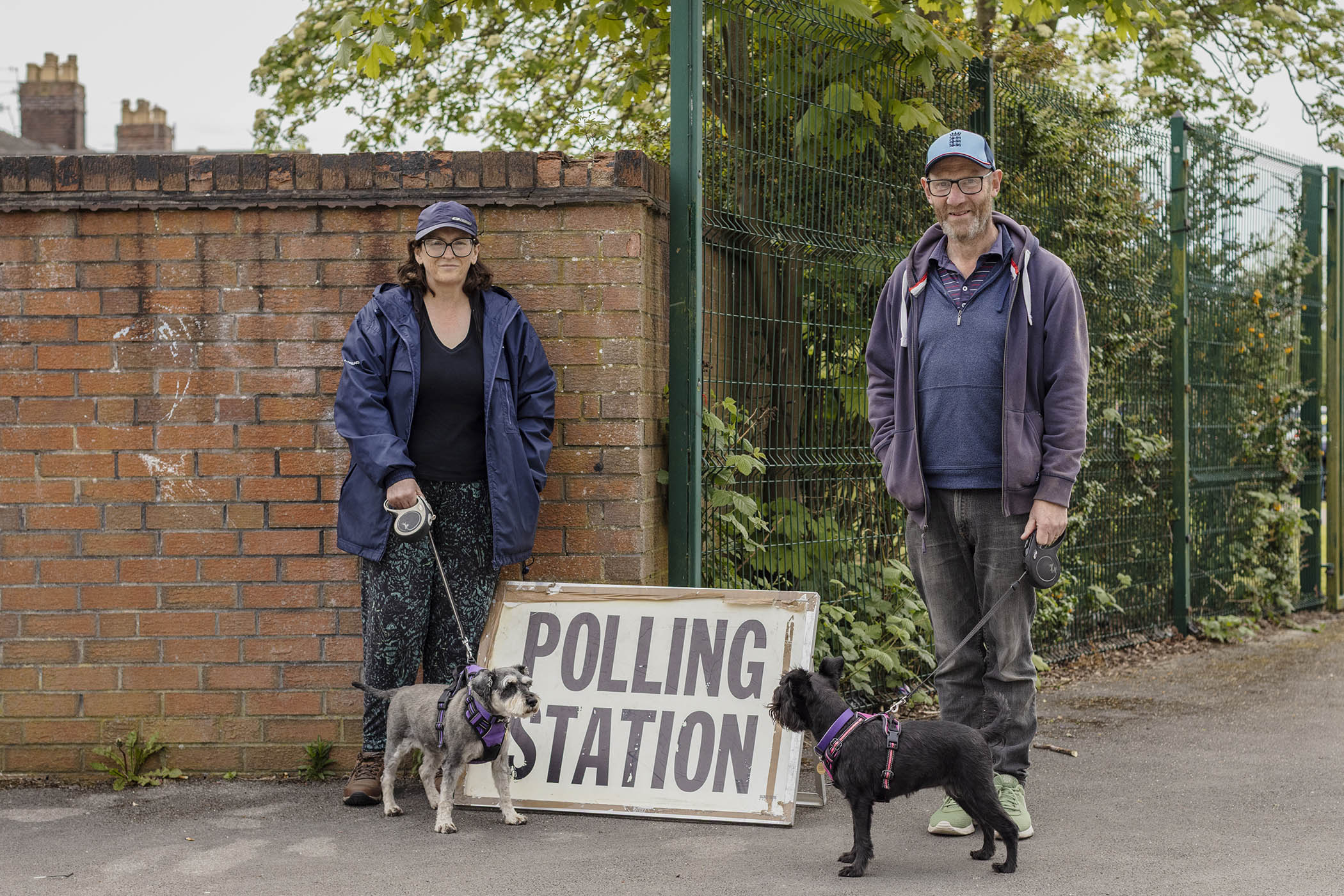
Down Cemetery Road (or, to be more precise, CEME–R- –AD, since several of the original tiles have gone missing), I found the polling station at a Sure Start centre, supposedly a great Labour initiative, and instantly met two Reform defectors. Andy and Karen Whittaker had been to vote with their miniature schnauzers, Winnie and Lizzie.
He had been a lifelong Labour voter until 2009 but voted Reform at the general election. She had stayed firm until now. “I’m completely disillusioned,” she said. “As a woman I feel you’ve got to vote for someone.” She was concerned by the decline of local businesses, observing that the butchers, grocers and paper shops of old Knutton have gone, replaced by a large multicoloured vape shop.
What swayed them was the candidate: Graham Shaw, a former Stoke City footballer who was born in Newcastle and grew up 10 doors down from Andy. “I knew his dad,” he said. “He’s a local lad and I’m prepared to give him a chance.”
This is what Reform was banking on: the feeling that “it can’t get any worse” to vote for them. That someone new deserves a go. It is not an optimistic message but it would deal the mainstream parties a bloody nose in seats such as this. The only crumb of comfort for Labour canvassers in Newcastle, even if they are scared to speak, is that situations change. A reminder of this was seen in the road sign outside their building: “Dunkirk, leading to Montgomery Court.” But today El Alamein feels a long way away.