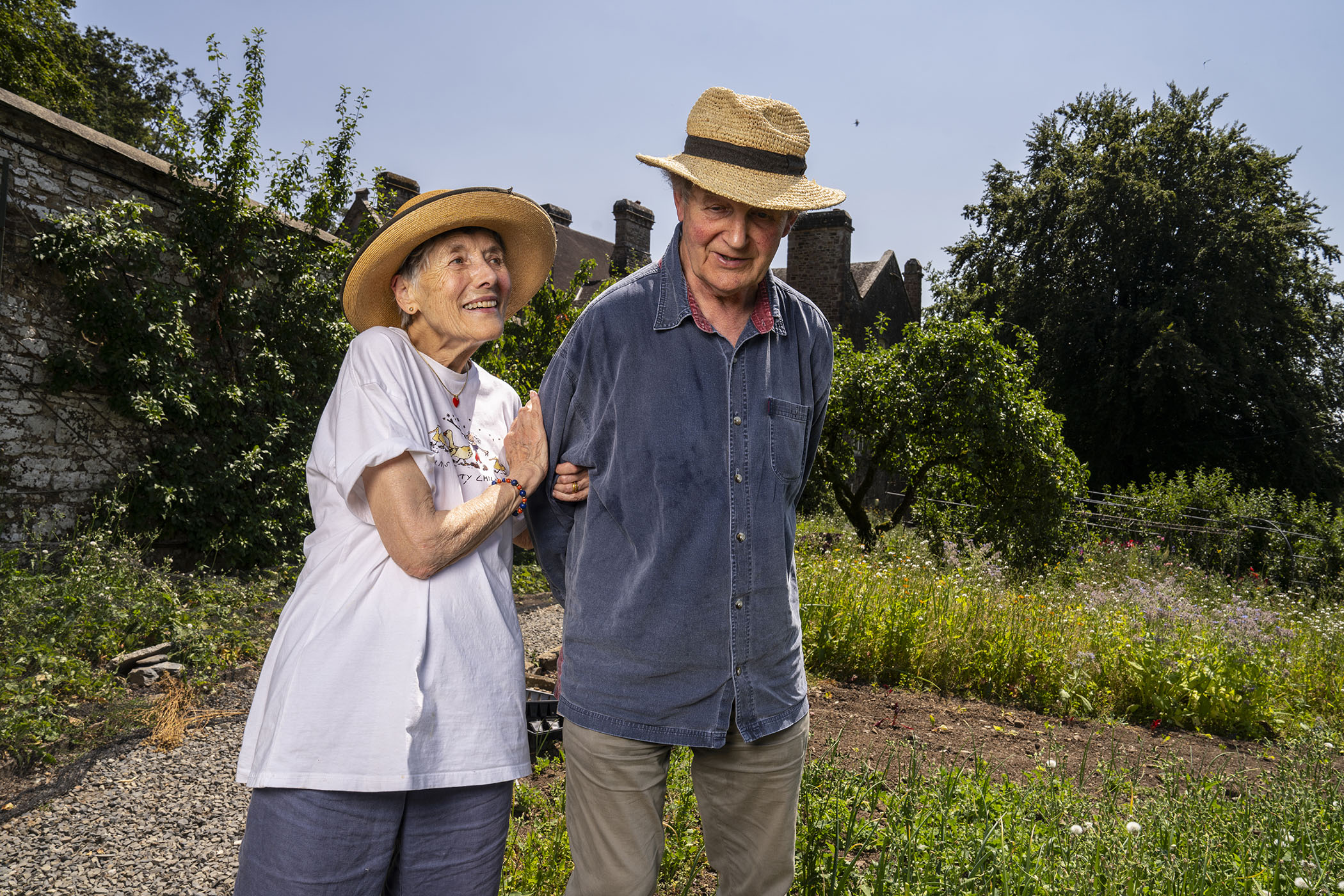


Photograph by Antonio Olmos for The Observer
If you go down Burrow Lane, near Candlelight meadow, under Hereabout hill, you will find yourself at Nethercott House farm, a place that could be Never-never land, though I’m assured it’s real.
Throughout the seasons, for 50 years, urban schoolchildren have come from across the UK to spend a week at the Victorian manor house – in timber-floored dormitories with views over Dartmoor, green as far as the eye can see – and learn about country life, food and farming. Mostly they are children who have never left the city, who will, for the first time, hear a swift sing, or squeal at a pig.
The author Michael Morpurgo and his wife, Clare, founded Farms for City Children all those years ago here in Iddesleigh. For this city dweller, immersion in the countryside begins before I even get off the train, which has ground to a halt on a single-track railway. We have – yes, really – hit geese. And the geese have dislodged a fuel line. For a moment it looks like we might be pulled back some 15 miles towards Exeter St Davids. Which is fitting, since that is in many ways where the story of the farm begins.
In 1934, Clare’s father, the publisher Allen Lane, had been changing trains at that station after a visit to Agatha Christie in South Devon, and to kill the time browsed the bookshop on the platform. He found the books were all hardback, expensive, and choice was limited. He decided then to open up the market, making high-quality books for the price of a pack of cigarettes. Within a year, Lane had founded Penguin books, and launched the first sixpenny paperbacks.
As a girl, Clare was there in court for the Lady Chatterley’s Lover trial, when in 1960 her father’s company was unsuccessfully prosecuted for obscenity. Sales from DH Lawrence’s novel made Lane a millionaire; eventually, this inheritance provided the down payment for Nethercott farm and the charity.
“Oscar Wilde as well!” adds Clare, whose great-uncle published him. That would be John Lane, who co-founded The Bodley Head and published Wilde. “So it’s a very English story, isn’t it?”
It is that, quintessentially – one told in lyrical detail by Morpurgo in Down Burrow Lane, his new memoir of life on the farm where he and Clare have lived since 1974. It is a tale of two children, born in the early 1940s, who grew up in the shadow of the Second World War. Of a girl, who spent much of her childhood wandering in wellies around Devon fields (“walking on her wild lone, like Rudyard Kipling’s cat,” as Morpurgo has it) and a boy sent away to boarding school – a Christopher Robin character – whose solace was the parkland around the school, which looked out over Ashdown Forest. It is also a story of this country’s great exports – books and teachers – and of farmers, who should rank among them, given the right support.
‘We’d like to think in 100 years time, there are so many more of these things that it’s not actually that special’
‘We’d like to think in 100 years time, there are so many more of these things that it’s not actually that special’
Michael Morpurgo
Since this is an English story it is also one of class and regional divisions. The Morpurgos’ lives have been shaped by their compassion for children, campaigning for equal access to books, education and nature – Michael through his writing, Clare through the charity, which has welcomed more than 100,000 pupils from low-income backgrounds since its inception.
Newsletters
Choose the newsletters you want to receive
View more
For information about how The Observer protects your data, read our Privacy Policy
“We first experienced the countryside as middle-class children,” Michael says, “and it made a huge difference to our lives. It’s not that programmes such as this should be directed only to those [from underprivileged backgrounds], but they are the priority. It matters more to those who can’t access it.”
Arriving in the driveway under swirling swallows, we look towards the neo-gothic house, where Clare has wandered off to catch up with the team cleaning up on changeover day, after a visit from a south-London school group.
“One of the problems you’re going to have with this interview is that my wife tells mistruths about herself,” Michael says. He recounts a time 30 years ago when a journalist asked how Clare was coping working 14-hour days, seven days a week, while raising her own family. “‘Oh,’ she said, ‘it’s a doddle!’” Later, I ask if she would like to revise that position. “It was a bit full-on,” she says, adding with characteristic humility: “I’m not sure I was that good at it, really.”
Morpurgo’s memoir is an ode to his wife’s work. To her ambition, hard graft, and tireless fundraising. It costs about £24,000 for a school to bring up to 40 pupils on the five-day trip; about half is subsidised by the charity, working out at about £300 per child for schools to foot.
There are two other UK farms – one in Pembrokeshire, looking out towards the Atlantic, and one in a medieval moated manor house in Gloucestershire – and the hope is to expand, with excited talk about a site in Yorkshire. There is the sense of shoring things up, preparing for a time when the Morpurgos step back, and a time after that. “In our heads, what we’d like to think is in 50, 100 years time, there are so many more of these things that it’s not actually that special,” Michael says.
After 63 years of marriage, their affection for one another is undimmed, and it is clear as we walk – the pair of them often arm in arm – that their roles are complementary; Michael, in his own words, is the talker, the performer, and Clare the gentler “mother figure, the one many children liked to hold hands with”. Clare delightedly reports the news from the house: the children had a wonderful week, and there were tears on departure, mostly from the charity staff.
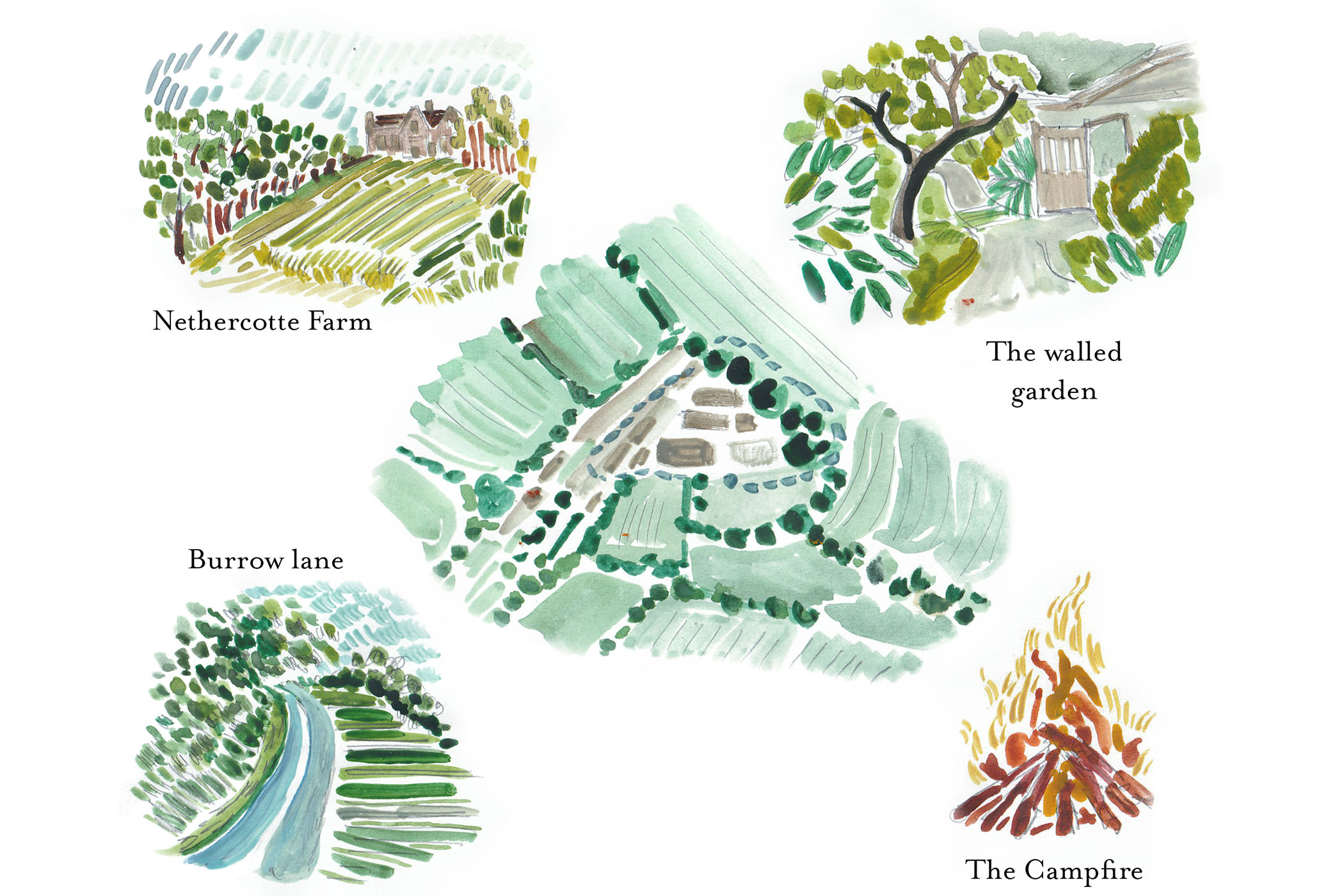
“These buildings should be lived in,” Michael says. “They’re not just for tea and crumpets.” Nethercott is not a petting zoo, and the week is not a holiday. As we shade-hop down Burrow Lane, Michael and Clare point out to me the fields where the children work with commercial farmers: on the right are the hens and ducks, fed by the kids every morning, on the left are the pigs. Michael points to meadowland and the site of a former dairy as Clare reminisces fondly about a time before health and safety, before foot-and-mouth – which nearly shut down the charity for good – and consequent concerns about zoonosis.
“The children used to go down and help with cows – not milking, but pushing the knobs in the dairy, that sort of thing – and Michael used to stand beside them with an apron to protect them from getting sprayed with pee. Well,” she says, “we were told the apron wouldn’t cut it.”
They still muck in though – digging, planting, picking and preparing vegetables, feeding the sheep, brushing the horses – and muck out. They learn about the food they eat: perhaps they weigh a lamb, then see it packed off to an abattoir. They might witness a calf born dead. “The point is that they do see life and death,” Clare says. This is the real world, not some faraway or imaginary place.
‘A lot of people have said: what good is a week? And the truth is, it’s almost like saying, what good is a good book?’
‘A lot of people have said: what good is a week? And the truth is, it’s almost like saying, what good is a good book?’
Michael Morpurgo
Down the lane at the bottom of the fields is the River Okement, which joins with the Torridge, famous for Tarka the Otter (“that’s literary history!” Michael says). The children used to swim here; now they paddle. They learn that the river is polluted, and why. And they learn about the herons as they take flight. “All the time they are coming across stuff they’ve never seen before,” he says. “They might have seen ducks on a city pond. And here they see hawks, kingfishers, and otter poo…”
Otter poo?
“Yes. You can pick a bit up in your finger and tell the children: smell that. It smells of fish, and you ask, why? What do otters eat? That’s why they’re at the river, isn’t it? And it goes from there.”
I wonder what else – beyond the marvel of otter poo – impresses city kids? The answer, as ever with children, is another thing they can hold in the palm of their hands. “I’ve seen something happen hundreds, probably thousands of times, when they’re holding a caterpillar, maybe for the first time in their life. Their eyes widen. It’s a moment you don’t forget.”
We meet Adam Bratt, the farm operations manager. He tells us the children were thrilled by the arrival of 12 piglets, healthy, but struggling in the heat. “It’s been the story of the week. When would the mother farrow? Would she have the babies before they left?” Bratt is off to tend to a calf with an abscess, but asks would we like to see them? Michael all but charges ahead.
Pepper the pig is lolling in the shade – smothered by a pile of suckling piglets. Clare asks what we are surely all thinking: “Does she have enough teats?” Bratt describes this week’s cohort as good company. “A lot of the best questions this week have been related to Pepper, and they’re empathetic questions. How do you think she’s feeling? Is she in pain? Does she know she’s going to have babies? I think that shows a lovely side of children.”
Farms for City Children is built on the belief that children should feel useful, that they learn something about the value of hard work, and their own value by extension. Michael and Clare talk of children with low self-worth, “bound for a world where there is no work or it’s boring work. So we give them jobs that need doing, that make them feel worthwhile. Nothing that happens on the farm is made up or contrived.”
We are soon stumbling up the hill, towards the walled vegetable garden, when we pass a campfire where Ted Hughes – a close friend of the Morpurgos and Devon local, who became founding president of their charity – would read poems to the children. Morpurgo, author of more than 150 books, still reads stories here, but only when he’s invited: “I never presume.”
There is an archway, covered in tumbling green, that is straight out of The Secret Garden; behind red brick are overgrown beds, humming with butterflies and bees, and troughs packed with herbs and raspberries. On the wall opposite a fig tree is a poem by Hughes – “this was my dream beneath the boughs, the dream that altered me”. I poke my head into a shed and find it is home to a flight of swallows. It is easy to become romantic. I imagine the sadness many children feel on leaving this, and wonder, not entirely seriously, whether it is worse to know what you are missing.
“In a way, I compare it to reading,” Michael says. “Through it, children are opening their eyes to another world. And they’re going to live in that world, and therefore, they travel the world, they find out about other people, without getting on a plane. I do believe very firmly that one book can change your life. A lot of people have said: what good is a week? And the truth is, it’s almost like saying, what good is a good book?”
Michael is cautiously optimistic about Andy Burnham – so long as he doesn’t “suck up” to Trump, like the last guy – and has faith in education secretary Bridget Phillipson, though he is waiting for her to come good on her pledge to make sure every state primary school in the country has a library: about one in seven do not. Into his 80s, he is still writing novels to line their shelves.
We are now back at the house that in other hands might have been a monument to cream teas, a shuttered holiday home or an Airbnb. Michael points up at a tiny ledge sticking out from a chimney. “That’s called the witches’ seat,” he says. “Whenever they built a house down here in those times, they had the theory that you can put a little ledge for the witches so they won’t harm the people inside. So we got one in our house as well.” He smiles. “I think that’s why we’ve had a bit of good luck in our lives.”
Good luck, good work, good company. And for today, at least, blue skies.
A special edition of Down Burrow Lane: Life and Love on the Farm featuring wood engravings and an exclusive Morpurgo poem is now available at www.morpurgo1976.com. The book will be on general release in September
Illustration by Ellie Wintour for The Observer