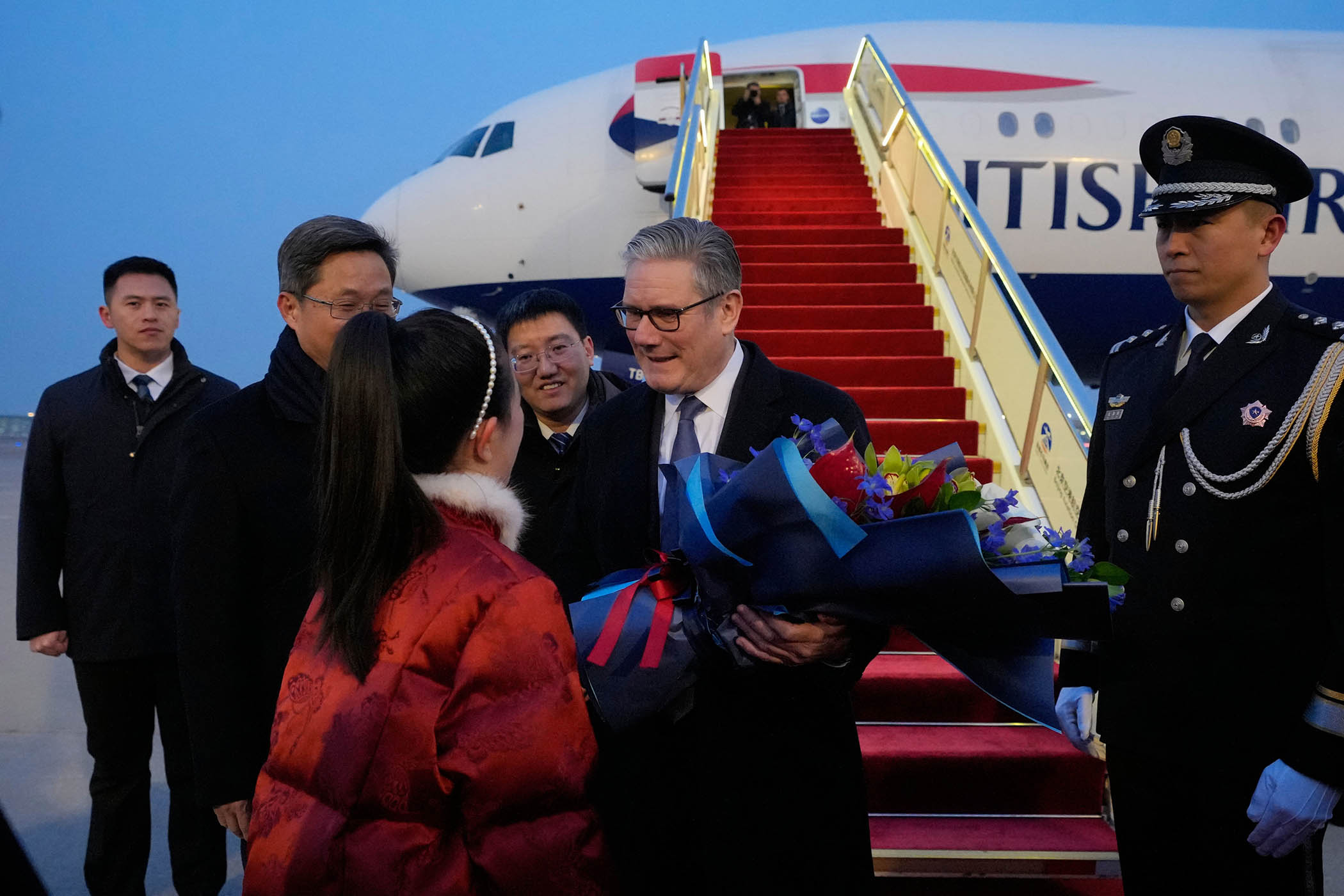

Keir Starmer lands in Beijing today with a delegation of nearly 60 business leaders and cultural organisations as part of a landmark visit that the government hopes will reset relations between the UK and China.
The prime minister, the first UK leader to visit China since Theresa May in 2018, is aiming to tread a middle path between his Conservative predecessors David Cameron, who sought to build closer economic ties with China, and Boris Johnson, Liz Truss and Rishi Sunak, who saw the Beijing government as a national security threat.
“For years our approach to China has been dogged by inconsistency – blowing hot and cold, from golden age to ice age, but like it or not China matters for the UK,” Starmer said last night. “As one of the world’s biggest players, a strategic and consistent relationship with them is firmly in our national interest. That does not mean turning a blind eye to the challenges they pose – but engaging even where we disagree.”
During the four-day trip, Starmer will meet Chinese president Xi Jinping and premier Li Qiang in Beijing for talks on trade, investment and national security before travelling to Shanghai for meetings with British and Chinese businesses.
The purpose of the visit is to drum up business with the world’s second largest economy as the UK adjusts to an unpredictable US president and the rebalancing of power between east and west.
Starmer will push for access in areas where better cooperation with China would boost growth, such as financial services, the creative industries and life sciences. The delegation includes HSBC, GSK, Jaguar Land Rover and the National Theatre.
China is already the UK’s third biggest trading partner, supporting 370,000 British jobs, and the prime minister is hoping to build on this relationship. With a population of 1.4 billion and a consumer class of around 900 million, it is a huge market to expand into. Starmer will be accompanied by business secretary Peter Kyle and economic secretary to the Treasury Lucy Rigby.
“This is Britain, back at the top table dealing with the world’s most consequential powers – including China,” a No 10 source said. “No transformation today carries greater consequence for the world than the rise of China. Sticking our heads in the sand and refusing to engage would be a staggering dereliction of duty.”
However, Downing Street said the prime minister would also raise national security and human rights concerns. “We will never trade economic access for our national security,” a spokesperson said. “We remain clear-eyed and realistic about the threats China poses in that regard and we will never waiver in our efforts to keep the British people safe. But engagement is the only way we can challenge China on the areas where we disagree.”
With the US looking like an increasingly unreliable partner, other countries are hedging their bets by boosting their links with China. The Canadian prime minister, Mark Carney, visited recently and the French president, Emmanuel Macron, went in December. Next month it will be the turn of the German chancellor Friedrich Metz.
Newsletters
Choose the newsletters you want to receive
View more
For information about how The Observer protects your data, read our Privacy Policy
US president Donald Trump has threatened to slap a 100% tariff on Canadian goods if the country strikes a trade deal with China. But Starmer believes the UK can deepen economic links with China without angering the US president. “I’m often invited to simply choose between countries. I don’t do that,” he told Bloomberg ahead of the trip.
Chris Patten, the former Conservative party chairman and last governor of Hong Kong, said the prime minister’s visit was an “important” moment, but he warned Starmer not to “kowtow” to Xi.
“I hope that he isn’t going with the delusion which has often haunted British policy on China that somehow you have to avoid doing anything which the Chinese disagree with in order to sell them things. That is complete drivel,” he said.
“The Chinese buy what they want at the best price they can get. Starmer going to China isn’t going to suddenly increase the amount of exports from Britain to China and it’s not going to immediately increase the investment from China in the UK unless they want it. Visitors shouldn’t go there under any illusions… There isn’t a causal link between doing good business with China and kowtowing to them – polishing their shoes as the Chinese would put it.”
Lord Patten insisted the prime minister must be candid with Xi about the UK’s legitimate human rights and security concerns. “You can’t have a meeting with the Chinese without having some disagreements because they are, as MI6 have said, a threat to many of the things we believe in,” he said. “I had lots of arguments with China but they knew what I believed and they always respect you if you stand up for what you believe in.”
Kerry Moscogiuri, Amnesty International UK’s interim chief executive, said the high-level visit was “a moment of real consequence and the UK government must use it to deliver a clear, public and uncompromising condemnation of Beijing’s grave human rights record”.
This includes the rounding up of Uyghur Muslims in Xinjiang by the Chinese state, and the treatment of Jimmy Lai, the British businessman who has been convicted of “colluding with foreign forces” in Hong Kong. British MPs including the former Tory leader Iain Duncan Smith and the former security minister Tom Tugendhat have also been sanctioned by the Chinese government for supposedly spreading “lies and disinformation” about human rights abuses.
Ruby Osman, China expert at the Tony Blair Institute for Global Change, said Starmer should not be afraid to set “clearer red lines” on issues of national interest. “Beijing respects strength and clarity. The UK should be confident that, despite the economic imbalance, its strong alliances, world-class science base and strategic capabilities make it a partner of value.”
Kerry Brown, professor of Chinese studies at King’s College London, said the trip had to produce “tangible outcomes” that demonstrate the risks of the relationship are outweighed by the opportunities. “The great thing that has changed since the last visit by Theresa May is that China has become a technology superpower, in almost every area – pharma, cancer treatment, quantum computing – it’s producing world class research.” He said China was investing 20 times more in research and development than the UK and producing 3.5 million science, technology, engineering and maths graduates a year.
While Britain scales back its plans for high speed rail HS2, the Chinese are trialling trains that can run at 1,000kmph (620mph). China is also storming ahead on robotics and artificial intelligence, according to Brown. Already, they have experimented with football matches between robots – using artificial intelligence to dribble, pass, shoot and tackle – and lunches delivered by drone. The social consequences of some of these technological advances are already being felt: almost a fifth of young people in China are unemployed and there are reports of significant unrest about workers’ rights.
But Brown believes the UK cannot ignore China’s capability on technology. “Every year they do something we didn’t expect and they’re surprising us with how fast they’re pulling ahead,” he said.
“Yes there are security issues, but the biggest security issue is us not being able to get access to this.”
Photograph by Kin Cheung/PA