

Photographs by Richard Saker for The Observer
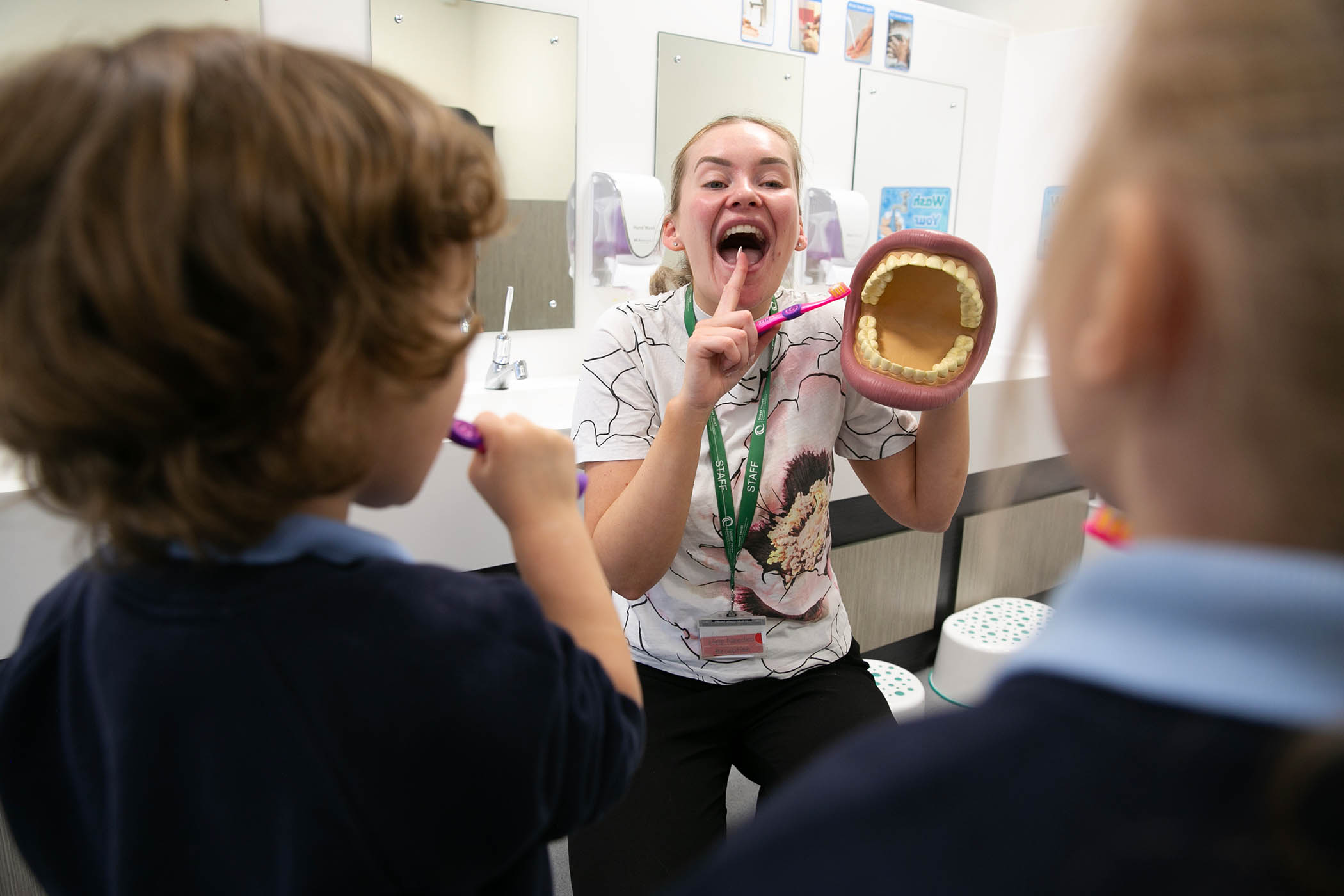
At St Peter’s Church of England primary school in Wigan, children take part in “Doh discos”, squeezing and stretching Play-Doh to develop their fine motor skills because so many start reception unable to hold a pencil. They have yoga classes and “tummy time” to improve their core strength so they can sit up properly at a table.
“We are seeing more children coming in in nappies,” said Kate Eastwood, director of early years at the Quest Trust, which runs the school. “We see a lot of children coming through with very delayed speech and language. In some children, it is about mispronunciation. That is generally down to having dummies or drinking bottles for too long, so they are not able to form the mouth in the correct way. Children will speak in an American accent because they have spent a lot of time on technology rather than interacting with adults.”
Instead of turning the pages of a book, pupils try to swipe the pictures. Some five-year-olds are pushed to school in a buggy, while others turn up in their pyjamas. “We’re doing a big push in our reception class to make sure they can use a knife and fork,” said Eastwood. “We do teeth-brushing twice a day. A lot of the parenting is done at school. You teach them maths, but you’re also making sure that they’re dressed in the morning.”
She does not blame parents. “People are so busy, they’ve got so much pressure elsewhere, it’s then impacting on the children. It’s not because parents don’t care – it is to do with the cost of living.” But she has seen a transformation in reception classes since she started teaching 15 years ago. “Children are not able to regulate themselves; they get very distressed or physically or verbally violent.”
Children are not able to regulate themselves; they get very distressed or physically or verbally violent.
Children are not able to regulate themselves; they get very distressed or physically or verbally violent.
Kate Eastwood, the Quest Trust
Many pupils find it difficult to socialise because they are used to the instant gratification of technology. “They’re struggling to wait or take turns. If you’re gaming, you die, you reset, you start again. That’s not the same in learning. It’s hard and they’re not used to that.”
Around the country the number of four- and five-year-olds who are not ready for school is growing. Last September, more than a quarter of children started reception still in nappies, almost a third were unable to eat and drink independently and a quarter struggled with basic language skills such as saying their name.
A poll of 1,000 teachers by the early years charity Kindred2 found that 88% had at least one child in their class who was not toilet trained. The survey found that 37% of pupils were not “school ready”, up from 33% in 2024.
Teachers estimate that children are now missing out on an average of 2.4 hours of learning every day because staff are spending so much time dealing with the basic needs of some pupils. “The scale of the problem is staggering,” said Felicity Gillespie, chief executive of Kindred2. “This is not a peculiar horror about some weird set of families. It affects part of the country and almost every primary school.
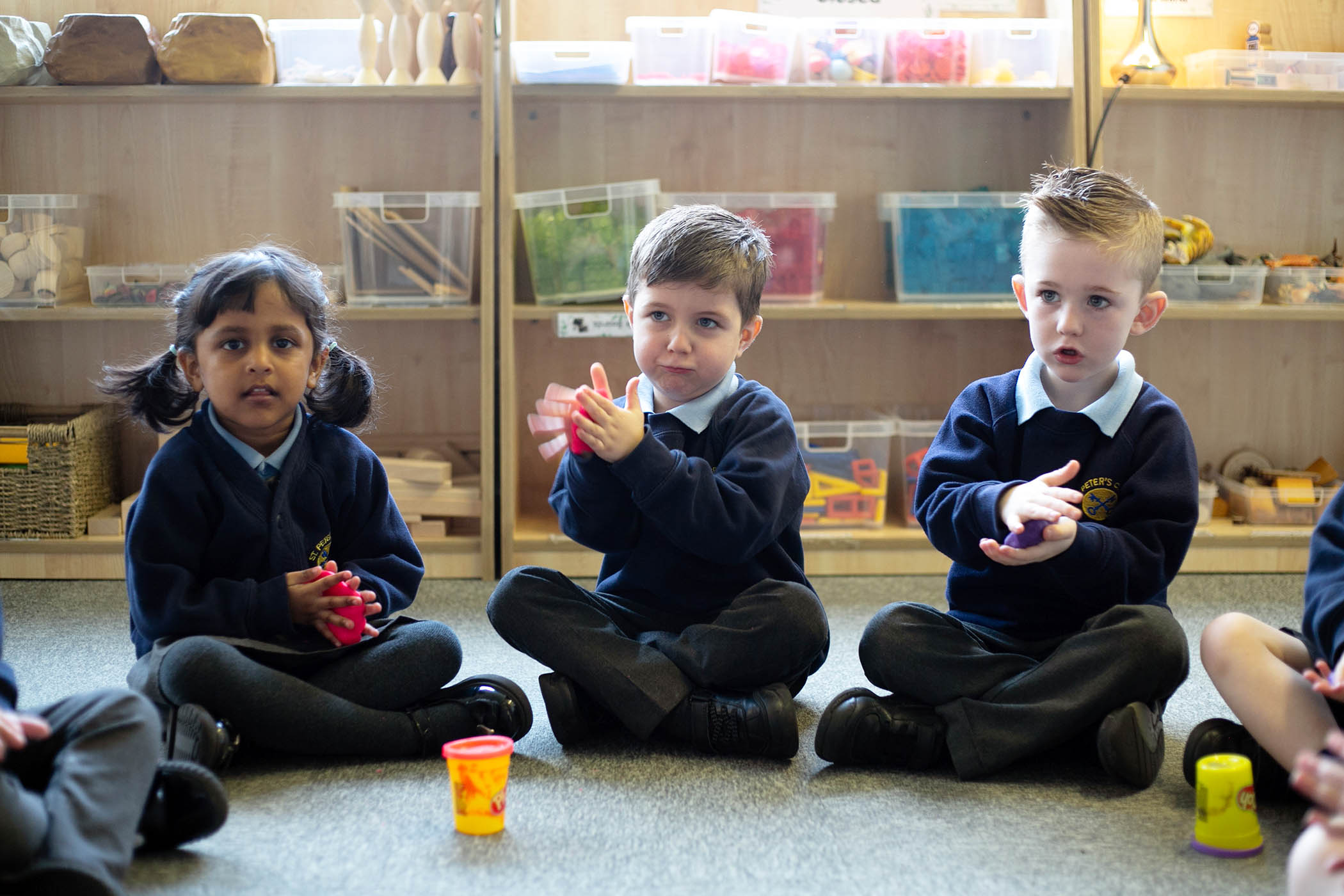
Children with play dough in Reception class at St Peter's Church of England primary school in Hindley , Wigan in Greater Manchester.
“If you speak to teachers, they will say: ‘It’s a complete nightmare.’ Every single child in their class is having their learning interrupted and it’s almost become accepted because of the national squeamishness about telling parents what to do. We’ve normalised the ‘teacher-fication’ of parenting because we’re terrified of being seen as the ‘nanny state’.”
Newsletters
Choose the newsletters you want to receive
View more
For information about how The Observer protects your data, read our Privacy Policy
The government has set a target that 75% of children should be “school ready” by 2028, but a stark class divide has already emerged. New data analysis by the Public First consultancy for the independent inquiry into white working-class educational outcomes found disadvantaged pupils are typically significantly behind wealthier classmates when they start school.
Last year, just 48% of white British pupils eligible for free school meals reached the expected level of development by the age of five, compared with 75% of white British pupils who were not eligible for free school meals. Only 40% of white working-class boys reached a good level of development. Among children from other ethnic groups who are eligible for free school meals, 59% of Asian pupils and 57% of black pupils achieved the expected outcomes.
Hamid Patel, co-chair of the inquiry and chief executive of Star Academies, said: “Levelling the playing field when it comes to school readiness is absolutely essential if we are to begin to resolve the massive challenge of the educational underperformance of England’s white working class. If children start school a long way behind their peers, and not ready to access the curriculum, then schools are forever playing an impossible game of catch-up.”
According to the Education Policy Institute, poorer pupils are typically 4.7 months behind their wealthier peers at the age of five, which starts a cycle of decline. By the time they turn 16, the “disadvantage gap” is more than 19 months.
Research by the Born in Bradford project found that pupils who have not reached a good level of development by the age of five are almost three times more likely to not be in education, employment or training 12 years later.
Mark Mon-Williams, professor of cognitive psychology at Leeds University and deputy chair of the Department for Education’s scientific advisory council, said a lack of school readiness “is highly associated with myriad adverse outcomes”, including persistent absence, heart disease, diabetes, anxiety, depression and even criminality.
“The early years are critically important because a child’s life trajectory is shaped before they start school,” he said. “This is not a marginal issue for schools but a major problem for children, families and society. If we act early, identify need in the first years of life and intervene immediately, we can change the course of children’s lives and decrease the pressure on the NHS, criminal justice and social care systems.”
The causes of the school readiness crisis are complex and predate the Covid pandemic. The strain on families in which both parents work – often doing more than one job to make ends meet – is undoubtedly a factor.
There are also perverse incentives in the welfare system. Schools report that parents are deliberately delaying potty-training to receive benefit payments for incontinence.
Gillespie said: “Some teachers are telling us about families getting a subsidy if their child is in nappies beyond a certain age. It’s meant to be for children with a medically diagnosed condition but a number of teachers have said to us that when they confront parents and say: ‘Why is your child still in nappies’ they say: ‘I’m not taking them out of nappies because I won’t get the benefit.’”
Vouchers or grants for essential day-to-day items can be given to families through the household support fund and vary between local councils. There has also been a big rise in disability living allowance paid to children under 10, although the Department for Work and Pensions was unable to say how many of the claims relate to incontinence.
Gillespie believes parents do not understand the importance of boundaries. “Last week, I heard about a boy who doesn’t have a bedtime; he goes to sleep in front of the TV with a bottle with Coca-Cola in it because that’s what he really likes. People have this idea that, in order to be a good parent, your child should always be happy so you must never say no.”
Then there is screentime. “It’s parents spending too much time on their screen, which means they’re not engaging with their child, and the children spending too much time on their screen, which means they’re not involved with their parents,” Gillespie said.
She added: “The way a baby’s brain develops is like playing tennis: I smile at you, you smile back – it’s serve and return. The problem with screens is it’s as if someone lobs the ball over the net and no one hits it back.”
The scientific evidence is overwhelming. What happens in the first 1,000 days of life, and even in the womb, is critical to outcomes later in life. Researchers found that babies who had suffered extreme emotional deprivation in the brutal Romanian orphanages that emerged under the dictator Nicolae Ceaușescu had brains that were 8.6% smaller than others their age. Even many years after they were rescued, the Romanian orphans typically had lower IQs and higher rates of attention deficit hyperactivity disorder, anxiety and depression
Peter Fonagy, head of the division of psychology and language sciences at University College London, said humans are born less developed than almost any other mammal. Kangaroos can immediately jump into their mother’s pouch but a baby “has to learn everything”, he said. “The brain is designed so that it is prepared to acquire the things it needs, but it has to have the right environment to stimulate that brain growth.” Children who are neglected will not develop the social or emotional skills they need to thrive.
Prof Sam Wass, director of the Institute for the Science of Early Years at the University of East London, said technology is changing the nature of modern childhood. “The neuroscience is very clear that young brains learn best from slow-paced, predictable interaction,” he said. “Screens give us fast-paced, unpredictable stimulation… and, of course, parents are less likely to respond to their child’s cues if they’re staring at their phone.” Bridget Phillipson, the education secretary, has declared that early years education is her “moral mission”. She has promised to create 1,000 Best Start family hubs and open 300 new or expanded nurseries in schools.
At the same time, though, there has been a shift in funding priorities, driven by the Treasury, which sees the purpose of early years provision as employment rather than education.
The government has introduced 30 hours of free childcare in England, but it is only for working parents, when those who need support the most may be unemployed. According to the Institute for Fiscal Studies, almost 60% of the money is now paid to working families, double the proportion in 2023.
Disadvantaged two-year-olds can receive 15 hours of free childcare, but frozen thresholds regarding parental income mean that the proportion of children that age who are eligible has dropped from 38% to 24% since 2015.
Research for the Princess of Wales’s Centre for Early Childhood found that the social cost of failing to intervene early enough in children’s lives is more than £16bn in England because of higher rates of crime, unemployment and mental illness that could have been avoided. A report by Deloitte concluded that £45.5bn could be generated for the economy every year by investing in early childhood.
As the Princess of Wales said this month, the early years are “not simply about how we raise our children. They are about the society we will become.” In Estonia, which has the best-perfoming education system in Europe, children do not start school until they are seven but they are legally entitled to a kindergarten place from 18 months. Nurseries are heavily subsidised and pre-school teachers all have degrees. Kristina Kallas, the Estonian education minister, believes early years education is the secret of her country’s success in the international school league tables and has created a fairer society. “If you don’t have basic social, emotional and self-regulatory skills, then academic learning is not going to happen,” she said. “We believe that early years is the foundation you must build so that even the children who have a more complex and vulnerable socio-economic background will have a much more equal starting point once they arrive at school. It’s not babysitting, it’s education.”
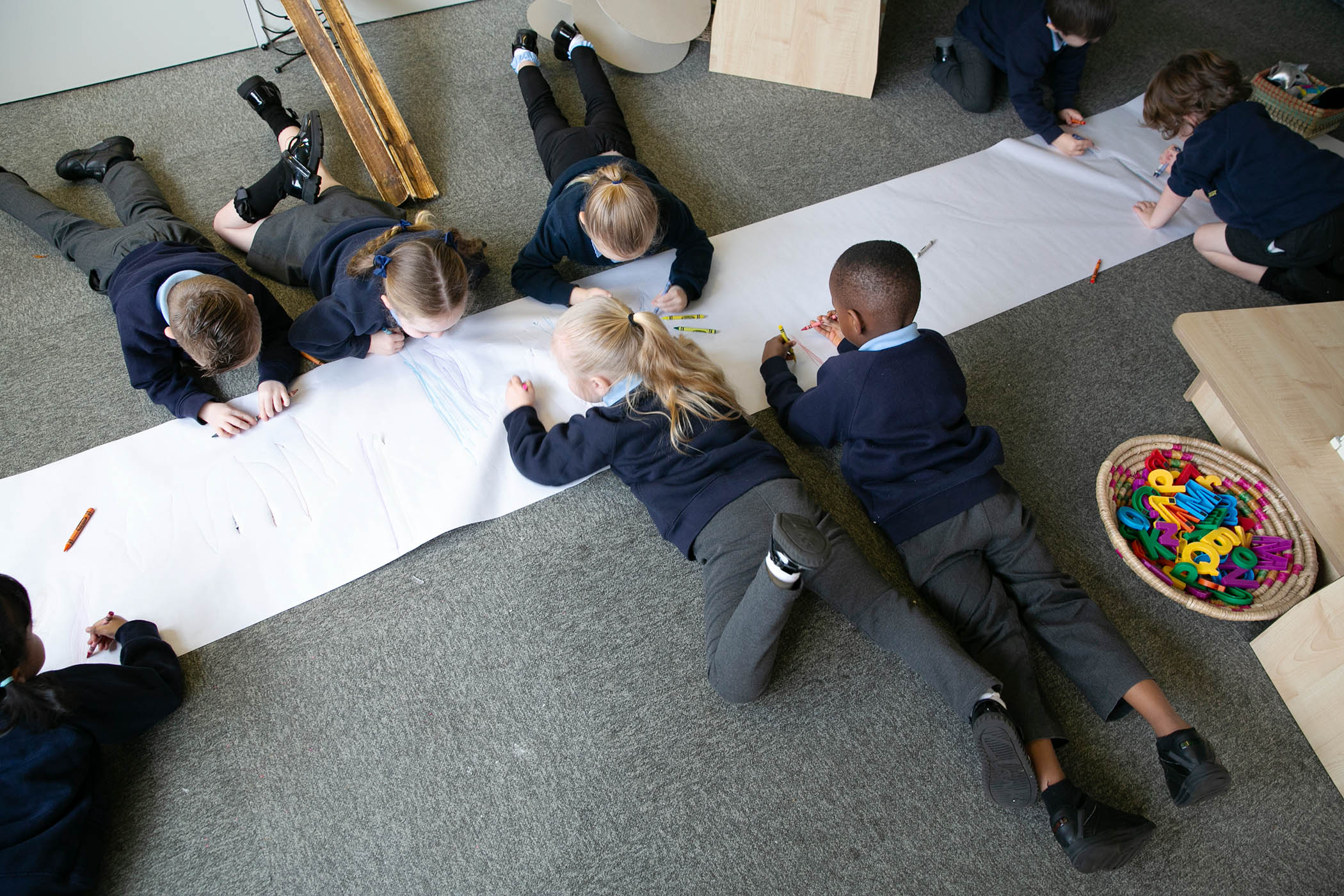
Children lying on their tummies to help core strength using crayons to draw in Reception class at St Peter’s Church of England primary school in Hindley , Wigan in Greater Manchester.
In numbers
88%
Primary school teachers polled who had at least one child in their class not potty trained
2.4
The number of school hours lost every day due to teachers having to deal with the basic needs of some pupils
40%
The amount of white working-class boys reaching a good level of development by age five
19
The disadvantage gap in months between poorer pupils and their wealthier classmates by the time they turn 16
£16bn
The social cost in England of higher rates of crime, mental illness and unemployment in later life linked to poor early years learning