
A decade after the country narrowly voted to leave the European Union, the Brexit omertà of the past few years is lifting.
Frustrated by the government’s failure to ignite the economy, panicked by dire polls and conscious of the ticking clock, backbench Labour MPs are becoming increasingly vocal on the question of Britain’s relationship with our nearest neighbours.
The idea of the UK rejoining the customs union – once the preserve of fringe figures – is now being voiced by the deputy prime minister, David Lammy, potential leadership contender Wes Streeting and the prime minister’s own economic adviser, Minouche Shafik.
So far, the three people who matter most in government – Keir Starmer, his chief of staff, Morgan McSweeney, and the chancellor, Rachel Reeves – have appeared unmoved, reluctant to make too much noise about Brexit for fear of losing the support of those who voted leave.
But the mood may now be changing in Downing Street. A customs union is still off the table, but The Observer understands that a proposal for a Swiss-style “dynamic alignment” deal, which would give the UK some access to the single market, is gaining support from some of those around Starmer.
“People [in No 10] have looked at the question and see that you get more growth, and less pain, from dynamic alignment than from a customs union,” said one source close to the matter. “Dynamic alignment is where the pro-European people in Downing Street and the government are exploring, rather than a customs union. It may even be that they can outflank Wes if he wants to wear the customs union badge.”
One supportive MP added: “If you want to turbocharge growth before the next election, you have to go for broke. The Swiss have sector-by-sector agreements [in] the single market. None of that is about rejoining, but it is just a much better deal with a much better economic impact, and likely to be of interest with the EU.”
A paper by the influential Labour Movement for Europe, pushing a Swiss-style dynamic alignment deal, is also gaining traction among backbenchers.
It outlines how the country has “a set of agreements which, in simple terms, will leave Switzerland with single market access in certain sectors, including industrial goods, agrifood, electricity, air and land transport, as well as participation in EU programmes such as Horizon, Erasmus+ and the satellite navigation systems Galileo and Egnos”.
There is a price to pay, though. “As part of this arrangement, Switzerland accepts freedom of movement – with a ‘safeguard’ brake if deemed to be causing serious economic or social damage – and makes financial payments to the EU.”
Newsletters
Choose the newsletters you want to receive
View more
For information about how The Observer protects your data, read our Privacy Policy
The prospect of anything approaching freedom of movement is likely to put McSweeney on high alert about the prospect of Reform UK and the Conservatives going on the attack.
But sources, including some close to Starmer, suggest it may yet prove a more likely option, not least because it would not undermine existing trade deals, as a customs union would.
The paper points out that Reform’s leader, Nigel Farage, endorsed a Swiss-style deal as recently as 2020. Supporters note that Starmer also considered such a model back when he was shadow Brexit secretary.
In the tearooms and bars of Westminster, in voting lobbies and on WhatsApp groups, Europe is becoming the defining topic of the year ahead for Labour MPs. Many believe that Europe will certainly feature in any possible leadership contest, but should Starmer survive the local elections in early May, it is thought that a reshuffle is likely to be carried out through the prism of the UK’s future with the EU.
“On the other side of May, it will be an important political question,” one Labour adviser noted. “That is my event horizon.”
Thus far, most attention has been given to the question of joining a customs union. Under the trade and cooperation agreement negotiated by Boris Johnson’s government, Britain already has tariff-free trade with the EU, although it has added time-consuming paperwork. Advocates of the new thinking on the customs union say that, as well as removing red tape and offering a boost to businesses in the longer term, it would be viewed positively by the bond markets, giving an immediate lift.
‘We are talking to ourselves about something that the EU is not necessarily going to give us’
‘We are talking to ourselves about something that the EU is not necessarily going to give us’
Anand Menon, UK in a Changing Europe
“If they are looking for growth, this is where it is,” said another adviser. “There is a constant conversation among MPs and spads about what is going wrong and how to right it, and this is an idea that has taken up more and more discussion… but I don’t think the PM and his chief of staff, or the chancellor, are interested in shifting position.”
The political environment has changed dramatically over the past year, as Labour MPs become increasingly worried about the economy and the polls.
“If you had asked me six months ago, I would say hardly anyone had raised it beyond the usual suspects,” said one adviser. “But now there is quite a broad spectrum of views being put forward… it’s a conversation that is definitely rising in salience and becoming more regular.”
A colleague concurred. “It’s not organised – it’s just happening organically. That mood has led to Wes coming out in favour.”
Streeting’s comments, made in a recent interview with The Observer, could put him in good stead for the much discussed leadership challenge, should it arise: the issue is of huge importance to Labour’s largely Europhile members. But experts caution against falling into the usual trap of considering only the domestic element.
“It is obviously the case that positions in Europe are being used by potential leadership figures to signal something for domestic party reasons, connected with leadership ambitions,” said Anand Menon, director of the thinktank UK in a Changing Europe. “It’s very reminiscent of the Boris Johnson Brexit era, where we are talking to ourselves about something the EU is not necessarily going to give us.”
A customs union would not be a “gamechanger” when it comes to the economy, said Menon, added to which, it would require single market membership and require the UK to unwind its recent trade deals with other countries. “It’s a lot more complicated than the current debate sounds,” he said.
Starmer loyalist and Cabinet Office minister Nick Thomas-Symonds remains the point person for European relations and the man who was able to bring his boss a last-minute Christmas present – giving young people across the UK the opportunity to access the EU’s Erasmus+ study abroad programme for the first time since Brexit – just before the festive break.
His priorities for the months ahead are youth mobility, previously stalled over the UK’s now dropped demands for a cap on numbers, and work on the single electricity market in time for the next UK-EU summit, which this year will be held in Brussels.
Getting a deal on youth mobility would go some way to warming EU member states up for any negotiation on a deeper relationship.
But with no date in the diary for the meeting, let alone any sign of an agenda, the question is whether Starmer will still be in the driving seat by then.
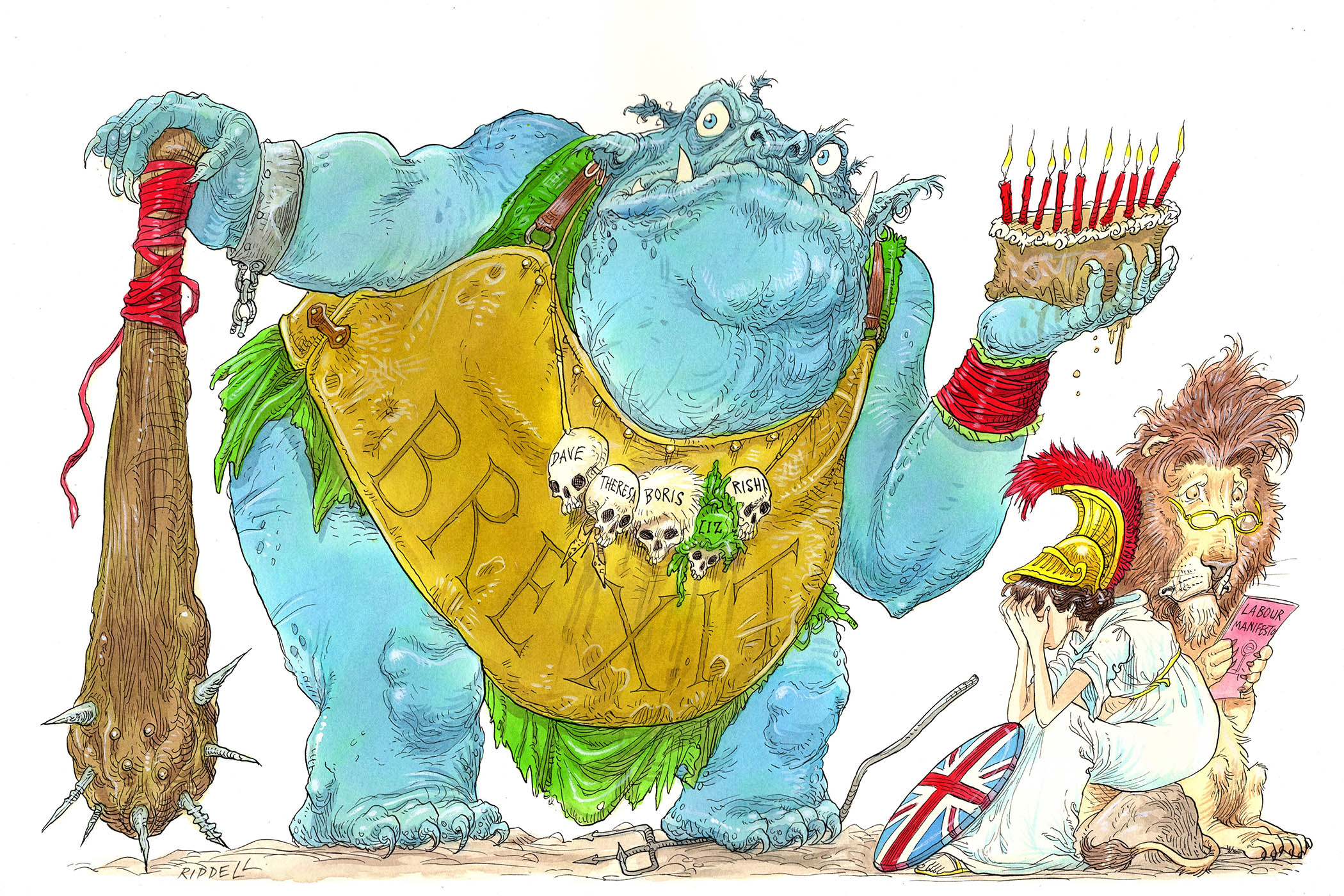
Illustration by Chris Riddell